Although diplomatic opportunities remain open, the region is standing at a dangerous threshold, where even the smallest miscalculation could be enough to trigger a harsh chain reaction leading to a full-scale, large-scale war.
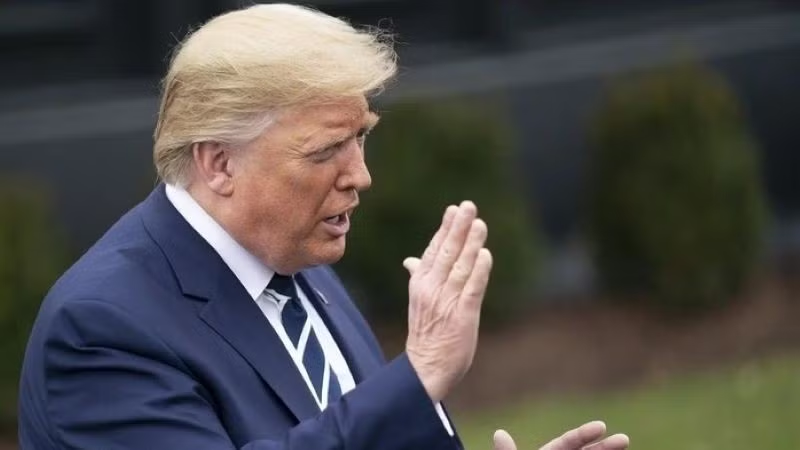
The US and Iran are being drawn into a new spiral of confrontation, originating from a wave of protests in Iran in late December 2025 against soaring inflation, which plunged the Middle Eastern country into turmoil. Against this backdrop, US President Donald Trump said he was considering “very strong options”, including the possibility of military action against Iran, citing concerns over the authorities’ crackdown on protesters. The statement immediately provoked a fierce response from Tehran.
US–Iran relations subsequently witnessed a series of developments in an increasingly dangerous direction. Washington deployed the USS Abraham Lincoln carrier strike group to the Middle East and warned of military measures should Tehran continue its heavy-handed response to demonstrations. Iran, for its part, declared it was ready to retaliate without limits. The Islamic Revolutionary Guard Corps (IRGC) asserted that its “finger is on the trigger”.
A rapid succession of military power displays and fragile “red lines” that could easily be crossed are leaving the Middle East situation hanging by a thread. Both the US and Iran have expressed readiness to negotiate a nuclear agreement as a major opportunity to cool the powder keg on the brink of explosion. However, reality shows that the strategic space for both sides to control tensions is extremely narrow, owing to a profound lack of mutual trust.
Iranian Foreign Minister Abbas Araghchi himself acknowledged to the media that Tehran has lost confidence in the US as a negotiating partner. This is hardly surprising, given that just over half a year ago, in June 2025, the US and Israel carried out air strikes on Iran’s nuclear facilities while US–Iran nuclear talks were being promoted in Oman.
In the US–Iran confrontation, Israel is a key intervening factor, widely seen as capable of further complicating the situation. Israel has recently conducted joint drills with the US in the Red Sea amid rising regional tensions. Iran has declared that, should it be attacked, Israel as well as all US bases and military vessels in the region would become legitimate targets of the Islamic Republic.
Some international observers argue that publicly floating military options is part of Washington’s strategy to increase pressure on Tehran, forcing the Islamic state back to the negotiating table on the nuclear deal under terms more favourable to the US. In other words, the tough rhetoric and displays of military might are primarily intended as deterrence to increase diplomatic leverage. Washington’s overarching goal remains preventing Iran from acquiring nuclear weapons.
Despite being the two principal poles in the fierce Middle East standoff, both the US and Iran face economic, political, and diplomatic constraints that make it difficult to escalate the confrontation into a full-scale war. US domestic politics has long been divided over a military campaign against Iran. Any military action targeting Iran could easily provoke strong reactions from US allies in the region. The United Arab Emirates (UAE), a US ally, has declared it would not allow attacks on Iran to be launched from its territory. On the other side, Iran must also weigh the potential losses of being drawn into a conflict, as long-standing economic sanctions have already strangled the livelihoods of its people.
Any US–Iran negotiations, should they take place, would also be precariously balanced on the brink of conflict. Behind statements that appear conciliatory and aimed at paving the way for dialogue remain relentless acts of military deterrence. The Middle East thus continues to stand at a dangerous threshold, with prospects for easing tensions through diplomacy remaining dim due to deep strategic differences and a severe lack of trust between the US and Iran.