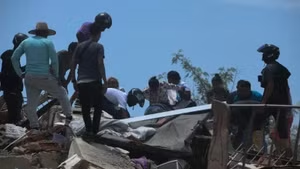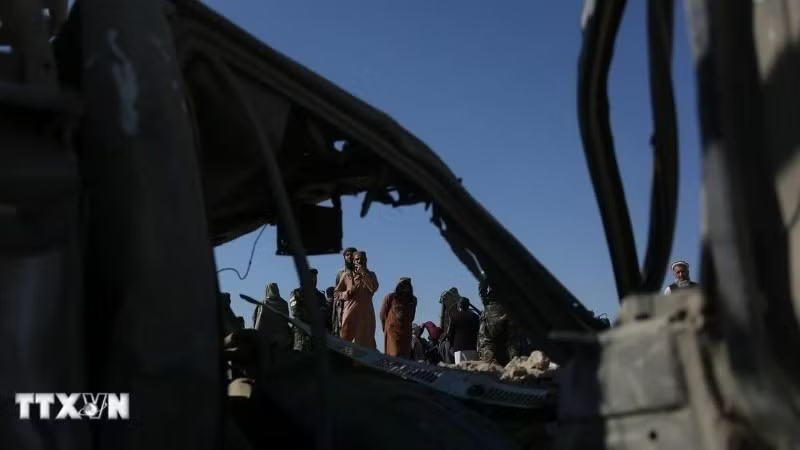
Serious fighting between Afghan and Pakistani forces broke out from February 26, when Afghan forces launched an offensive in the border area in response to Pakistani airstrikes.
Earlier, Pakistan confirmed it had carried out airstrikes along the border targeting militant groups in retaliation for the bombing of a mosque in Islamabad two weeks earlier and an attack in northwestern Pakistan.
The outbreak of hostilities between Afghanistan and Pakistan is the result of tensions that have persisted for many years along their roughly 2,600km border, where clashes and mutual accusations over the activities of armed groups have frequently occurred.
Pakistan has insisted that, despite repeated requests, the Taliban authorities have failed to prevent militant groups from using Afghan territory to launch attacks against Pakistan. Kabul, meanwhile, has firmly rejected all such allegations.
Once it can no longer be contained, the escalating conflict becomes not only a concern for Afghanistan and Pakistan, but also a threat to the geopolitical and economic stability of Central Asia as a whole.
Because of their geography, the Central Asian countries, including Kazakhstan, Uzbekistan, Turkmenistan, Kyrgyzstan, and Tajikistan, need alternative corridors to access global trade networks. Afghanistan has long been seen as an important transit route for Central Asian countries seeking access to the outside world.
However, the military conflict between Afghanistan and Pakistan is undermining the foundation of regional security stability and seriously threatening Central Asia’s long-term trade and logistics strategies.
After the Taliban returned to power in Afghanistan in 2021, Central Asian countries adopted a more pragmatic approach, treating security challenges emanating from Afghanistan as manageable risks.
Hoping that the Taliban authorities could ensure internal stability, Central Asian countries put aside ideological differences to pursue a new policy, gradually promoting and establishing diplomatic and economic relations with Kabul and bringing Afghanistan into regional economic processes.
Uzbekistan and Turkmenistan, in particular, have sought to integrate Afghanistan into regional connectivity projects by continuing economic and technical cooperation with the Taliban authorities, believing that security risks could be reduced to a minimum through economic integration. However, the escalating military tensions between Afghanistan and Pakistan are raising serious questions about the sustainability of this approach.
Apart from the economic risks, tensions between Afghanistan and Pakistan have also heightened concerns over a possible rise in extremist activity. Instability in Afghanistan could open the door to terrorist organisations.
Moreover, the escalation of the Afghanistan-Pakistan conflict carries the risk of illegal migration and transnational crime. A new wave of instability could increase illegal migration flows towards Central Asia, especially through Tajikistan and Uzbekistan, placing fresh pressure on countries in the region.
Central Asia’s security architecture is facing major challenges. For many years, countries in the region have sought to maintain balanced relations with partners while promoting regional cooperation to ensure long-term stability.
However, the rising tensions between Pakistan and Afghanistan may force Central Asian countries to adjust their foreign and security policies, pushing some countries to strengthen military cooperation or seek new security mechanisms to cope with mounting risks.
In a world of growing volatility, the Afghanistan-Pakistan conflict is not merely a matter for the two countries themselves. For Central Asia, it is like a stone thrown into a lake, creating ripples that spread across the region.
The region’s current challenge is not only to cope with security risks and instability, but also to safeguard strategies for economic development and regional integration. If not brought under control in time, tensions between Pakistan and Afghanistan could slow the process of Asia-Europe economic connectivity and increase instability in a region that is playing an increasingly important role in global geopolitics.