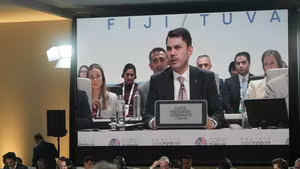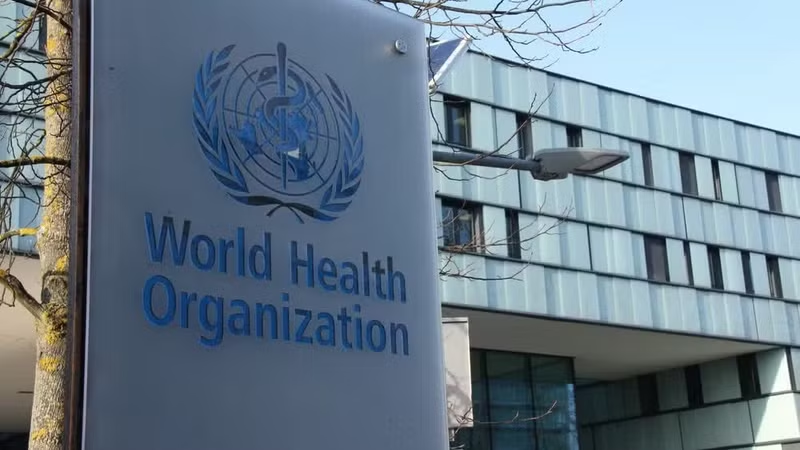
Bringing together delegations from WHO member states, WHA79 aims to set global health policy and advance the organisation’s strategic priorities as the world grows increasingly concerned over the Hanta virus outbreak and the Ebola outbreak.
The meeting builds on the momentum of WHA78 in 2025, which adopted the Global Plan of Action on Climate Change and Health — an updated roadmap to strengthen the global response to adverse health impacts caused by air pollution — and elevated climate change to a top strategic objective in WHO’s 14th General Programme of Work for 2025-2028.
In addition, ahead of the 31st Conference of the Parties to the United Nations Framework Convention on Climate Change (COP31), WHA79 offers an opportunity to advance global solutions on climate and health as well as sustain the political momentum achieved at WHA78.
WHA79 takes place after an especially difficult year for WHO, following the US announcement of its withdrawal from the organisation and deep budget cuts of around 21%, equivalent to nearly 1 billion USD. Many programmes have been scaled back and hundreds of jobs cut, forcing the organisation to undertake sweeping reforms at a time of emergency.
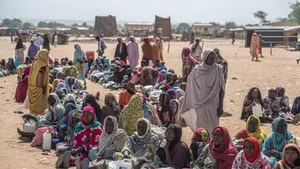
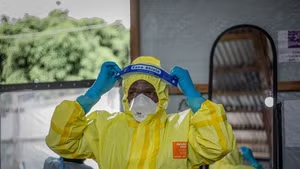
During the session, WHO had to declare the sharp rise in cases of the highly contagious Ebola virus in the Democratic Republic of the Congo and Uganda, which has so far claimed 131 lives, as a global health emergency. The latest crises involving Ebola and Hanta are clear evidence of why the world needs an effective, credible, neutral, and fully funded WHO.
The world is not yet truly safe from pandemics. As disease outbreaks become more frequent, their consequences are growing more severe, with widespread health, economic, political, and social impacts, while also weakening resilience. A decade of current investment has not kept pace with rising pandemic risks.
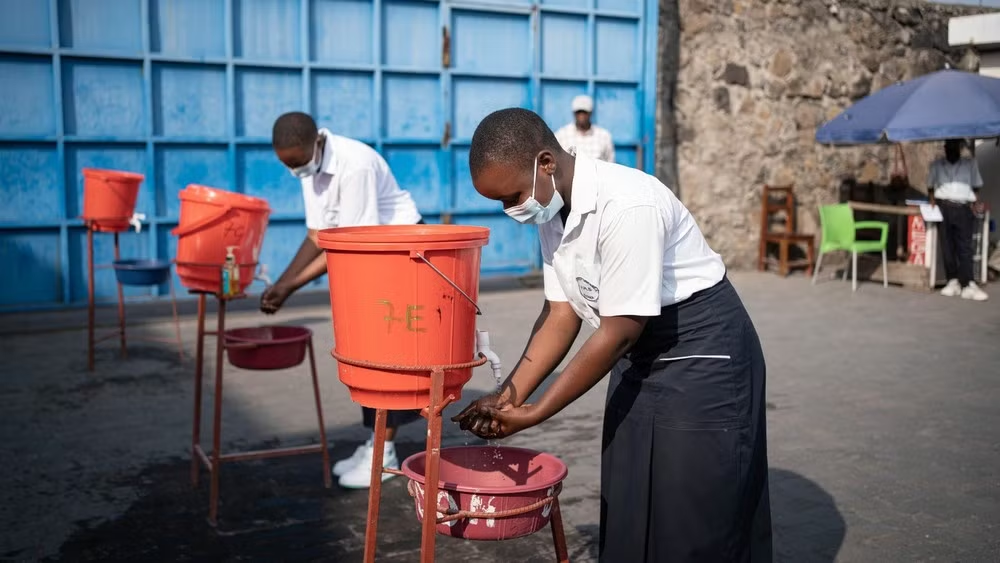
After reaching a historic peak of about 80 billion USD during the Covid-19 pandemic, development assistance for health is now seeing a sharp decline, directly threatening essential healthcare programmes in low-income countries.
Total development assistance for global health is expected to fall to about 39 billion USD in 2025-2026, its lowest level in more than 15 years. The decline is mainly due to major donor countries shifting budget priorities towards domestic issues, geopolitical conflicts, and post-pandemic economic recovery. The US has cut assistance by around 67%, the UK by 40%, France by 33%, and Germany by 12%.
The Global Preparedness Monitoring Board was established by WHO and the World Bank (WB) following the Ebola outbreak in West Africa between 2013 and 2016. The board has warned that outbreaks of infectious diseases around the world are becoming more frequent and causing increasingly severe damage.
Health experts have called for the establishment of a standing independent monitoring body to track pandemic risks, while ensuring equitable access to vaccines, testing, and treatment through a global pandemic agreement.