Opening the conference, ILO Director-General Gilbert F. Houngbo stressed that the future of work will not be determined by technology alone, but also by the policies, institutions, and social dialogue that guide it. In the context of a global economy already marked by slow growth and a prolonged shortage of decent jobs, the choices made today will determine whether AI expands opportunities and shared prosperity or deepens inequality and insecurity. Workers everywhere need to be able to share in the productivity gains generated by AI.
Those benefits must be distributed fairly through better wages, stronger labour protection mechanisms, and more inclusive growth. Under a scenario of a prolonged oil crisis, the ILO forecasts that global working hours could decline by the equivalent of 14 million full-time jobs in 2026 and 38 million jobs in 2027, with labour income losses reaching up to 3 trillion USD by 2027.
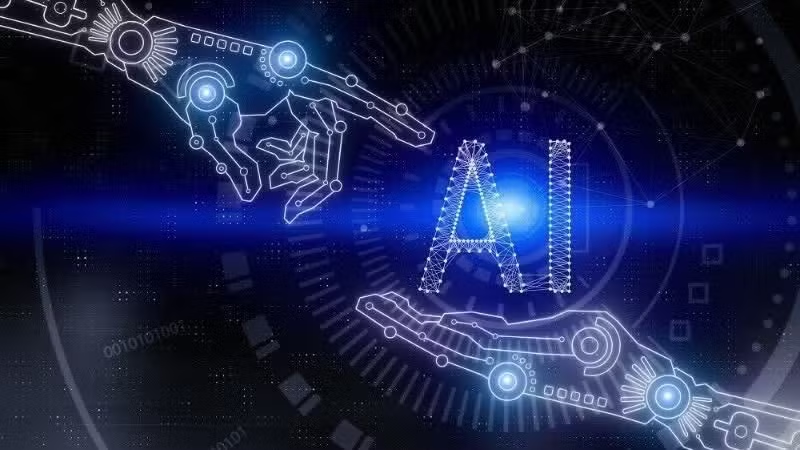
Concerns that AI will “take away” jobs are well founded and have become a hot topic around the world. However, viewed objectively, the relationship between AI and the labour market is not simply a matter of “AI replacing humans.” It is a process of transition and restructuring of jobs. AI is particularly effective at processing data, identifying patterns, and performing repetitive tasks.
Concerns that AI will “take away” jobs are well founded and have become a hot topic around the world.
Therefore, the jobs under the greatest pressure include office and administrative work, basic content creation and design tasks, junior programming, and customer service. A common misconception is that AI will completely eliminate an entire job title. In reality, AI often replaces only certain tasks within a job.
For example, AI does not completely replace a doctor, but it can read X-ray results faster and more accurately. Doctors can then spend less time on technical analysis and focus more on consultation, treatment planning, and interaction with and encouragement of patients.
The greatest risk does not lie in the absence of new jobs, but in the skills gap and the pace of adaptation, which may lead to temporary unemployment. AI creates new jobs such as prompt optimisation engineers, AI ethics specialists, and data engineers. However, a person who has just lost a job in translation or data entry cannot immediately move into these high-tech positions. Wealth inequality may increase as those who master AI can become five to 10 times more productive and earn very high salaries. By contrast, those who reject AI or lack access to it will fall behind, creating the risk of a surplus of low-skilled labour.
In the context of digitalisation and AI, the green transition and demographic changes are reshaping labour markets worldwide. The ILO has called on countries to elevate lifelong learning to a central pillar of economic and social policy. Instead of worrying about being displaced by AI, the best response is to proactively upgrade oneself through lifelong learning in order to become a person who can control and make use of AI. Experts recommend focusing on values that AI will take a very long time to match, or may never be able to match, such as emotional intelligence, critical thinking, ethics, and breakthrough creativity.
Based on new worker surveys, online job vacancy analysis, institutional data, and an assessment of 174 studies, the ILO’s report “Lifelong Learning and Skills for the Future” warns that without stronger investment in comprehensive learning systems, these transformations could widen inequalities between and within countries.
The ILO emphasises that lifelong learning is the bridge between today’s jobs and tomorrow’s opportunities. This is not only related to employability and labour productivity, but also supports high-quality jobs, promotes genuine innovation, and builds sustainable societies, making lifelong learning a central element of any successful strategy for sustainable growth and development.