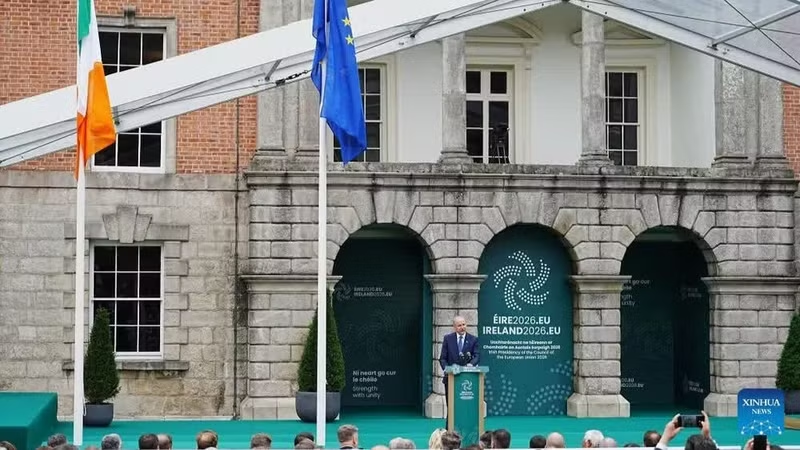
Ireland assumed the rotating Presidency of the Council of the EU on July 1, 2026, marking its eighth term it has held the rotating Presidency, at a time when Europe is facing overlapping challenges, including the impact of the prolonged conflicts in Ukraine and the Middle East, migration pressures, energy security instability, intensifying climate change, and, notably, growing strains in the transatlantic relationship with the US.
As the US shifts its strategic focus towards the Indo-Pacific, the Western security architecture is undergoing profound change. An old order that was closely bound together under Washington’s leadership and security guarantees is gradually giving way to a new one in which Europe is compelled to enhance its strategic autonomy and share security responsibilities more evenly with the US.
Strengthening the EU’s capabilities and standing is among Ireland’s top priorities during its presidency. Speaking in Dublin on July 1, Irish Prime Minister Micheal Martin affirmed that Ireland is prepared to make every effort to ensure Europe becomes safer and more competitive while continuing to uphold the EU’s core values.
Whereas Ireland’s previous presidency in 2013 was concentrated on internal issues such as stabilising the regional economy and promoting recovery from the financial crisis, this term requires the country to steer the EU through a range of foreign policy challenges.
The EU’s role in global affairs has increasingly been viewed as under strain. Even in efforts to resolve the conflict in Ukraine — which is closely linked to the bloc’s own security — Russia and the US at times pursued separate diplomatic initiatives without involving the EU.
Ireland has stated that during its presidency it will maintain its support for Ukraine while promoting EU enlargement, one of the bloc’s strategic objectives aimed at strengthening its power and influence.
Ireland also intends to advance the “One Europe, One Market” agenda and work towards reaching consensus on the Multiannual Financial Framework for the 2028–2034 period.
However, one of Ireland’s greatest challenges will be guiding the EU beyond its differences and securing consensus in implementing these priorities. Divergent views are particularly evident on the issue of enlargement.
The EU has repeatedly faced internal divisions over the method and timing of Ukraine’s accession, with opposition coming primarily from Hungary. Hungarian Prime Minister Peter Magyar said that accelerating Ukraine’s accession negotiations would send a highly negative signal to the Western Balkan countries that are already undergoing the EU accession process.
As such, despite receiving strong political backing from EU member states, Ukraine’s path towards becoming part of the “EU family” remains fraught with obstacles.
Reaching consensus on the Multiannual Financial Framework for 2028–2034 will also be far from straightforward. Member states continue to hold differing views on how resources should be allocated among strengthening defence capabilities, advancing the green transition and supporting social welfare.
Ireland also aims to chair negotiations on digital technology and artificial intelligence (AI) policy. However, the country hosts the European headquarters of many major US technology companies, including Meta and Apple, a reality that places Ireland in something of a delicate position.
The EU is not lacking in ideas or initiatives to strengthen its capabilities and standing across areas ranging from defence and security to the economy, foreign affairs, technology, and climate action. What the bloc lacks is strategic consensus — a factor that continues to hamper Brussels’ ability to respond to major issues swiftly and effectively.
Ireland's Presidency of the Council of the EU during this turbulent period will serve as an important test of its ability to build consensus within the bloc, thereby helping to strengthen the EU's standing and voice.