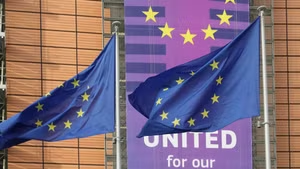
France has sent an urgent letter to the European Union (EU), calling for regulations to be swiftly eased to help increase supplies of diesel and aviation fuel.
Paris has openly proposed that the EU postpone requirements for quality reporting on imported oil and gas.
In the letter to European Commission (EC) President Ursula von der Leyen, French President Emmanuel Macron warned that measures taken in recent months to maintain supply, including increased refining output, the use of strategic reserves, weaker demand in Asia, and trade diversions, are rapidly losing their effectiveness.
According to the French Government, about 14% of petrol stations in the country are experiencing fuel shortages. With the conflict in the Middle East showing no sign of ending soon, President Macron hopes the EU will stand united in responding to mounting energy price pressures.
The French leader told the EU that energy supplies have still not improved largely because Europe has lost its access to cheap and abundant supplies from Russia.
If the Strait of Hormuz remains shut and Saudi Arabia’s East-West pipeline remains disrupted, dwindling stocks in Middle Eastern countries could cause global crude oil supplies to fall by at least another 4 million barrels per day.
Faced with increasingly tight supplies, France has proposed that the EC temporarily relax some EU fuel quality standards, including those relating to density, volatility, and desulphurisation, which could enable refineries to increase output by around 5-20%.
Paris has also proposed allowing wider use of B10 diesel, which contains up to 10% biofuel, instead of the currently common B7.
The EU currently relies significantly on fuel supplies from the Middle East, which supplies 36% of the EU’s imported aviation fuel and 18% of its imported diesel.
Alongside measures to increase supplies, France has proposed that the EU postpone the requirement to report and verify methane levels in imported crude oil and gas shipments for one year, until January 1, 2028.
Previously, the EC proposed postponing financial penalties related to the regulation until the end of 2029 but has not agreed to defer the reporting requirement.
Paris has also asked the EC to consider expanding the EU’s joint gas purchasing mechanism to diesel and aviation fuel, with a view to better coordinating supply efforts.
In response to France’s proposals, the EC said the risk of fuel shortages in member states was being treated as a very high priority and that it would soon discuss the issue with EU countries.
It is not only oil and gas shortages that are worrying the EC; electricity supplies are also proving a headache.
The EC has just put forward a draft electricity and energy regulation aimed at strengthening its powers to intervene to prevent the risk of blackouts and ensure energy supplies.
Under the draft, the EC would be empowered to declare a regional or EU-wide electricity alert if it identifies a risk of a crisis. The EC could require member states to take measures to reduce electricity consumption.
However, what the EC wants most is solidarity among member states in responding to the crisis, while avoiding unilateral measures that would restrict cross-border flows of electricity or gas. Without coordination, the risk of energy shortages in neighbouring countries could become even more serious.
The package was developed by the EC based on the still-fresh lessons of the 2022-2023 energy crisis. The proposal would give the EC a greater role in coordinating and handling energy emergencies, with the aim of limiting the knock-on effects of disruptions and ensuring security of supply across the EU.
This is particularly important as the EU accelerates the electrification of its economy and becomes increasingly reliant on renewable electricity, which is highly vulnerable to current volatile weather conditions.