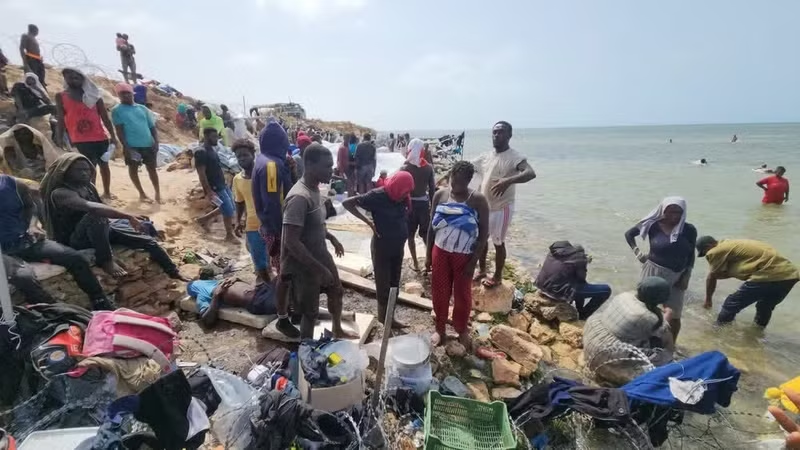
On September 30, Italy introduced controls at its air and sea borders with Spain for 15 days, for the third time since late July 2026, citing security concerns related to the wave of migration in Ceuta, a Spanish autonomous territory in North Africa. Notably, the move runs counter to the principle of free movement under the Schengen Agreement, which has become a symbol of integration and cohesion and reflects the dream of a Europe without borders.
In response to Rome’s decision, Spain also introduced border controls on passengers arriving from Italy. Clearly, tighter controls do not mean that the Schengen Area will collapse, but they are enough to fuel debate over the vitality of the principles of freedom and integration underpinning the agreement, particularly as exceptions introduced for specific purposes are becoming increasingly frequent and continuous.
The situation in Ceuta is also a test of the principle of solidarity and responsibility-sharing set out in the EU Pact on Migration and Asylum, which only came into force a few months ago. The pact was once hailed by the public as a historic step, marking a far-reaching overhaul of the European Union’s migration management policy after years of controversy and division.
One notable aspect of the pact is its solidarity mechanism, under which member states are to support one another when migration pressures increase, for example by helping each other relocate asylum seekers or providing financial and logistical assistance.
By using secure digital tools, the EU will help border guards manage migration more effectively and ensure security at the external borders.
Henna Virkkunen, European Commission Executive Vice-President for Tech Sovereignty, Security and Democracy
As the Schengen Area has open internal borders, protecting its external borders is particularly important. The crisis in Ceuta has highlighted the importance of close coordination between European countries and Morocco in preventing waves of migration.
However, the current chaotic migration situation in Ceuta points to a fundamental issue: the question is not whether the EU has a mechanism for controlling migration but how effectively that mechanism is implemented. The challenge lies in the gap between political will and the implementation of regulations by member states when they are actually confronted with a crisis.
Recent developments show that the EU is leaning increasingly towards strengthening controls at its external borders. In late September 2026, the European Commission proposed a five-point plan: strengthening cooperation with partner countries, reinforcing external borders, focusing on monitoring and early warning, dismantling networks involved in migrant smuggling and human trafficking, and stepping up returns.
Henna Virkkunen, European Commission Executive Vice-President for Tech Sovereignty, Security and Democracy, stressed that by using secure digital tools, the EU would help border forces manage migration more effectively and ensure security at the external borders.
A sustainable solution to the issue will not come from walls or reinforced fences along borders but from a combination of factors, including intelligence capabilities, information management, control of migration routes, and efforts to address socio-economic problems in countries from which migrants originate.
A sustainable solution to the issue will not come from walls or reinforced fences along borders but from a combination of factors, including intelligence capabilities, information management, control of migration routes, and efforts to address socio-economic problems in countries from which migrants originate. Poverty, conflict, and natural disasters are among the root causes behind the mass movement of people seeking the “promised land” of Europe despite the dangers involved.
The migration issue leaves European countries caught between difficult choices: meeting their international humanitarian obligations while ensuring national security and social welfare; and balancing national interests with the values of regional cohesion and integration. A strong and united bloc does not mean disagreements among its members will disappear. What matters is that member states make efforts to turn differences into mechanisms for closer coordination and shared responsibility, working towards a unified common policy and a balance of interests when crises arise.