However, whether this landmark agreement will bring an end to Europe’s migration crisis remains an open question.
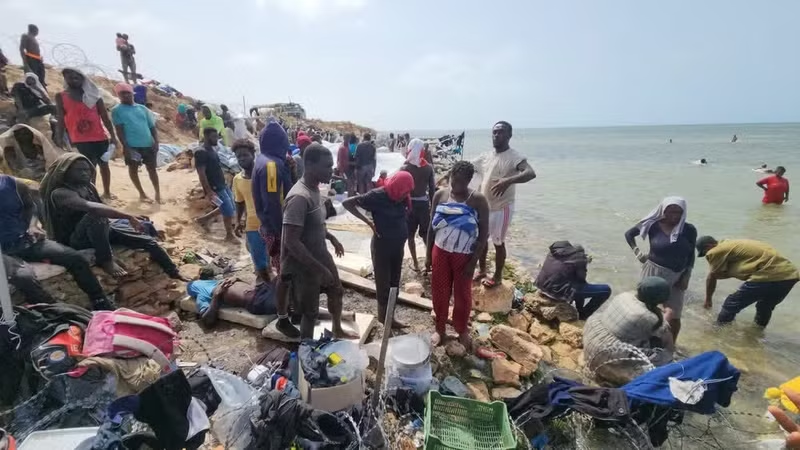
The influx of illegal migrants has long been a challenge for Europe, with millions of people fleeing poverty and violence risking dangerous journeys in search of a better life on the continent.
This reality has had significant consequences for economic, political, and social stability, and even the solidarity of the EU. Although migration has consistently remained a high-profile issue on the bloc’s agenda, efforts to curb illegal immigration have so far fallen short of expectations.
Against this backdrop, the Pact on Migration and Asylum represents a comprehensive reform aimed at strengthening control of the EU’s external borders and establishing a unified asylum system. Featuring some of the toughest measures introduced in years, the pact is expected to address bottlenecks in the EU’s refugee management system.
European Commissioner for Internal Affairs and Migration Magnus Brunner described the pact as an important step towards restoring Europe’s control over migration flows.
One of its most notable provisions allows EU member states to establish “return hubs” in non-EU countries. Asylum seekers whose applications are rejected may be transferred to these facilities.
The pact also significantly expands the powers of authorities by requiring individuals subject to deportation orders to cooperate with authorities and leave EU territory.
Those failing to comply may face stricter penalties, including the withdrawal of social benefits, confiscation of documents, or detention. The maximum detention period for illegal immigrants will be extended from the current six months to 24 months, with the possibility of further extensions.
For individuals deemed a threat to national security, detention could be prolonged indefinitely. These measures are designed to close one of the largest loopholes in the EU asylum system whereby many people whose asylum claims have been rejected nevertheless remain within the bloc.
According to official statistics, fewer than 30% of those ordered to leave the EU actually return to their countries of origin or depart from EU territory. Many attempt to remain illegally by evading authorities, changing residence, or moving to another member state.
The tougher measures in the Pact on Migration and Asylum clearly demonstrate the EU’s shift towards a more stringent approach to migration.
The move is regarded as necessary to address the security, economic, and social challenges posed by illegal migration to EU member states.
From a security perspective, concerns include instability in border regions and in some European cities. The threat is heightened by the potential for extremist elements to infiltrate refugee flows, enter Europe, and carry out terrorist activities, directly endangering public safety.
In addition, many experts have expressed concern that spending on refugees could place increasing pressure on welfare systems and national budgets. These issues are having a growing impact on European politics, deepening divisions among member states and creating favourable conditions for the rise of far-right parties.
Against this backdrop, the EU has been compelled to act, and the Pact on Migration and Asylum is expected to be a solution to this problem. Nevertheless, implementation of the pact has also faced criticism.
France and Spain have questioned the practical effectiveness of the “return hub” model, noting that similar initiatives in the past failed to achieve the desired results.
Several human rights organisations have also warned of potential legal risks and humanitarian consequences, expressing concern that migrants’ fundamental rights may not be adequately protected.
The European Commission has emphasised that the entry into force of the Pact on Migration and Asylum is only the beginning of a long journey that will require sustained efforts, solidarity, and responsibility from all member states.
At the same time, the EU cannot fully resolve the large-scale influx of migrants on its own if the root causes driving migration, such as conflict and poverty in migrants’ home countries, remain unaddressed.