From July 24, 2026, the US began imposing additional tariffs under Section 301 on goods imported from 60 economies to strengthen controls over goods produced using forced labour. Viet Nam is among those subject to a tariff rate of 12.5%, the highest rate under this policy.
Different impacts on different sectors
According to experts from KB Securities Viet Nam (KBSV), the US's new tariff policy is generally not expected to alter the positive outlook for exports in 2026. However, it will have different impacts on different sectors.
Electronic equipment, high-tech products, artificial intelligence (AI), and semiconductors remain exempt, while a number of agricultural products, chemicals, and other goods have also been added to the exemption list. These products account for approximately 45-50% of Viet Nam's export turnover to the US. As such, long-term risks for the electronics, high-tech, and semiconductor sectors are assessed to have reduced significantly.
The 12.5% tariff applied to Viet Nam is not significantly different from those imposed on many regional competitors and is also lower than the 20% rate previously proposed under the US International Emergency Economic Powers Act (IEEPA) mechanism. Along with available advantages such as its geographical location, stable political environment, and extensive network of free trade agreements (FTAs), Viet Nam is still expected to maintain its attractiveness to FDI inflows and promote exports.
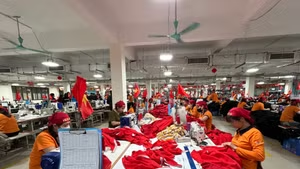
Conversely, sectors where domestic enterprises hold a competitive edge — such as textiles, rubber, and wood products — are not exempt. These sectors must compete with products from Bangladesh, Cambodia, Indonesia, and Malaysia, all of which benefit from quota-based preferences. Shipments from these nations that meet quota conditions may qualify for tariff exemptions under Section 301, whereas this mechanism does not currently apply to Viet Nam.
Le Hang, Deputy Secretary-General of the Viet Nam Association of Seafood Exporters and Producers (VASEP), said many enterprises are still maintaining stable orders and delivery schedules thanks to previously-signed contracts. However, the impact of the policy will become more apparent from August and will be concentrated in the fourth quarter, when new contracts are negotiated and implemented.
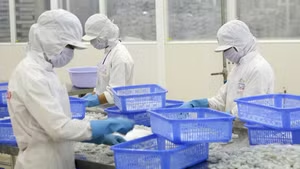
New contracts with US partners are likely to require renegotiation as importers may ask for lower free-on-board (FOB) prices to share the cost of tariffs or may sign only short-term contracts to limit risks. Vietnamese seafood will face a competitive disadvantage compared with Ecuador, India, and Indonesia, which are subject to a tariff rate of only 10%. This tariff gap will particularly affect products that compete directly with those countries, such as white leg shrimp and canned tuna.
In addition, Section 301 tariffs will be added to import duties, anti-dumping duties and countervailing duties, where applicable. US importers will therefore scrutinise individual enterprises and product codes more carefully when selecting suppliers, rather than mainly comparing countries as they did previously.
Notably, unlike tariffs imposed under Section 122, which are effective for only 150 days, Section 301 tariffs have no expiry date. Enterprises need to regard this as a long-term factor and proactively adjust their investment strategies, markets, and supply-chains.
Completing the legal framework in line with international standards
In the short term, Vietnamese enterprises are unlikely to avoid sharing part of the tariff costs with importers. However, in the medium and long term, Viet Nam still has certain advantages in its production capacity, ability to fulfil orders, and product quality, as well as its increasingly important position in global supply chains serving the US market.
Viet Nam's issuance of Decree No. 292/2026/ND-CP, which prohibits the import of goods produced using forced labour and takes effect on September 5, 2026, is considered an important step towards completing the legal framework in line with international standards. If the implementation process is recognised by the US side, this could provide a basis for Viet Nam to continue dialogue and advocacy efforts towards adjusting the tariff rate in a more favourable direction.
According to the Ministry of Industry and Trade, to demonstrate that products have not been wholly or partly produced using forced labour, enterprises must be able to identify and provide reliable information on the origin of raw materials, suppliers, production locations, and the stages through which products are made. This requirement is particularly important for industries with multi-tier supply chains that use materials from multiple countries and territories, such as textiles and garments, leather and footwear, electronics, electrical equipment, and energy.
To help enterprises strengthen the traceability of goods, the Ministry of Industry and Trade has issued Circular No. 31/2026/TT-BCT, which sets out regulations on the traceability of products and goods under the ministry's management. Traceability is mandatory for high-risk product groups, while other groups are encouraged to implement it on a voluntary basis.
In addition, the list of goods at risk of being subject to US inspections concerning forced labour, transshipment, or evasion of trade-remedy measures does not completely overlap with Viet Nam's list of high-risk goods. Therefore, enterprises should not rely solely on the list used for domestic management. Instead, they need to proactively review their supply chains, map their suppliers — including suppliers at deeper tiers — and collect and retain complete records on the origin of raw materials, components, production locations, transportation processes, and the delivery and receipt of goods.
Enterprises also need to classify suppliers according to their level of risk, strengthen due diligence on sources subject to warnings, standardise traceability data for each product, shipment, or serial number, and strictly control the origin of goods. They must not facilitate illegal transshipment or relabelling aimed at declaring Vietnamese origin. Requirements concerning traceability, labour conditions, and origin should also be incorporated into contracts with suppliers. Enterprises should prepare designated contact points and documentation in advance so that they can respond promptly when regulatory authorities or importing partners request verification.
According to Assoc Prof, Dr Nguyen Thuong Lang, a lecturer at the Institute of International Trade and Economics under the National Economics University, the imposition of Section 301 tariffs on Vietnamese goods is only a consequence of one of three investigations currently being conducted by the US. The other two investigations concern overcapacity and intellectual property and have not yet reached conclusions.
Therefore, Viet Nam needs to continue dialogue with the US side on the basis of objective data and evidence to clarify the grounds for the tariffs. Achieving this goal requires close coordination among regulatory authorities, industry associations, and the business community.
"Amid increasingly numerous trade barriers, what matters is not only responding to a specific tariff rate, but also improving competitiveness, ensuring supply-chain transparency and proactively engaging in policy dialogue. This is the foundation for Vietnamese goods to maintain their position and expand export markets," the expert stressed.