A potential market
According to the Centre for Information and Services on Agriculture and Environment under the Institute of Agricultural and Environmental Strategy and Policy, Viet Nam’s rice exports to ASEAN reached 1.4 billion USD in the first seven months of 2026, equivalent to 68.7% of the total export turnover for the whole of 2025.
In terms of volume, Viet Nam shipped approximately 3 million tonnes of rice to the ASEAN market, equivalent to 75.3% of the export volume for the whole of the previous year. However, the ASEAN rice market is also changing rapidly, with Viet Nam not being the only source of supply.
In addition to Thailand, Cambodia is gradually increasing its market share in various segments. During the seven-month period, Cambodia exported approximately 707,000 tonnes of rice, worth 415.12 million USD, representing a year-on-year increase of 68% in volume and 34.3% in value. Notably, ASEAN imported approximately 266,300 tonnes of Cambodian rice, worth 102.84 million USD.
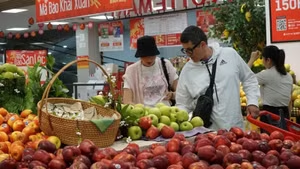
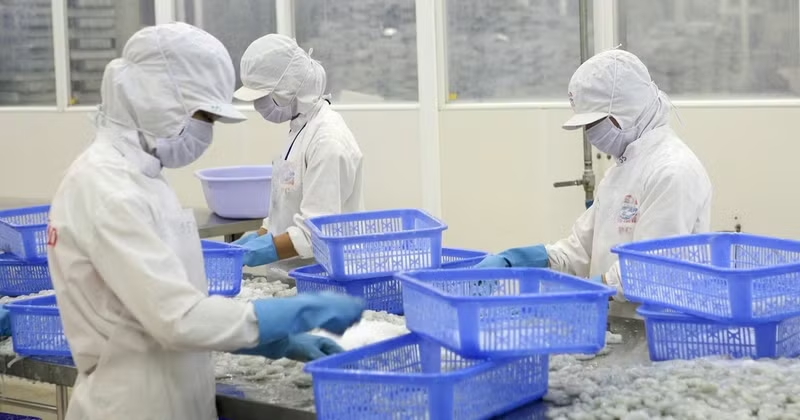
In other product groups, Viet Nam’s exports to ASEAN are also of significant scale. In the first seven months of the year, fruit and vegetables reached 249.8 million USD, equivalent to 68.8% of the export turnover for the whole of 2025; seafood reached 439.6 million USD, equivalent to 61.1% of the 2025 figure.
Dang Phuc Nguyen, Secretary-General of the Viet Nam Fruit and Vegetable Association, said that Malaysia and Thailand are among the top 10 export markets for Vietnamese fruit and vegetables; in particular, in the first seven months of the year alone, the volume of vegetables exported from Viet Nam to Malaysia increased by around 45% compared with the same period in 2025.
In the Thai market, Viet Nam remains an important source of fruit and vegetable supplies. For example, Vietnamese dragon fruit continue to hold a dominant position in Thai supermarket chains such as Big C and Central Food Hall, thanks to year-round supply, attractive colour, and reasonable prices.
In addition, Thai businesses are increasing imports of frozen vegetables, dried fruit, concentrated juices, and semi-processed agricultural products from Viet Nam to serve the food processing industry for export and restaurant and hotel chains.
By effectively taking advantage of the 0% tariff preferences under the ASEAN Trade in Goods Agreement (ATIGA), together with the advantage of short road and sea transport routes and logistics costs, Vietnamese processed and canned fruit and vegetable products and dried nuts and seeds are gradually improving their ability to compete directly with domestic Thai brands.
Establishing a stable position in the value chain
ASEAN is becoming a competitive arena for multiple sources of agricultural, forestry, and fisheries products in the region, placing Vietnamese businesses under increasing pressure to establish a more stable position in the market.
Le Phu Cuong, Commercial Counsellor at the Viet Nam Trade Office in the Philippines, said businesses need to improve their capacity to forecast and respond to policy changes concerning tariffs and technical barriers. One proposal is to establish a task force to assess and provide early warnings of changes related to tariffs and quarantine permits, thereby helping businesses proactively adjust prices, delivery methods, and export plans.
For the key product of rice, Viet Nam needs to shift its structure towards mid-range and premium segments such as fragrant rice, organic rice, and high-quality rice, while building the Vietnamese rice brand in major retail systems such as S&R and Savemore.
This approach aims to reduce dependence on the mass-market rice segment as the Philippines diversifies its sources of supply from Cambodia, Myanmar, and other countries.
Alongside products, the market presence also needs to be expanded. Instead of focusing mainly on the core area of Metro Manila, businesses should establish deeper trade links in the rapidly developing regional economic centres of the Philippines, such as Cebu in the Visayas region and Davao in the Mindanao region. These are areas with high demand for rice and frozen seafood but have yet to be exploited commensurately.
In the Indonesian market, requirements concerning product standards and certification are becoming increasingly clear. The Import-Export Department under the Ministry of Industry and Trade has reminded businesses to promptly comply with the host country’s import requirements, particularly regarding Halal standards.
Recently, Indonesia’s state regulatory authority in the Halal sector issued Decision No. 4/2026, strengthening the inspection of documents and actual products in the country of loading and/or country of origin before shipment.
Therefore, for an agricultural product to penetrate deeper into ASEAN, businesses must prepare everything from raw material areas, production processes, quality, traceability, and certification dossiers to logistics and distribution systems.
According to Vu Ba Phu, Director-General of the Trade Promotion Agency under the Ministry of Industry and Trade, ASEAN is not only an important market for Viet Nam but also a network of trade, investment, supply, and production partners which is playing an increasingly important role in the regional value chain.
The Trade Promotion Agency will continue to support businesses in effectively taking advantage of regional cooperation frameworks and trade agreements to which Viet Nam is a party, enhancing their capacity to meet market standards, and strengthening connections with importers, distributors, and investors in order to expand the presence of Vietnamese agricultural products in ASEAN.