Scope for developing marine aquaculture into a commercial-scale industry
According to the Ministry of Agriculture and Environment, Viet Nam’s marine aquaculture industry currently has a total cage volume of approximately 9.7 million cubic metres, with an output of around 832,000 tonnes. In 2025, seafood export turnover reached roughly 11.3 billion USD.
Director General of the Viet Nam Administration of Seas and Islands Nguyen Quoc Toan said that in the first six months of 2026, the agency had worked with local authorities to process more than 1,100 applications to allocate marine areas, mainly for aquaculture. These figures demonstrate the growing potential for marine aquaculture to develop into a large-scale commercial industry. However, as the sector expands, mounting pressure from waste, water quality issues, and the carrying capacity of marine ecosystems is becoming an increasingly urgent challenge.
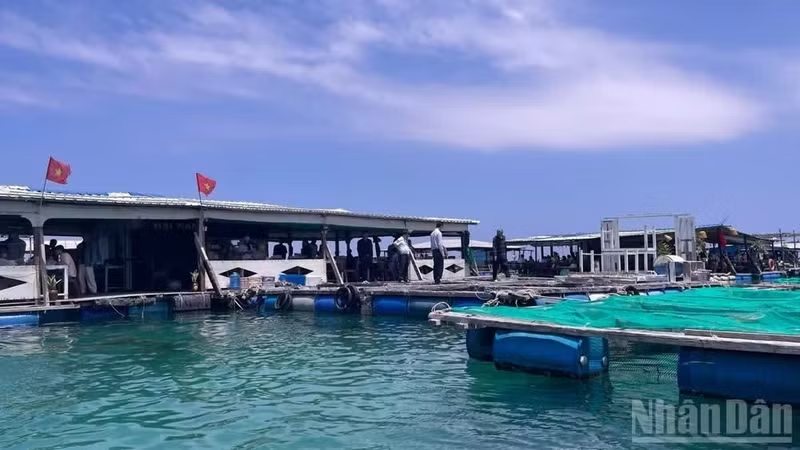
Waste from industrial marine aquaculture stems from various sources, including uneaten feed, dead aquatic animals, excreta, damaged nets and mooring lines, buoys, and plastic materials used in cage systems. Wastewater from farming operations also contains considerable amounts of nutrients and suspended solids. Meanwhile, most marine aquaculture facilities still rely on traditional cage systems, limiting their ability to control waste discharge.
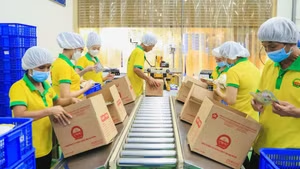
According to figures from the Department of Quality, Processing, and Market Development, the total designed capacity of seafood processing facilities in Viet Nam is estimated at 3 million tonnes of products annually. However, these facilities also generate around 1.3 million tonnes of by-products, including heads, bones, skin, shells, and internal organs. Of this volume, approximately 30% could be recovered and used as raw materials for producing fish oil, collagen, gelatine, chitin, chitosan, and other high-value products.
According to Director General of the Department of Fisheries and Fisheries Surveillance Tran Dinh Luan, the current imperative is not simply to address pollution after production, but also to promote a circular economy throughout the entire seafood value chain, from aquaculture and fishing to processing. Key priorities include waste treatment, by-product recovery, energy conservation, and emissions reduction.
Scaling up circular economy models
One notable technology is the recirculating aquaculture system (RAS). Instead of continuously drawing in fresh water and discharging wastewater into the environment, RAS uses filtration, pumping, and treatment systems to recirculate water multiple times. The system can reuse approximately 80–95% of the water, allowing operators to maintain better control over farming conditions. It is particularly suitable for coastal and island areas where supplies of clean water are limited. However, the high initial investment cost — currently around 5–7 billion VND per 1,000 square metres — remains a barrier to wider adoption.
For hatcheries and high-value aquaculture species, combining biological filtration, mechanical filtration, and ultraviolet (UV) disinfection can reuse 80–95% of water, reduce wastewater volumes by up to 90%, and increase seed survival rates by 15–30%.
When combined with solar power, operating costs could be reduced by a further 20–30%, according to estimates. While RAS focuses on water recirculation, integrated multi-trophic aquaculture (IMTA) aims to recycle nutrients within the farming area itself. Under this model, marine fish or shrimp are the primary farmed species, generating organic waste and dissolved nutrients. Species such as oysters, mussels, and clams utilise some of the uneaten feed and organic detritus, while sea cucumbers consume material that settles on the seabed. Meanwhile, seaweed absorbs dissolved nitrogen and phosphorus from the water to support its growth. As a result, waste generated by one species becomes a source of nutrients for another, curbing pollutants released into the environment and creating a more closed-loop farming system than conventional monoculture.
The efficiency of resource recovery can be further enhanced through technological applications. Automated feeding systems combined with environmental sensors can reduce uneaten feed by 15–20%. Parameters such as dissolved oxygen, pH, nitrate, ammonia, and suspended solids are monitored and transmitted to a central control system. Waste-collection nets installed beneath cages can capture settled waste for processing into biogas or organic fertiliser. According to the proposed model, this closed-loop system could reduce organic waste loads by 30–60% compared with monoculture farming and increase production efficiency by approximately 10–20%.
Initial models have already emerged in Viet Nam. In Quang Ninh, STP Group Joint Stock Company has introduced a multi-layer marine farming model combining seaweed and oysters, making more efficient use of water space while improving the marine environment. In Khanh Hoa, an initiative combining spotted babylon snails with sea cucumbers and seaweed has generated profits of approximately 449.4 million VND per hectare per crop, 42.4% higher than those from a monoculture system covering the same area, in addition to its environmental benefits.
Based on real-world results, experts note that circular technologies do more than address environmental challenges. When properly organised, waste recovery can generate additional products and create greater value from the same unit of marine farming area.
Associate Professor Nguyen Huu Dung, Chairman of the Viet Nam Marine Aquaculture Association, said that industrialising marine aquaculture does not simply mean replacing traditional cages and rafts with modern equipment. Future farming technologies must move towards zero-waste industrial production models while incorporating the Internet of Things (IoT), artificial intelligence, digitalisation, and automation.
To put circular economy models into practice and scale them up, the Department of Fisheries and Fisheries Surveillance says Viet Nam needs to promptly establish environmental standards for industrial marine aquaculture, issue guidelines for assessing the ecological carrying capacity of individual farming areas, and introduce cirularity criteria for the aquaculture sector.
Other priorities include investing in automated environmental monitoring stations, introducing preferential credit policies for recirculating aquaculture systems and integrated multi-trophic aquaculture models, establishing by-product processing clusters, and promoting research into technologies for extracting high-value biomaterials.
In terms of production organisation, the focus should be on developing high-tech marine aquaculture cooperatives, establishing links between farming, processing, recycling, and by-product recovery, and moving towards building regional-scale circular aquaculture zones.