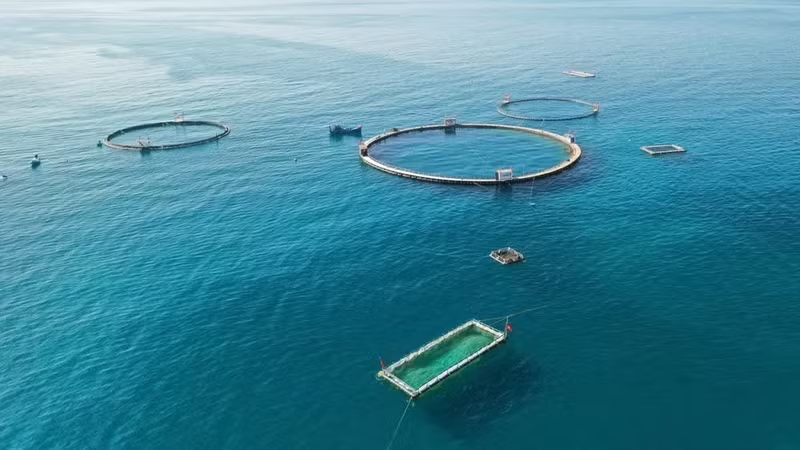
This shift in materials signals a paradigm shift from small-scale aquaculture practices towards sustainable, high-tech mariculture development.
With nearly 500 km of coastline, over 200 islands and islets, a system of sheltered lagoons and bays, and vast open waters — complemented by a network of research institutes, universities, and numerous fisheries enterprises — Khanh Hoa wields formidable advantages for cultivating a modern mariculture ecosystem.
Catalysing economic value
The Van Ninh Aquaculture Cooperative (Van Ninh Commune) currently has over 100 members, primarily engaged in farming lobsters and high-value marine fish. The introduction of the first HDPE cages — which are durable against wind and waves, long-lasting, environmentally friendly, and suitable for offshore farming — has unlocked revolutionary operational methods for these farmers.
Nguyen Xuan Hoa, the cooperative’s director, stated that nine member households have so far invested in 14 circular and 42 square HDPE cages. HDPE cage technology has demonstrated exceptional productivity; the cooperative supplies thousands of tonnes of high-value seafood to the market annually.
Similar success stories are unfolding in the waters of Hon Noi (Cam Lam Commune) and Dam Bay (Nha Trang City). Vo Lam Dong, Director of the Hon Noi High-Tech Mariculture Cooperative, shared that following a successful trial period, cooperative members have stocked 100,000 golden pompano fish in HDPE cage systems. On average, utilising approximately 1,000 square metres of water surface, each household yields nearly 90 tonnes of commercial-grade fish per year.
Operating in the waters off Vinh Hai Commune, Bien Dong Live Squid Joint Stock Company stands as one of the country’s largest owners of sea-based squid farming cages, utilising HDPE technology to raise commercial squid in a semi-natural environment across a water surface area of nearly 3,000 square metres.
Nguyen Ba Ngoc, Chairman of the Board and Director of the company, shared that after spending over a decade travelling to dozens of provinces and cities to accumulate entrepreneurial expertise, he launched a pilot project in early 2021 to breed and raise commercial squid in a semi-natural setting.
His method involved collecting squid eggs from the wild and placing them in a 70-square-metre cage submerged approximately ten metres deep in the sea to facilitate hatching.
The cage features a technical design cantered on a frame made of HDPE (High-Density Polyethylene) piping — a petroleum-based thermoplastic known for its high-density molecular structure, which makes it thick and rigid.
The HDPE piping serves a dual purpose as both the structural frame and a flotation device, offering superior impact resistance compared to standard PE plastic and ensuring the cage withstands wave action without damage.
The cage frame is enclosed with netting — adjusted in size according to the squid's growth stage — to protect the eggs and newly hatched squid, ensuring stable growth without interference from other marine species.
Using this method, the squid reach a weight of 1 kg or more per individual after a ten-month rearing period (spanning from the initial placement of eggs through hatching and growth in the semi-natural environment). To date, Ngoc has successfully raised over 50,000 commercial squid in this semi-natural marine setting, yielding profits of billions of dong.
In early 2024, Bien Dong Live Squid Joint Stock Company invested an additional 6 billion VND to deploy a nearly 3,000 m² HDPE cage for raising commercial squid in a semi-natural environment. This is currently the largest aquaculture cage in Viet Nam and the largest HDPE cage in the world.
However, significant concerns overshadow these modern farming facilities. With unstable market outlets, weak supply chain linkages, and incomplete procedures for allocating water surface rights, many farmers lack the confidence to embrace this innovation.
According to Nguyen Xuan Hoa, although the Van Ninh Aquaculture Cooperative supplies thousands of tonnes of seafood to the market annually, the majority is consumed domestically, posing logistical hurdles for farmers.
As of 2025, only about 10% of the output is purchased by enterprises for export. Due to this market instability, farmers are hesitant to invest billions of VND in developing HDPE cage systems.
What farmers need most right now are product off-take agreements with enterprises and stable export markets to ensure long-term development. Local aquaculture cooperatives and companies urge authorities to expedite the allocation of water surface areas, thereby enabling stronger partnerships with local residents to jointly develop the marine aquaculture sector and realise the dream of enhancing the economic value of Viet Nam’s mariculture industry.
Towards a high-tech marine aquaculture hub
In reality, the primary concern for farmers looking to develop high-tech marine aquaculture in Khanh Hoa is market access.
Exporting requires products to meet traceability standards; however, many farming households have not yet been allocated sea areas in accordance with regulations, leaving them without the necessary legal basis to complete the required documentation.
This highlights a paradox where management mechanisms have lagged significantly behind practical needs.
Representatives from aquaculture cooperatives emphasise that expediting farming zone planning, allocating sea surface areas, and providing support for traceability are key to expanding export markets and encouraging farmers to invest in large-scale operations.
Recognising these bottlenecks, Khanh Hoa is systematically overhauling its policy framework to foster high-tech marine aquaculture. Notably, during its second session, the 8th Khanh Hoa Provincial People’s Council passed a resolution supporting the transition of farming cages and rafts from traditional materials to modern alternatives for the 2026–2029 period.
Under this resolution, farmers will receive subsidies covering 50% to 70% of the investment costs for HDPE cages — up to a maximum of 395 million VND per household — during the 2026–2027 period, followed by a 30% subsidy for transition costs in 2028–2029. The total estimated budget is nearly 60 billion VND.
This initiative serves as a vital catalyst to alleviate the initial investment burden on farmers and accelerate the modernisation of the marine aquaculture sector.
Concurrently, the agricultural sector is escalating trade promotion efforts, building the Khanh Hoa seafood brand, and connecting farmers with processing and export enterprises. These steps aim to gradually establish a closed-loop value chain encompassing everything from seed production and commercial farming to processing and consumption.
According to Le Dinh Khiem, Head of the Sub-Department of Fisheries and Marine Affairs, the locality will prioritise assisting farmers in meeting standards for official exports, expanding the allocation of water surface areas, and refining traceability systems to enhance product competitiveness.
However, technology alone is insufficient to transform this potential into a growth engine. Farmers require secure rights to use water surface areas, and businesses need to engage more deeply in the value chain. The state must overhaul mechanisms and policies to resolve bottlenecks regarding markets, capital, and administrative procedures.
Today’s HDPE cages represent not merely new production tools but also a symbol of the aspiration to harness the ocean’s bounty through knowledge and technology. High-tech mariculture creates sustainable livelihoods for fishermen and serves as a key driver in realising Khanh Hoa’s goal of becoming the nation’s leading hub for the marine economy and high-tech mariculture.