However, to achieve sustainable growth amid increasingly competitive export markets and more stringent technical barriers, this billion-dollar industry must effectively address challenges relating to fingerling quality and disease risks.
Positive growth momentum
In the current production cycle, Nguyen Van Tuan, a fish farmer in An Huu Commune, Dong Thap Province, invested in pangasius farming on an area of 3,000 square metres. Having recently sold more than 100 tonnes of market-size fish at 33,000 VND per kilogramme, his family has confidently reinvested in the next production cycle.
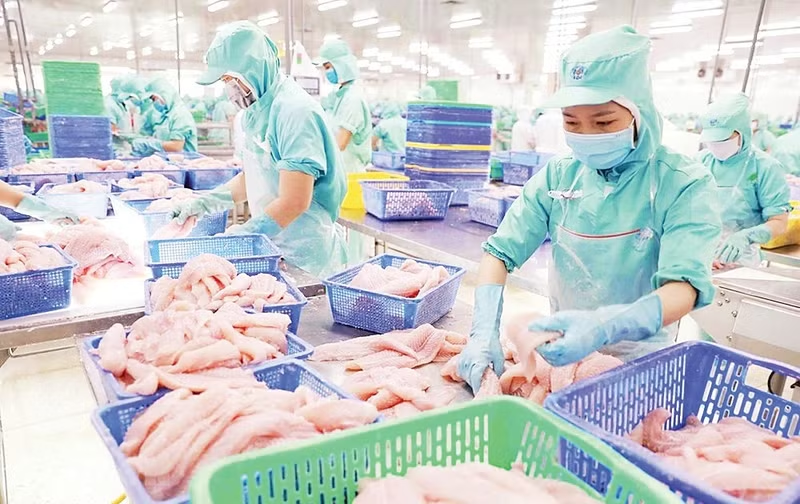
Not only have raw fish prices remained high, bringing profits of around 10,000 VND per kilogramme to farmers in Mekong Delta provinces such as Dong Thap and An Giang, but seafood production, processing, and export activities have also been performing strongly due to rising demand from major markets including China, the European Union (EU), ASEAN countries, and the Middle East.
Nguyen Huu Nghia, Deputy General Director of Go Dang Joint Stock Company, said: “In the first four months of 2026, the company exported more than 15,000 tonnes of seafood products, with pangasius fillets remaining the key product. Export value reached nearly 40 million USD, up 25 percent compared with the same period in 2025.”
According to Le Hang, Deputy Secretary-General of the Viet Nam Association of Seafood Exporters and Producers (VASEP), “National pangasius export turnover exceeded 200 million USD in April, up nearly 20 percent year-on-year, marking another month of double-digit growth since the beginning of the year. In the first five months of 2026, cumulative pangasius export earnings surpassed 900 million USD, reflecting the strong growth momentum of this flagship product.”
As one of Viet Nam’s strategic aquaculture industries, pangasius contributes significantly to export earnings while providing livelihoods for tens of thousands of households. In 2025, the country’s pangasius farming area expanded to more than 5,500 hectares, producing around 1.7 million tonnes, and generating nearly 2.2 billion USD in export revenue.
Despite these achievements, the sector continues to face major challenges, particularly in ensuring fingerling quality and mitigating disease risks.
Addressing “bottlenecks” of fingerling quality and disease
In aquaculture, fingerlings play a decisive role in determining survival rates, growth performance, disease resistance, and environmental adaptability. The pangasius sector currently maintains approximately 2,000 hectares dedicated to fingerling production, supplying between 4 and 4.5 billion fingerlings annually.
However, during the 2024–2025 period, localised shortages of fingerlings led to sharp price increases, directly affecting the commercial farming chain. Climate change, increasingly unpredictable weather patterns, and complex disease outbreaks have reduced fingerling survival rates, which at times fell to only 5–15 percent. Some farming areas reported significant mortality among fish less than 30 days old.
To improve the quality of pangasius fingerlings, Tran Huu Phuc, Deputy Director of the Southern Freshwater Aquaculture Research Centre under the Viet Nam Fisheries Science Institute, stressed the need to combine genetics, hatchery technology, and nutrition.
It is necessary to improve breeding efficiency by integrating traditional selection methods with gene technologies to enhance accuracy and maintain genetic gains. Hatchery management should also be restructured towards stricter environmental control and stronger biosecurity measures. At the same time, comprehensive nutritional strategies should be applied throughout the production cycle, from broodstock to fingerlings. The synchronised implementation of these solutions will provide a solid foundation for the sustainable development of the pangasius industry,
Tran Huu Phuc,
Deputy Director of the Southern Freshwater Aquaculture Research Centre under the Viet Nam Fisheries Science Institute
Dong Thap Province is the largest pangasius-producing locality in the Mekong Delta, with approximately 2,500 hectares of farming ponds contributing around 35 percent of the nation’s total output. The province is currently accelerating the restructuring of the industry through high-technology applications.
According to leaders of the Dong Thap Fisheries Sub-Department, the province is promoting technological applications across the entire value chain, from fingerling production to commercial farming. Efforts are focused on utilising genetically improved broodstock and increasing the availability of high-quality fingerlings. Dong Thap is also pursuing the development of salt-tolerant pangasius to expand farming areas, while integrating digital transformation through solutions such as AI-based feeding monitoring systems and environmental management robots.
As the world’s leading exporter of pangasius, Viet Nam’s industry still holds considerable growth potential, supported by favourable government policies and continuous innovation in technology and management.
With the commitment of the Ministry of Agriculture and Environment, together with the active participation of local authorities and businesses, this billion-dollar sector is expected to make a significant leap forward during the 2026–2030 period, paving the way for more sustainable and efficient development in the years ahead.