No longer just a manufacturing base
Data from the National Statistics Office (NSO) show that in the first seven months of 2026, foreign investment into Viet Nam continued to grow strongly, reaching more than 38 billion USD, up 58% year on year. Of this, 2,429 newly licensed projects were registered nationwide with total capital of more than 21 billion USD – the number of projects up 7.8% and registered capital up 2.1 times year-on-year.
Additional capital injected into existing projects reached 10.43 billion USD, up 4.4%, while capital contributions and share purchases totalled 6.58 billion USD across 1,815 transactions, up 61.6%. Notably, disbursed foreign investment was estimated at 15.2 billion USD, up 11.8% year on year – the highest first-seven-month figure in five years.
Commenting on capital flow trends, Phi Huong Nga, Head of the Industrial and Construction Statistics Division under the NSO, said the structure of investment was shifting in a positive direction. Previously, manufacturing consistently ranked first among sectors, followed by real estate. Now, electricity and gas production and distribution have moved into second place, with their share continuing to increase.
The growing number of foreign-invested projects in new energy is expected to support Viet Nam’s gradual transition from traditional to green and renewable energy, helping meet stricter environmental protection standards and reduce greenhouse gas emissions.
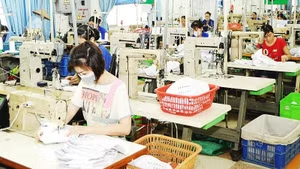
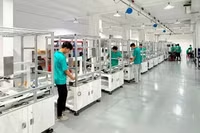
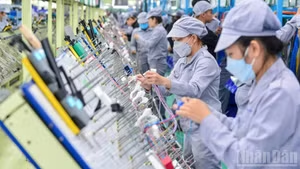
Notably, foreign investment in manufacturing, which has consistently accounted for more than 50% of total foreign investment in Viet Nam, is also shifting from labour-intensive industries such as footwear and garments to high-tech sectors such as semiconductors and electronics.
This shift is expected to help Viet Nam gradually move beyond its role as a low-cost contractor and processor and advance to a higher position in global production chains.
Bui Thu Thuy, Deputy Director of the Foreign Investment Agency under the Ministry of Finance, said that in the new context, attracting foreign investment was no longer simply about securing financial resources, but about attracting high-quality capital accompanied by technology, management skills, operational experience and the ability to connect with global value chains.
Closely following the Party and State’s orientation towards developing the foreign-invested economic sector in a quality-driven, effective and sustainable manner, the Ministry of Finance has proposed a range of special mechanisms and policies for the current strategy of attracting foreign capital.
These include mechanisms to promote technology transfer, increase spillover effects and strengthen linkages with the domestic economy; attract investment in research and development centres, operations centres and innovation hubs; provide incentives for strategic investors and priority industries and sectors; and support the development of a high-quality workforce.
Driving force for a new development model
According to economic experts, after 40 years of attracting foreign investment, Viet Nam no longer needs to attract as much external financial capital as possible. Instead, it is redefining the role of a new generation of capital, marking an important shift from a mindset of attracting foreign capital to one of using it to upgrade the economy.
The foreign-invested sector is an additional resource for development investment and a driving force for transforming the country’s development model in the new era.
Professor Tran Tho Dat of the National Economics University said this was precisely how Viet Nam could participate in global value chains at a higher level during its new stage of development.
To improve the quality of foreign investment attraction, the Foreign Investment Agency said Viet Nam was focusing on four key, coordinated groups of solutions: improving institutions and policies, continuing infrastructure investment, addressing human-resource bottlenecks, and implementing other support measures.
In particular, the continued review, amendment and improvement of the investment legal framework towards greater consistency, transparency, stability and predictability is a crucial task as the global minimum tax is fundamentally changing traditional investment incentive mechanisms.
This requires Viet Nam to shift decisively from tax incentives towards investment support mechanisms based on actual costs, such as infrastructure, human resources, research and development (R&D), and innovation.
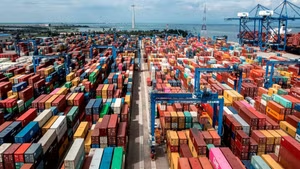
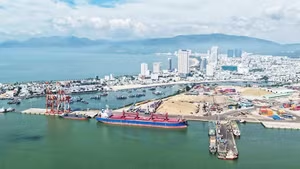
Regarding infrastructure solutions, the Vietnamese government continues to prioritise investment in strategic infrastructure, particularly transport, energy and logistics, linked to key industrial and economic corridors to reduce transport costs and improve supply-chain connectivity.
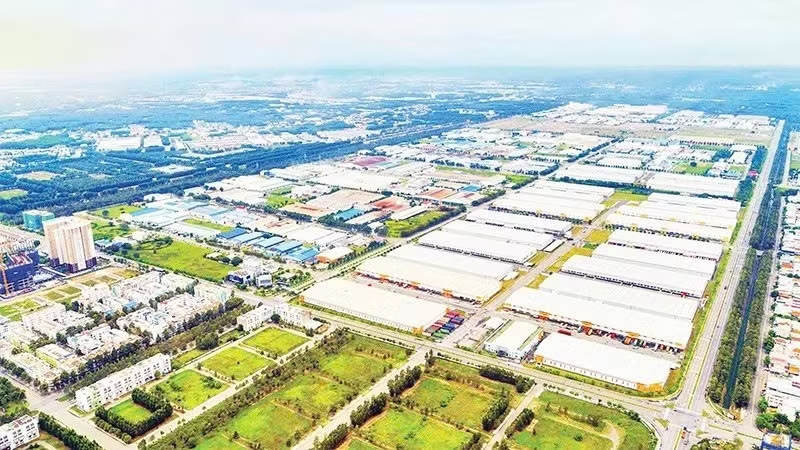
Many localities are also establishing and developing integrated industrial-urban-logistics service clusters in key economic regions, creating space to attract large-scale and concentrated foreign investment.
The government is also focusing on accelerating renewable energy development in line with the green-transition requirements of multinational corporations and the trend towards sustainable investment, thereby ensuring a stable and long-term power supply for high-tech industries, data centres and the semiconductor industry.
At the same time, Viet Nam is strengthening links between educational institutions and foreign-invested enterprises, introducing demand-driven training mechanisms in semiconductors, information technology, electronics and AI, and improving mechanisms for attracting and employing foreign experts.
The European Chamber of Commerce in Viet Nam (EuroCham) noted that skilled labour was one of the three biggest challenges facing businesses as Viet Nam prioritises attracting and developing high-tech industries.
Dr Phan Huu Thang, former head of the Foreign Investment Agency, said that at this critical turning point, Viet Nam’s sustainable competitive advantage needs to be built on institutional quality, with a transparent legal environment, a professional administrative apparatus, policy predictability and the capacity to protect investors’ legitimate rights and interests.
This is considered crucial to achieving the target of attracting 40-50 billion USD a year in foreign investment during 2026-2030, raising the average localisation rate in key industries to 45-50% and striving to have around 10,000 domestic enterprises participate in global value chains, as set out in Resolution 10.





![[Infographic] GRDP growth scenarios for 34 provinces and cities in fourth quarter of 2026](https://en-cdn.nhandan.vn/images/nyM650OGFWrOVWc-xajqN-rTZ68Rlmc1fiGJOhBRYHFSa4DhrHNDxEFdnz313Vk5dNJuxdkHglPA3rLeaPeiaUheNuCI723k2lNssd-YLJuKR58epWq7s21lV5WjM-HR2-Qpbi4MwAzqt9wRjL4WjGkfEz7RO9qhcwg8o8LQFK8/grdp-growth-scenarios-for-34-provinces-and-cities-in-q42026-anh-dai-dien.jpg.avif)