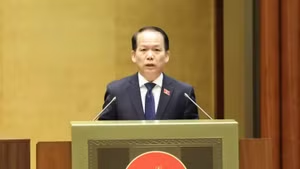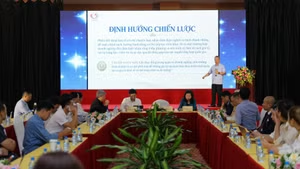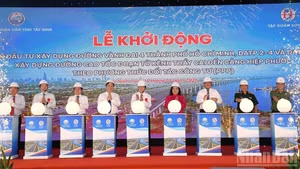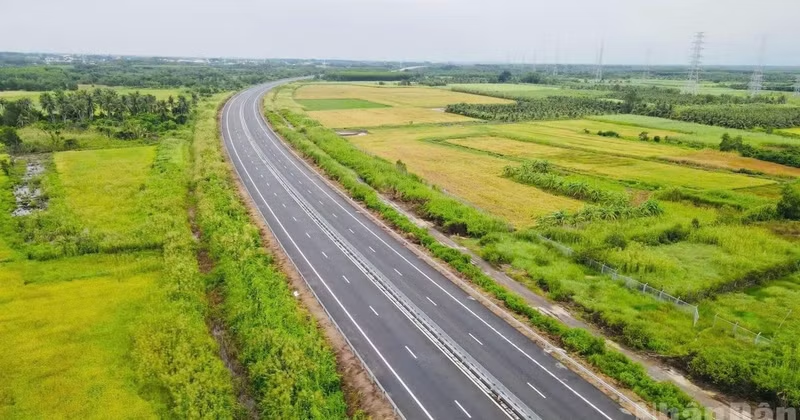
On September 29, the Ministry of Construction held an investment promotion conference on expressway development for the 2026–2030 period in Ha Noi, aimed at effectively mobilising social resources towards building a synchronous and modern expressway network.
According to Minister of Construction Tran Hong Minh, for the 2026–2030 period, the 14th National Party Congress has set a target of average annual GDP growth of more than 10%. To achieve this goal, the expressway system needs to continue to stay one step ahead, opening up new development space, strengthening regional connectivity, shortening distances, reducing logistics costs and enhancing the economy’s competitiveness.
The consistent policy of the Party and State regarding investment and the mobilisation of non-budget capital is to maximise resources from across society and diversify funding channels, with the private sector identified as an important source of capital alongside public investment.
Since the Law on Public-Private Partnership (PPP) took effect, investment policies have been approved for 30 PPP projects with total investment of around 1.3 quadrillion VND.
According to calculations by the Ministry of Construction, Viet Nam is expected to build nearly 2,830 kilometres of new expressways and expand or upgrade nearly 1,200 kilometres of existing expressways during the 2026–2030 period, requiring total investment of nearly 1.3 quadrillion VND.
So far, around 423 trillion VND has been secured through the State budget and investor commitments, leaving approximately 846 trillion VND still to be mobilised.
To attract additional non-budget resources, the Ministry of Construction has identified 29 priority expressway projects for investment promotion under the PPP model during 2026–2030, based on approved planning and priority principles. Their combined investment is estimated at nearly 923 trillion VND.
Le Thang, Director of Project Management Unit No. 2 under the Ministry of Construction, said expanding the eastern North–South Expressway to six lanes is necessary not only to meet transport demand but also to generate broader spillover effects across the economy.
Preliminary calculations indicate that the project could stimulate approximately 235.5 trillion VND in economic output, generate 80.1 trillion VND in added GDP value and create around 179,000 direct and indirect jobs.
“To maximise investment efficiency, 15 component projects, totalling 966 kilometres and already completed with public investment along the eastern North–South Expressway, will be consolidated into two larger component projects based on geographical areas for investment under the PPP model in the form of build-operate-transfer (BOT) contracts,” Thang said.
He added that reorganising the component projects geographically under the PPP and BOT models is intended to enhance investment efficiency and provide a foundation for expanding the eastern North–South Expressway to six lanes.
According to several businesses directly involved in PPP projects, Resolution No.68-NQ/TW on private-sector development, issued by the Politburo on May 4, 2025, has introduced a new approach to the private economy: rather than merely participating in the market, the private sector is expected to work alongside the State in organising and developing the economy.
In the transport sector, effectively mobilising private resources could significantly ease pressure on the State budget. However, private-sector mobilisation should not simply be understood as identifying projects and then leaving businesses to conduct studies and arrange financing on their own.
Experts said the early completion of the expressway network is an urgent requirement for socio-economic development. Given limited State budget resources, mobilising non-budget capital is therefore particularly important.
However, major challenges remain, including financial risks and access to credit, pressures related to site clearance and resettlement, and price fluctuations. A lack of readily available contingency funding and cumbersome procedures for supplementing State capital to compensate for revenue shortfalls can also leave investors facing considerable short-term payment pressures.