The move is regarded as a decisive step towards translating into practice the spirit of the Politburo’s Resolution No.57-NQ/TW on breakthroughs in science, technology, innovation and digital transformation. Across the programme’s orientations and implementation measures, the business community is positioned at the core, playing a decisive role in bringing core technologies from laboratories to global markets.
Placing businesses at the centre of the ecosystem
The programme’s overarching goal is to master, develop, refine and commercialise highly competitive strategic technology products, gradually enabling Viet Nam to participate more deeply in global value chains. To realise this vision, the establishment of a strategic technology ecosystem based on close linkages among the three key stakeholders of the State, businesses, and science and technology organisations is considered essential, with businesses serving as the principal actors in technology application and commercialisation.
To lay a solid foundation for economic breakthroughs in the new era, the programme sets out a systematic roadmap with specific milestones aimed at developing a group of strategic technology enterprises capable of serving as industry leaders. During the 2026–2030 period, the focus will be on nurturing and developing at least 20 enterprises capable of mastering core technologies and strategic products by directly undertaking national-level tasks.
Of these, at least five are expected to become leading enterprises capable of bringing Vietnamese products into global value chains, while raising the localisation rate of commercial products to around 40%. For the 2031–2035 period, the programme aims to expand this pool to at least 30 enterprises with full autonomy in technologies and products. At least 10 are expected to attain global reach, proactively participating in and establishing their positions within global value chains.
To help businesses overcome the “valley of death” in the commercialisation of high-tech products, the programme sets out a series of strong measures addressing markets and product uptake. Accordingly, the State will encourage government agencies, public service units and enterprises to prioritise the commissioning, procurement, leasing and use of strategic technology products developed under the programme.
Alongside policies to support trade promotion and connect supply with demand, the programme places particular emphasis on establishing linkages from the task-design stage. Encouraging the identification of enterprises that will receive, test or commercialise technologies from the project-registration stage will help ensure that research closely reflects practical needs and prevent research outcomes from simply being “left on the shelf”.
Another important feature of Decision No. 1493/QD-TTg is its technology diffusion model. The Government encourages strategic technology enterprises, particularly lead firms in value chains, to proactively cooperate with small and medium-sized enterprises, research institutes and universities. Such cooperation will span research and development, testing, refinement and technology transfer, thereby fostering interconnected strategic technology production chains under Vietnamese brands.
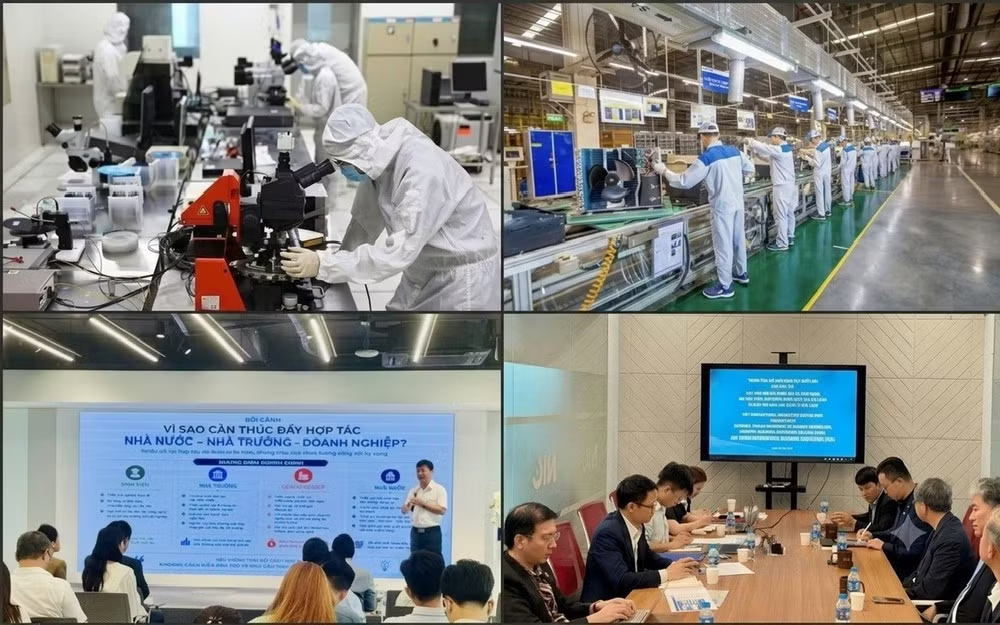
Businesses will also serve as an important practical environment for human resource development. The programme encourages tripartite cooperation among enterprises, research institutes and higher education institutions in training and developing high-quality human resources, while attracting chief engineers, leading experts and outstanding scientists to participate directly in key projects.
Decision No. 1493/QD-TTg not only demonstrates the Government’s determination to strengthen Viet Nam’s technological self-reliance, but also opens up major opportunities and entrusts the Vietnamese business community with a historic mission to master the strategic technologies of the future.
Party organisations as the leadership nucleus and the pioneering role of Party members
However, for the ambitious goals of Decision No.1493/QD-TTg and the orientations of Resolution No.57-NQ/TW to truly bear fruit at the grassroots level, the decisive factor lies first and foremost in the leadership capacity and combativeness of Party organisations within each enterprise.
Practice has shown that Party organisations in enterprises serve as the political “rudder”, providing strategic direction and a solid foundation for every technological breakthrough. By issuing thematic resolutions, Party organisations directly translate national science and technology goals into key production and business tasks, while establishing inspection and supervision mechanisms to ensure that research and development (R&D) resources are used effectively, transparently and for the right purposes. As core technology research invariably involves considerable risks and pressures, the steadfast support and political resolve of Party committees can foster a spirit of “daring to think, daring to act and daring to take responsibility” among executive boards and the entire workforce.
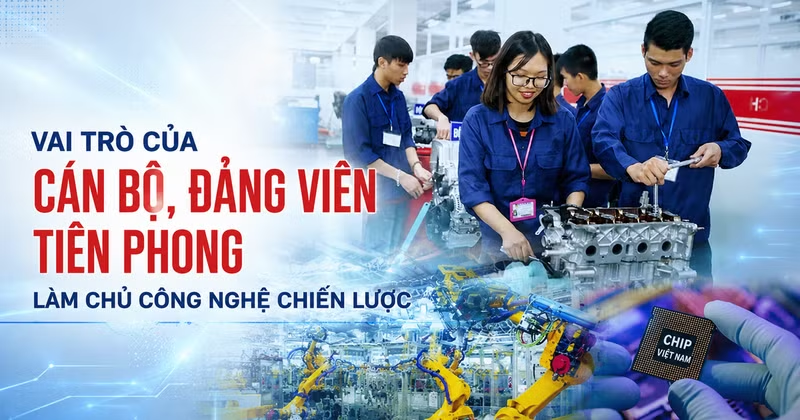
Alongside the enabling role of Party organisations, officials and Party members within enterprises serve as the “pioneers” who directly turn technological aspirations into reality. Whether working as managers, research engineers or operational workers, Party members must take the lead in mastering new knowledge and proactively undertake difficult tasks and explore new areas throughout the process of research, development and product commercialisation. Through a strong sense of responsibility, innovative thinking and exemplary conduct in the workplace, each Party member not only demonstrates a core professional role but also helps spread the spirit of innovation, connect colleagues and harness collective strength.
It can therefore be affirmed that Decision No. 1493/QD-TTg not only opens up major opportunities for the Vietnamese business community on its journey towards mastering strategic technologies, but also entrusts Party organisations and individual Party members within enterprises with a historic mission: to serve as the nucleus that brings people together, provides leadership, and transforms the major policies of the Party and Government into tangible technological products, thereby making practical contributions to the country’s technological self-reliance and the advancement of the national economy.
International lesson: China – From the “world’s factory” to a high-tech powerhouse
Over more than four decades of reform and opening up, China has undergone a profound transition from a labour-intensive economy towards a development model driven by science, technology and innovation.
During the early stages of industrialisation, China established itself as the “world’s factory”, underpinned by low-cost labour and large-scale production. However, following the 2008 global financial crisis, the limitations of this model gradually became apparent as labour costs rose, international competition intensified and dependence on external markets remained high. Seeking to enhance its position in the global economic order, Beijing proactively shifted its focus towards high technology and technological self-reliance, regarding them as vital to its development strategy.
This transformative shift was strongly advanced through a series of major national strategies. Foremost among them was the “Made in China 2025” strategy, launched in 2015, which marked a turning point in China’s ambition to move from a “manufacturing giant” based on scale to a “high-tech manufacturing powerhouse”. The strategy focused on 10 key sectors, including robotics, aerospace, advanced information technology, new-energy vehicles and biotechnology.
In parallel, the “Internet Plus” programme provided further impetus by integrating the internet, big data and artificial intelligence (AI) across the economy to accelerate national digital transformation. Building on these efforts, the “China Standards 2035” initiative emerged as another strategic step, reflecting the country’s ambition not merely to participate in, but ultimately to help shape, global technology standards in the digital era.
On that foundation, China has focused on developing standards for future technologies such as the Internet of Things (IoT), cloud computing, big data, 5G and AI which are core components of global strategic infrastructure. As a result, the country has achieved a number of significant milestones: its digital infrastructure has been fully localised, while the self-sufficiency rate of its semiconductor industry rose dramatically from almost zero to 40% by early 2025, according to the Global Times. These developments illustrate a fundamental shift in Beijing’s development thinking—from “manufacturing for growth” towards “mastering technology to lead”.
However, the rapid rise of Chinese technology corporations did not occur in isolation, but has been closely linked to a state-guided and state-enabled innovation ecosystem. In particular, strong connections among the State, research institutes and universities, venture capital funds and the start-up community have transformed Shenzhen, Hangzhou and Beijing into major innovation and growth hubs.
Systematic investment in core technology research, coupled with the development of high-quality human resources, has provided a powerful springboard for China to strengthen its position in the global technology landscape.
Lessons for Viet Nam
The experience of leading regional economies such as China and the Republic of Korea shows that the journey towards becoming a technological powerhouse has never been the result of chance or spontaneous market forces. Viewed against Viet Nam’s ongoing implementation of the Prime Minister’s Decision No.1493/QD-TTg, these experiences offer valuable theoretical and practical lessons, calling for a profound shift in both strategic thinking and implementation.
First and foremost, the State’s enabling role must be strengthened to shape a long-term strategic vision. High-tech industries and strategic technology sectors are inherently characterised by high risks, enormous investment costs and long payback periods. If left solely to market mechanisms, an economy can easily become trapped in low-value-added processing and assembly. The State must therefore pave the way and provide strategic direction through an ambitious industrial policy: identifying the right priority sectors, venturing boldly into the challenging domains of core technologies, and introducing breakthrough support mechanisms for leading enterprises. This is a crucial key to building technological self-reliance and strengthening the economy’s endogenous capacity.
At the same time, investment in research and development (R&D), education and training must be regarded as investment in the nation’s future. No country can master technology without a highly skilled workforce and independent R&D capabilities. International experience shows that R&D expenditure as a proportion of GDP is not merely an economic indicator, but also a measure of a nation’s political determination and development vision. To achieve breakthroughs in the new era, Viet Nam needs to concentrate resources on nurturing talent and fundamentally reforming technical and technological training programmes, while introducing exceptional mechanisms to attract leading experts and chief engineers to directly address the country’s major technological challenges.
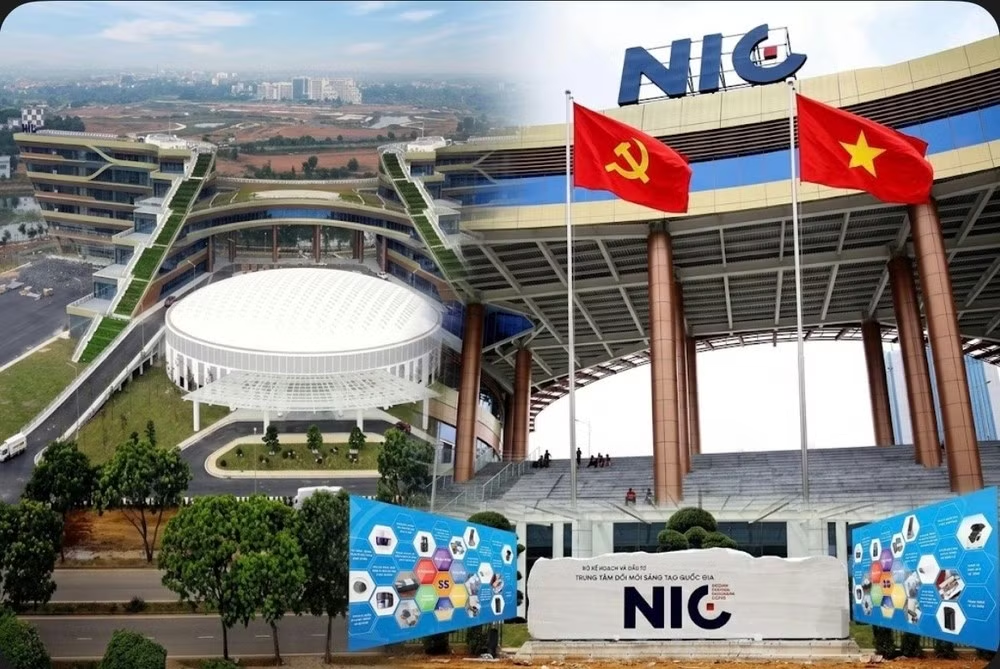
Effective implementation of the “three-stakeholder” linkage model is also a prerequisite for developing a coherent innovation ecosystem. The strength of a technological economy does not lie in isolated “islands” of research, but in the organic connections within a complete ecosystem.
Linkages among the State, businesses, and research institutes and universities must be elevated into a vital strategic partnership: the State creates an enabling institutional framework, proactively commissions projects and helps secure markets for their outputs; research institutes and universities serve as engines for generating knowledge and highly skilled human resources; and, most importantly, businesses are placed at the centre as the driving force for commercialisation, bringing technological products from laboratories to global markets.
However, for these strategic orientations to truly become a source of endogenous strength within each organisation, the leadership role of Party organisations and the pioneering spirit of individual Party members are decisive.
The reality has demonstrated that the close and steadfast leadership of Party committees within enterprises, research institutes and universities serves as a “compass” for translating the objectives of Decision No.1493/QD-TTg into concrete action programmes aligned with the realities of production and business. Party organisations must provide a firm political foundation, foster the spirit of “daring to think, daring to act and daring to take responsibility”, and give enterprises greater confidence to venture into high-risk R&D activities.
At the same time, every official and Party member, whatever their position, from managers and research engineers to workers on production lines, must genuinely serve as a pioneer in innovative thinking, strive to master new knowledge, and inspire creativity throughout the workforce.
Nguyen Thi Lam Giang, Director General of the Agency for Innovation, Green Transition and Industry Promotion under the Ministry of Industry and Trade, said that, in the spirit of the Politburo’s Resolution No.57-NQ/TW, Decision No.1493/QD-TTg and the Government’s consistent policies, the ministry has proactively developed a programme to support and promote smart manufacturing and digital transformation in the industrial and commercial sectors. The programme identifies smart manufacturing as the central “link” connecting digital transformation with green transition, thereby helping businesses enhance their competitiveness and make more efficient use of resources.
Explaining this mutually reinforcing relationship, Nguyen Thi Lam Giang said digital technologies provide powerful tools for businesses to measure and control emissions and optimise the use of raw materials and energy. Conversely, green transition standards create practical requirements and define specific indicators that can guide digital transformation along the appropriate pathway.
To translate these strategic orientations into practice, the Ministry of Industry and Trade is gradually completing a coherent policy framework that closely links climate change response and the circular economy with digital transformation. The Ministry’s Digital Transformation Plan for the 2026–2030 period, under Decision No.405/QD-BCT, and the Programme to Support and Promote Smart Manufacturing and Digital Transformation in the Industrial and Commercial Sectors through 2035 (Programme 2708) are regarded as two key policy pillars for translating macro-level objectives into businesses’ production activities.
Entering a new phase, Programme 2708 is being implemented on the consistent principle of placing businesses at the centre, linking digital and green transformation across value chains, while strengthening cooperation among enterprises, research institutes, universities and support organisations to build a robust smart manufacturing ecosystem.
Under the roadmap to 2030, the programme will focus on developing the necessary technical foundations by completing a readiness assessment index, a system of standards and a smart factory architecture framework, while developing a network of consultants. Notably, it aims to provide training to businesses on at least 1,000 occasions, assess the readiness of 500 enterprises, and support at least 200 businesses in successfully adopting smart manufacturing solutions. By 2035, the programme will be expanded to provide training on 5,000 occasions and support 500 enterprises in practical implementation.
To remove bottlenecks and ensure the substantive implementation of Programme 2708, the Ministry of Industry and Trade has identified four closely interconnected groups of key tasks.
First and foremost, the legal foundation must be prioritised through improvements to institutions, standards, technical regulations and reference architectures for smart manufacturing, thereby creating a robust legal framework for businesses to advance. Alongside this framework, particular emphasis is placed on people through human resource development and the fostering of a digital culture, with a focus on strengthening strategic thinking among business leaders and equipping workers with practical professional skills.
For technological solutions to take root, ecosystem development and expanded international cooperation will serve as important bridges for strengthening connections between technology supply and demand. To underpin this entire process, the final core task is to develop digital infrastructure, digital data and technology platforms that directly support businesses’ smart production and business operations.
Under this model, the Ministry of Industry and Trade serves as the coordinating body, mobilising diverse resources from the state budget, international cooperation and non-state sources. Industry associations act as bridges, while businesses themselves are both beneficiaries and proactive participants in implementing, evaluating and scaling up effective models. Concluding her presentation, the ministry representative emphasised that policies can only deliver their full impact when they are translated into businesses’ practical capabilities on a unified data platform.
The implementation of Decision No.1493/QD-TTg goes far beyond a conventional science and technology programme. In essence, it entrusts the Vietnamese business community with a historic mission. When the sound policies of the Party and Government are reinforced by the comprehensive leadership capacity of grassroots Party organisations and the pioneering commitment of individual Party members, Viet Nam has a solid foundation for realising its aspiration for national self-reliance and confidently advancing into a new era of national rise.