Numerous positive results
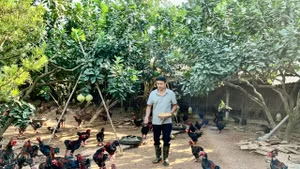
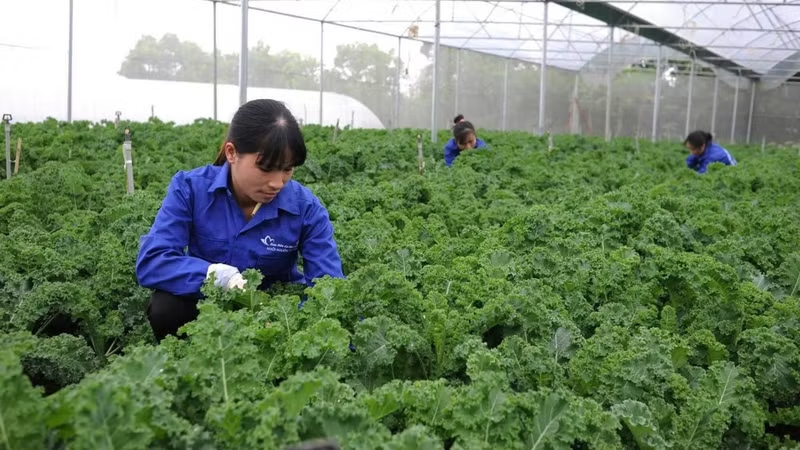
With an area of up to 20ha and organic certification under the strict standards of Viet Nam, the US, Europe (EU) and Japan, Hoa Vien Farm in Yen Xuan Commune is currently the largest organic vegetable production facility in Ha Noi. Hoa Vien Farm owner Truong Thi Kim Hoa said the farm began organic cultivation in 2013, mainly growing seasonal vegetables, indigenous vegetables and medicinal plants. Under the brand “Dai Ngan Organic Vegetables”, the farm supplies the market with 30-40 tonnes of various agricultural products each month. Hoa Vien’s partners are mainly clean food and premium food distribution chains.
In addition to the Ha Noi market, the farm’s products are also available in many other provinces and cities, including Quang Ninh, Hai Phong, Bac Ninh, Lao Cai and Hung Yen. Thanks to stable outlets and prices, Hoa Vien is creating regular jobs and ensuring stable incomes for about 100 local workers.
Organic agricultural production requires major investment in time, effort and discipline. According to Hoa, the farm’s production process must strictly comply with ecological criteria, from water sources, soil improvement, seed selection and organic fertilisers to pest and disease prevention and control measures. The farm also regularly sends agricultural samples to international laboratories to assess thousands of food safety indicators.
In recent years, more professional and systematic organic farming models like Hoa Vien have appeared in localities across the country. Ha Phuc Mich, Chairman of the Viet Nam Organic Agriculture Association, said that in 2018, the Government issued Decree No. 109/2018/ND-CP on organic agriculture. This created a solid legal framework as well as specific financial support policies, giving producers added momentum.
Before the decree was issued, only a few localities nationwide had implemented organic farming. Today, the model has spread widely across the country. Many provinces and cities have also proactively developed schemes and well-structured plans, thereby attracting strong interest and investment capital from businesses. Thanks to these coordinated advances, Viet Nam’s organic agricultural production area has increased 1.5-2 times compared with 2017.
According to the annual report published in 2026 by the Research Institute of Organic Agriculture (FiBL) in coordination with IFOAM - Organics International, Viet Nam’s organic agricultural land area had reached 125,045ha by the end of 2024, ranking fifth among the top 10 Asian countries with the largest organic production areas, after India, China, Kazakhstan and the Philippines.
Focusing on removing difficulties and obstacles
Despite notable achievements, the development of organic agriculture in Viet Nam still faces many difficulties and challenges. Specifically, production remains small-scale and fragmented; Viet Nam’s organic agricultural land area is still relatively modest, accounting for only about 1.07% of the country’s total agricultural land.
Human resources with knowledge of organic agricultural production have yet to meet demand, while there is still a lack of key programmes and commensurate investment to create breakthroughs for organic agriculture. In addition, standard-compliant inputs remain limited, production costs are high, value-chain linkages are weak, and outlets remain unstable.
Truong Thi Kim Hoa said that domestic sources of organic-standard seedlings and agricultural inputs remain very limited, meaning growers mainly have to import them at high cost. In addition to facing large initial investments, farms also have to bear considerable annual organic recertification costs.
Notably, although the State has introduced many policies to encourage the development of organic agriculture, especially vegetables, farms still find it difficult to access and benefit from these policies, particularly preferential loans.
The Ministry of Agriculture and Environment has set a target that by 2030, organic agricultural land will account for around 2.5-3% of total agricultural land, of which organic crop land will account for more than 2% of total crop land. The value generated from more than 1ha of organic crop land is expected to be 1.5-1.8 times higher than that of non-organic production.
To achieve these targets, Ha Phuc Mich, Chairman of the Viet Nam Organic Agriculture Association, recommended that competent agencies urgently review and comprehensively assess the development of organic agriculture in recent years, thereby formulating a development strategy that is appropriate and close to reality.
At the same time, it is necessary to strengthen the capacity of management officials and those directly engaged in production and business, issue more practical support policies, and promote the development of standard-compliant agricultural inputs. The certification process and the list of certification bodies, including both domestic and international organisations, should also be made public and updated every month so that people and businesses can access information more easily.



![[Infographic] GRDP growth scenarios for 34 provinces and cities in fourth quarter of 2026](https://en-cdn.nhandan.vn/images/nyM650OGFWrOVWc-xajqN-rTZ68Rlmc1fiGJOhBRYHFSa4DhrHNDxEFdnz313Vk5dNJuxdkHglPA3rLeaPeiaUheNuCI723k2lNssd-YLJuKR58epWq7s21lV5WjM-HR2-Qpbi4MwAzqt9wRjL4WjGkfEz7RO9qhcwg8o8LQFK8/grdp-growth-scenarios-for-34-provinces-and-cities-in-q42026-anh-dai-dien.jpg.avif)