Untapped potential for export growth
Viet Nam has set a target of achieving double-digit economic growth during the 2026–2030 period, reflecting a strong political determination. New-generation FTAs are regarded as one of the key drivers that could help the country realise this ambition.
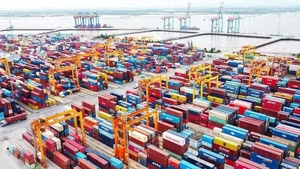
According to Ngo Chung Khanh, Deputy Director-General of the Multilateral Trade Policy Department under the Ministry of Industry and Trade, Viet Nam still has considerable room to expand exports and diversify markets through these agreements.
Three prominent agreements are the EU–Viet Nam Free Trade Agreement (EVFTA), the UK–Viet Nam Free Trade Agreement (UKVFTA), and the Comprehensive and Progressive Agreement for Trans-Pacific Partnership (CPTPP).
Viet Nam has already made relatively effective use of earlier bilateral and multilateral FTAs to access a range of markets. However, its export performance in several markets covered by new-generation FTAs, including the EU, Canada, Mexico, and the UK, remains modest.
Although these agreements have enabled many Vietnamese products to benefit from preferential import tariffs, which are gradually being reduced to almost zero under agreed schedules, Viet Nam's market shares remain relatively small.
For example, the EU imports approximately 2 trillion USD worth of goods annually, while Viet Nam's exports to the bloc amount to just over 50 billion USD, representing a market share of slightly more than 2%. Similarly, Canada's annual imports total around 700 billion USD, however, Vietnamese exports to the market stand at just over 7 billion USD, accounting for approximately 1%.
Amid global geopolitical uncertainties, Viet Nam faces both challenges and growing opportunities as international partners increasingly seek new markets and business relationships. Ngo Chung Khanh noted that many Vietnamese enterprises have yet to make effective use of FTA commitments. The biggest bottleneck lies in implementation, particularly compliance with rules of origin and technical standards, as well as the capacity of domestic businesses to meet these requirements.
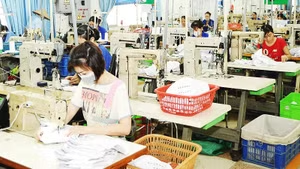
The textile, garment, and footwear industries are notable examples. Many enterprises have struggled to fully capitalise on FTA preferences because domestic value added remains relatively low and they continue to rely heavily on imported raw materials and components.
This is also why the utilisation rate of FTA tariff preferences, despite improving over time, has fallen short of expectations, currently standing at just over 35%.
According to Ngo Chung Khanh, the prime minister has repeatedly emphasised the need to diversify export markets and expand preferential market access arrangements. He described this as an appropriate approach in the current context, as negotiations with a wider range of partners could deliver early results and help unlock further export growth potential.
International resources can only be effectively harnessed when the country possesses sufficient internal capacity to absorb and transform them into drivers of faster and more sustainable development.
PHAM QUANG VINH — Former Deputy Minister of Foreign Affairs
Combining international resources with domestic strengths
At the national conference held in mid-June 2026 to study and implement Resolution No. 06-NQ/TW on implementing the foreign policy adopted at the 14th National Party Congress, Party General Secretary and State President To Lam highlighted a particularly important point: “No country can achieve rapid and sustainable development without engaging in international integration and cooperation.”
Commenting on this issue, Pham Quang Vinh, former Deputy Minister of Foreign Affairs, said international integration and cooperation are inseparable from the country's development process. While the signing of new-generation FTAs opens the door to major markets, Viet Nam's domestic strengths remain the decisive factor in determining its position when entering those markets. In the current context, he noted, this relationship needs to be viewed more concretely; harnessing external resources must go hand in hand with strengthening the country's internal capabilities.
According to Pham Quang Vinh, Viet Nam should first pursue a sufficiently proactive, flexible, and effective foreign policy to make the most of international resources, particularly those that meet higher standards, offer greater sustainability, and better align with the country's new development requirements.
At the same time, Viet Nam needs to restructure and strengthen the internal foundations of its economy, from institutions and infrastructure to human resources and business capabilities, to enhance its attractiveness to new flows of capital, technology, and knowledge. “Therefore, the key lies in combining internal strengths with external resources,” Pham Quang Vinh emphasised.
In fact, Viet Nam has established an extensive network of economic partnerships with major international partners by capitalising on the strategic advantages offered by new-generation FTAs. These agreements have created broader opportunities for economic cooperation in an increasingly fragmented world.
However, amid intensifying competition among major powers, the resurgence of protectionism and continued shifts in global supply chains, a highly open economy such as Viet Nam needs stable cooperation frameworks with clear rules and long-term commitments from major partners. In other words, new-generation FTAs provide Viet Nam with strategic opportunities to deepen its integration into the global economy and generate greater value for the country.
Strengthening capabilities for the country’s long-term development
Today, standards relating to green development, labour, rules of origin, intellectual property, and supply chain transparency are no longer confined to individual trade agreements. They have increasingly become established norms governing the global economy. Although Viet Nam has undergone a lengthy process of international integration and gradually fulfilled numerous commitments concerning climate change adaptation, emissions reduction, rules of origin, food safety, labour, and environmental protection, the challenge now is to adopt a more proactive approach rather than merely meeting external requirements.
According to Pham Quang Vinh, to make further progress, Viet Nam must regard these standards as intrinsic requirements of its economy and essential to the country's long-term development interests. This means that, to move into higher-value segments, the Vietnamese economy must become more transparent, greener, more digitally advanced, and better governed. Once these high standards are embedded in domestic capabilities, Viet Nam will be better positioned within global value chains.
“More importantly, Viet Nam must transform these FTAs into a strategic platform that enables Vietnamese enterprises to participate more deeply in global value chains, improve product quality, increase technological content, and gradually establish Vietnamese brands in international markets,” Vinh emphasised.
Ngo Chung Khanh further observed that: “To move into higher-value segments, Viet Nam must become an integral part of the global business ecosystem, particularly the networks of transnational corporations.”
This approach is also consistent with the spirit of Politburo Resolution No. 10-NQ/TW on the development of the foreign-invested economic sector. Accordingly, attracting foreign direct investment (FDI) in the new development period must prioritise quality, technology, innovation, digital transformation, and positive spillover effects on the domestic economy. FDI should become an effective channel for technology transfer and foster substantive linkages between foreign-invested enterprises and Vietnamese businesses.
If FTAs open the doors to international markets, FDI creates the channels for deeper economic integration, while the internal capabilities of domestic enterprises remain the decisive factor in determining Viet Nam's position within global value chains. When these three elements converge, Vietnamese products can move beyond trade-based advantages towards technological competitiveness, enabling the country to progress from market participation to establishing a stronger national position in the global economy.



![[Infographic] GRDP growth scenarios for 34 provinces and cities in fourth quarter of 2026](https://en-cdn.nhandan.vn/images/nyM650OGFWrOVWc-xajqN-rTZ68Rlmc1fiGJOhBRYHFSa4DhrHNDxEFdnz313Vk5dNJuxdkHglPA3rLeaPeiaUheNuCI723k2lNssd-YLJuKR58epWq7s21lV5WjM-HR2-Qpbi4MwAzqt9wRjL4WjGkfEz7RO9qhcwg8o8LQFK8/grdp-growth-scenarios-for-34-provinces-and-cities-in-q42026-anh-dai-dien.jpg.avif)