A wide network and export records
After four decades of reform and integration, Viet Nam has become one of the most open economies in the region. According to data from the Inter-Agency Steering Committee on International Economic Integration under the Ministry of Industry and Trade, as of mid-2026, Viet Nam has signed, implemented, and is negotiating approximately 20 free trade agreements (FTAs), 17 of which are in effect, including new-generation FTAs with high standards such as CPTPP, EVFTA, UKVFTA, and RCEP. This network connects Viet Nam with more than 60 countries and territories, accounting for about 90% of global GDP.
The actual results are very encouraging. According to the General Statistics Office under the Ministry of Finance, total import and export turnover of goods in 2025 reached 930.05 billion USD, an increase of 18.2% compared to the previous year — marking the highest level ever — with a trade surplus of 20.03 billion USD. Although they slowed down in 2023 due to declining demand in major markets, exports maintained high growth momentum during the 2021-2025 period, while the trade balance has remained in surplus for ten consecutive years.
This growth continued into the first half of 2026: Total import and export turnover for the first six months reached 549.69 billion USD, an increase of 27.1% compared to the same period, although the trade balance temporarily shifted to a deficit of 16.65 billion USD due to businesses increasing imports of raw materials and machinery for production.
Based on this foundation, the government aims for an export turnover increase of 15%-16% in 2026, reaching 546-550 billion USD, as stated in Government Resolution No. 01/NQ-CP (dated January 8, 2026) on the main tasks and solutions for implementing the socio-economic development plan and state budget estimates for 2026.
Exports, therefore, are identified as one of the pillars for realising the aspiration of double-digit growth. However, at a time when the scale is continuously reaching its peak, a strategic question needs to be asked: How much of the value that FTAs bring are we actually exploiting?
The "untapped potential"
The answer reveals a significant gap. The utilisation rate of tariff preferences through certificates of origin (C/O) by Vietnamese businesses currently averages only about 32%-33%, according to data on FTA utilisation announced by the Multilateral Trade Policy Department under the Ministry of Industry and Trade, in December 2025. In other words, more than two-thirds of goods exported to markets with FTAs have not yet benefited from the tariff preferences that businesses are rightfully entitled to.
Notably, even within the new-generation FTAs, the level of utilisation is very uneven. According to updated figures from the Ministry of Industry and Trade, the UKVFTA has achieved a preferential utilisation rate of approximately 38% and the EVFTA approximately 35% — slightly higher than the average — but the CPTPP is only about 16%. The CPTPP figures need to be examined thoroughly, partly because many markets within the bloc already have other FTAs with Viet Nam, so businesses choose the more advantageous C/O form, but the rest reflects the reality that many businesses have not yet met the strict rules of origin to "unlock" the preferential treatment. Even when some key export items achieve very high C/O utilisation rates, the absolute export value of this group remains modest.
Behind the low utilisation rate are two points to note. Firstly, export achievement still heavily depends on the foreign-invested sector: According to the General Statistics Office, in the first half of 2026, the domestic economic sector only contributed about 20.1% of total export turnover, while the FDI sector accounted for as much as 79.9%.
Secondly, the value content that the economy actually retains is limited; according to the World Bank's assessment, the domestic value-added ratio in Viet Nam's export goods is only 48.9%. When the majority of export turnover comes from processing, assembly, and imported raw materials, meeting the rules of origin to enjoy preferential treatment naturally becomes difficult, and the net value retained domestically is also thinned out.
Why haven't the preferential treatment been fully exploited?
The first and core reason lies in the rules of origin. This is the "legal key" of every FTA; goods only enjoy preferential tariffs if their origin can be proven according to the specified criteria. Meanwhile, many of Viet Nam's key industries still depend on imported raw materials and components, causing goods to fail to meet the domestic content threshold or the criteria for tariff classification change. The textile and garment industry is a prime example; as the leaders of the Viet Nam Textile and Garment Association have pointed out, the industry no longer has much room for extensive growth and is forced to proactively secure raw materials, increase the localisation rate, and add value.
The second reason is the capacity and information of businesses, especially small and medium-sized enterprises. Many businesses still lack understanding of specific commitments and the application process for certificates of origin (C/O) or are apprehensive about compliance costs; consequently, they accept paying taxes at the normal rate instead of exploiting preferential treatment. The development and positioning of the "Made in Viet Nam" brand in demanding markets has not received adequate investment.
The third reason stems from the new "rules of the game" of global trade. The increasing trend of protectionism, trade defence investigations, the risk of origin fraud, and increasingly stringent technical barriers, such as the Carbon Border Adjustment Mechanism (CBAM) — which officially entered full implementation on January 1, 2026 — the Environmental-Social-Governance (ESG) standards, and traceability requirements, are changing the nature of "preferential treatment." Tariff preferences are no longer an automatic right but are closely linked to the capacity to comply with green, transparent, and sustainable standards.
Turning the potential into a growth driver
To make the potential of FTAs a real driver for double-digit growth, several groups of solutions need to be synchronised.
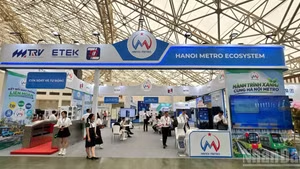
Firstly, perfecting the institutional framework and effectively operating the ecosystem to support the utilisation of FTAs. The formation of an FTA ecosystem connecting domestic and foreign entities, along with the promotion of digitalisation of the certificate of origin (C/O) issuance process and commitment lookup, will reduce compliance costs and shorten the gap between commitments on paper and actual benefits. This is also a concrete step in implementing the spirit of substantive institutional reform that the Party and State are promoting.
Secondly, developing supporting industries and increasing the localisation rate to meet rules of origin is crucial. This is the root solution: only when Vietnamese goods can proactively secure domestic or FTA-related raw materials and components, will they be eligible for preferential treatment and retain a larger share of value. The cumulation of origin mechanism in RCEP and other new-generation FTAs should be exploited as a tool to restructure regional supply chains in a way that benefits Viet Nam.
Thirdly, enhancing the capacity and role of the domestic economic sector is essential. Practical programs on legal, market information, and brand building support for small and medium-sized enterprises (SMEs) are needed, so that the domestic sector can gradually increase its share in export turnover and reduce dependence on the FDI sector.
Fourthly, proactively defend against trade fraud and control origin fraud. In the context of increasing protectionism, strengthening the capacity for early warning, responding to lawsuits, and preventing the misuse of Vietnamese origin to evade taxes is essential to maintaining the reputation of goods and protecting the preferential treatment that has already been gained.
Fifthly, greening to maintain preferential treatment. Meeting CBAM, ESG, and sustainable development standards should not be considered a burden but rather a condition for maintaining access to preferential treatment in high-end markets such as the EU. Linking the FTA utilisation with green transformation and digital transformation is the path to upgrading the growth model.
New generation FTAs have already opened "highways" to the global market. However, highways only realise their value when there are sufficiently good vehicles and competent drivers. Fully utilising the preferential treatment — instead of just expanding in scale — is the way to shift exports from extensive to intensive growth, thereby increasing domestic value and the resilience of the economy. This is also a solid foundation for realising the goal of sustainable double-digit growth in the country's new development phase.