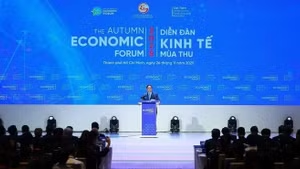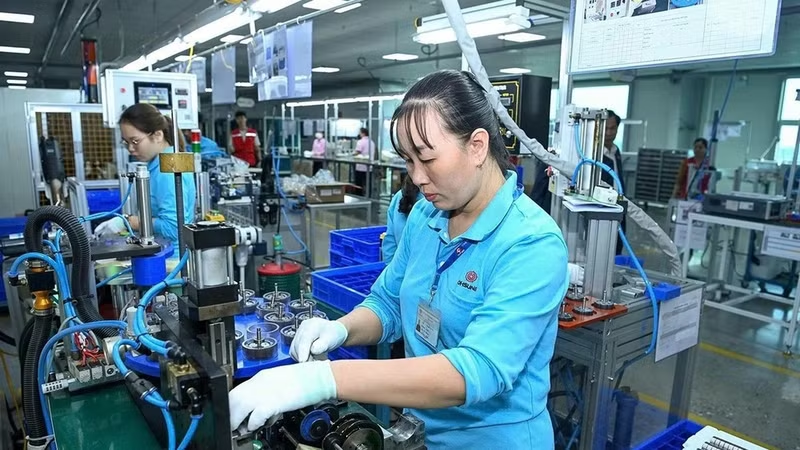
As competition to attract investment enters a new phase, Resolution No. 10-NQ/TW, dated June 8, 2026, issued by the Politburo on the development of the foreign-invested economy (Resolution 10), has marked an important shift in the approach and development mindset towards foreign investment cooperation.
Vietnamese enterprises at the centre
Resolution 10 identifies the foreign-invested economic sector as an important component of the national economy and calls for a strong shift from attracting investment capital to creating development value. Rather than treating the foreign-invested economy as a separate economic sector, the resolution places it within the broader national development ecosystem, comprising foreign-invested enterprises (FDI), domestic private enterprises, research and development entities, research institutes, universities, and innovation centres.
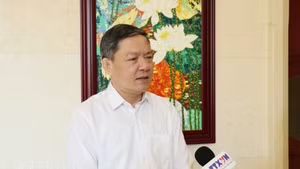
Dr Phan Huu Thang, Chairman of the Viet Nam Industrial Park Finance Association, said that with the adoption of Resolution 10, for the first time, the development of domestic enterprises had been identified as a central task of foreign investment policy, rather than merely an expected outcome of the investment attraction process. To achieve the set objectives, Thang proposed implementing a selective FDI model linked to technology transfer and domestic spillovers through a policy shift from an incentive-based mindset to conditional requirements.
High-tech, large-scale FDI projects should be required to meet three mandatory conditions: having a substantive technology transfer roadmap with specific verification mechanisms; establishing joint ventures and co-investing with Vietnamese enterprises; and maintaining close links with the domestic innovation ecosystem. Such institutional requirements are becoming increasingly urgent given the significant gap between FDI enterprises and domestic businesses.
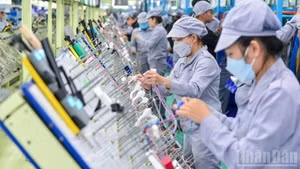
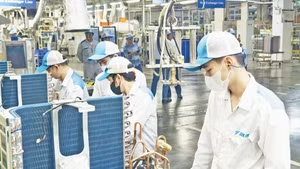
Specifically, FDI enterprises account for 80.7% of the country's total merchandise exports, while newly registered FDI capital has exceeded 50 billion USD, up 76.4% year on year. Disbursed capital has reached more than 21 billion USD, up 12.1%, marking the highest level for the first nine months of the year in the past five years.
Improving FDI attraction policies
According to Prof. Dr Nguyen Trong Hoai, senior lecturer at the University of Economics Ho Chi Minh City, to narrow the gap between the FDI sector and the domestic economy, policy priorities should shift from simply attracting FDI to improving the quality of linkages between FDI enterprises and domestic businesses through a legal framework established by the Government. FDI attraction should be linked to creating opportunities for domestic small and medium-sized enterprises to participate in supply chains and access technology transfers.
Hoai noted that the World Bank had emphasised the need to connect global enterprises with domestic suppliers, improve the business environment, and develop supply chain finance solutions. These measures would enable domestic businesses to gradually meet requirements for quality, technology, cost, and delivery times, thereby qualifying to become suppliers to multinational corporations. In this process, human resource training should be more closely aligned with business needs and global value chains to address the shortage of highly skilled workers.
This provides a basis for boosting productivity, increasing domestic value added in exports, and strengthening the economy's long-term competitiveness. Resolution 10 also sets out tasks to improve institutions and the investment and business environment, with a view to bringing about a breakthrough in cooperation with and the development of the foreign-invested economic sector.
Sharing the policy direction for incorporating Resolution 10 into the Law on Investment, Bui Thu Thuy, Deputy Head of the Foreign Investment Agency under the Ministry of Finance, said that future FDI attraction policies would not offer uniform, broad-based incentives or pursue projects based on scale and quantity alone.
Instead, incentives must be tied to investors' fulfilment of commitments on technology transfer, domestic supplier development, workforce training, and environmental protection. Projects delivering high socio-economic benefits will receive commensurate support, while unfulfilled commitments will be assessed and may lead to adjustments or the withdrawal of incentives. Policy priorities will also shift from investment management towards creating a favourable environment and establishing a unified national coordination mechanism, replacing competition among localities to attract investment.