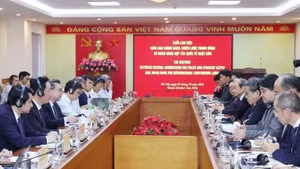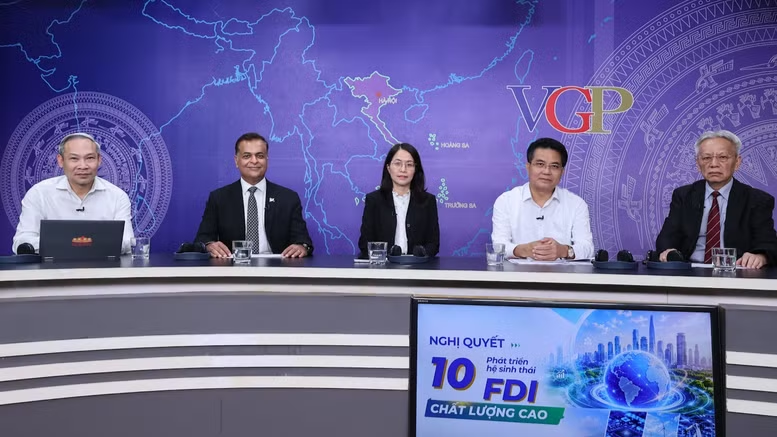
The seminar centred on four key questions: Why does Viet Nam need to rethink its approach to FDI? What FDI model is the country pursuing? What value should FDI create for the Vietnamese economy? And what will determine the successful implementation of Resolution No. 10?
From a regulatory perspective, Bui Thu Thuy, Deputy Director General of the Foreign Investment Agency under the Ministry of Finance, said Resolution No. 10 embodies six major shifts in development thinking.
The first is a transition from “attracting foreign investment” to “developing the foreign-invested economy”, reflecting a more comprehensive approach that encompasses direct investment, indirect investment, capital markets and international financial institutions. At the same time, the foreign-invested sector is recognised as an integral component of the national economy.
Another shift is from prioritising the scale and volume of investment capital to focusing on quality, efficiency and added value.
Third, the approach to investment incentives is being reoriented so that incentives are linked to actual outcomes, spillover effects, the application of advanced technologies and the capacity for technology transfer.
Fourth, Viet Nam is moving away from attracting individual FDI projects towards developing an integrated ecosystem that connects different sources of international capital.
Another important change is the transition from “investment management” to “creating an enabling investment and business environment”. Accordingly, alongside ensuring legal compliance, the State needs to ensure adequate technical infrastructure, high-quality human resources, a favourable business environment, sound governance and an appropriate institutional framework to strengthen the economy’s capacity to absorb high-quality investment flows.
According to Phan Duc Hieu, full-time member of the National Assembly’s Economic and Financial Committee, a notable feature of the new approach is that it is more systematic, comprehensive, substantive and grounded in practical realities. For FDI to generate meaningful spillover effects, Viet Nam must not only attract high-quality capital but also strengthen the economy’s “absorptive capacity”, particularly that of domestic enterprises. Improving the capabilities of Vietnamese businesses will both strengthen their linkages with the FDI sector and enhance the economy’s self-reliance.
A key issue receiving particular attention at the seminar was the linkage between FDI enterprises and domestic businesses. According to Bui Thu Thuy, after four decades of development, although the FDI sector has generated significant positive results, a considerable capability gap remains between foreign-invested and Vietnamese enterprises. Most domestic businesses are small and medium-sized, with limitations in capital, technology and management capacity, while relatively few are sufficiently prepared to participate in the supply chains of multinational corporations.
Meanwhile, FDI enterprises often bring established supplier networks with them when investing in Viet Nam. Technology transfer from multinational corporations to businesses outside their own operations also remains limited. This underscores the need for sufficiently strong policies to simultaneously strengthen Vietnamese enterprises and incentivise FDI companies to increase their use of domestic suppliers.
According to the representative from the Ministry of Finance representative, a key message of Resolution No. 10-NQ/TW is that the foreign-invested economy constitutes an important component of the national economy. The success of FDI enterprises therefore also contributes to the country’s overall economic development. The roles and responsibilities of the State, foreign investors and domestic enterprises need to be clearly defined. In particular, the State should focus on improving institutions and preparing strategic infrastructure and human resources to enhance Viet Nam’s capacity to absorb high-quality FDI.
Drawing on local experience, Le Quang Hoa said Hung Yen Province is working to develop industrial parks based on an ecosystem model. Rather than accommodating foreign enterprises alone, these industrial parks will also create opportunities for Vietnamese businesses operating in related industries to participate and gradually integrate into the supply chains of multinational corporations.
Representing the FDI business community, Binu Jacob, Managing Director of Nestlé Vietnam, said that the factors that drove success in the past would not necessarily guarantee success in the future. In its new stage of development, Viet Nam should seek investment commitments that are more long-term, sustainable and inclusive.
Policies may evolve as the country develops, but investors need to be able to see a clear roadmap for such changes. Uncertainty and unpredictable policy shifts are among the key concerns for long-term investors. In addition, linkages among FDI enterprises, domestic businesses, educational institutions and research institutes need to be further strengthened.
![[Infographic] GRDP growth scenarios for 34 provinces and cities in fourth quarter of 2026](https://en-cdn.nhandan.vn/images/nyM650OGFWrOVWc-xajqN-rTZ68Rlmc1fiGJOhBRYHFSa4DhrHNDxEFdnz313Vk5dNJuxdkHglPA3rLeaPeiaUheNuCI723k2lNssd-YLJuKR58epWq7s21lV5WjM-HR2-Qpbi4MwAzqt9wRjL4WjGkfEz7RO9qhcwg8o8LQFK8/grdp-growth-scenarios-for-34-provinces-and-cities-in-q42026-anh-dai-dien.jpg.avif)