However, alongside the efforts of businesses, the early completion of institutions, mechanisms and policies to promote the development of the marine economy is of great importance, creating a legal framework and favourable environment for resources to be unlocked and used effectively.
Mastering technology
At the Vietsovpetro port construction and fabrication yard (Vung Tau-Ho Chi Minh City), hundreds of engineers and workers are urgently carrying out construction works under the Dai Hung Nam Development Project, with the WHP-DHN wellhead platform as the key facility. Launched on October 3, 2025, the project has reached a number of important milestones, from fabrication, assembly, launching and transportation to offshore installation, demonstrating the organisational capacity, technological mastery and ability of domestic personnel to construct large-scale offshore oil and gas facilities.
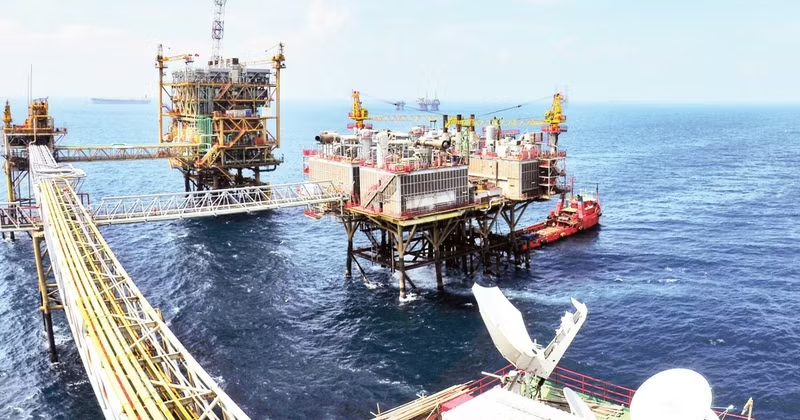
Nguyen Xuan Ninh, Director of the Nam Con Son Petroleum Exploration and Production Branch (PVEP-NCS), said that the WHP-DHN platform jacket has a total weight of approximately 8,000 tonnes, including piles, and was designed to suit deep-water conditions, integrating 11 well slots and a drilling support deck. This is a large-scale facility requiring high capacity in the design, fabrication, transportation and installation of offshore structures.
After nearly a year of construction and assembly using domestic human resources, the WHP-DHN jacket was successfully launched and installed at its offshore location at the Dai Hung oil field. Alongside the fabrication, transportation and installation of the jacket, the pipeline route-laying campaign serving the connection of WHP-DHN is under way, laying the groundwork for the connection and completion of the offshore system.
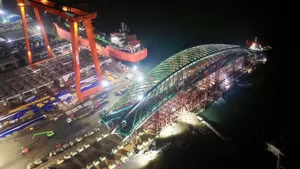
Recently, PTSC Mechanical & Construction Company (PTSC M&C), a subsidiary of PetroVietnam Technical Services Corporation (PTSC), successfully completed, launched and transported four offshore substations under the Baltica 2 Project. This marks the first time that offshore wind power products have been fabricated in Viet Nam and exported to Europe, opening up greater opportunities for Viet Nam's oil and gas mechanical services industry to participate more deeply in the global renewable energy supply chain. The project's success demonstrates the capacity of Vietnamese enterprises to undertake EPC contracts, while also marking a new stage in Petrovietnam's development in supplying equipment and services for offshore renewable energy projects.
Baltica 2 is an offshore wind power project jointly developed by Ørsted (Denmark) and PGE (Poland) in the Baltic Sea, off the coast of Poland. With a total capacity of approximately 1.5 GW, the project comprises 107 wind turbines and four offshore substations (OSS), each with a capacity of 375 MW, receiving electricity from the turbines and transmitting it to shore. From the fourth quarter of 2027, Baltica 2 is expected to supply electricity to around 2.4 million households in Poland, adding a large-scale source of renewable electricity and contributing to Europe's energy transition.
Completing institutions and policies soon
According to Petrovietnam leaders, in implementing Resolution No. 20-NQ/TW, the oil and gas industry has rolled out numerous solutions to promote production and business activities, contributing to the development of the marine economy. During the 2018-2025 period, the industry achieved a number of notable results. Total oil and gas output exceeded 155.2 million tonnes; 37.2 billion cubic metres of dry gas was supplied for power generation, with annual electricity output exceeding 53 billion kWh, equivalent to 33% of the country's total electricity generation; 60% of domestic petroleum demand and 70% of domestic fertiliser demand were met.
Petrovietnam's total revenue during this period reached 6.3 quadrillion VND; consolidated pre-tax profit exceeded 414.5 trillion VND; and contributions to the State budget amounted to 1.08 quadrillion VND. To date, the group has removed four of the five projects from the list of 12 troubled projects in the industry and trade sector. Key national projects are being actively implemented.
Previously, the oil and gas industry focused primarily on the traditional value chain, from prospecting, exploration and extraction to oil and gas processing. At present, the industry is gradually expanding into new energy fields such as offshore wind power, gas-fired power, hydrogen, green ammonia and other forms of clean energy. This is not merely an expansion of investment areas, but also a process of transforming the development model based on existing advantages in infrastructure, marine survey capabilities, a pool of experts and experience operating in the marine environment.
Sharing his views on these strengths, Ta Dinh Thi, Deputy Chairman of the National Assembly Committee on Science, Technology and Environment, stressed that the capabilities of oil and gas enterprises need to continue to be brought into full play, not only to serve traditional oil and gas activities but also to support the development of new energy industries. Against the backdrop of continued growth in the economy's energy demand, the role of oil and gas enterprises is increasingly linked to the requirement of ensuring national energy security. Expanding into new energy fields is also a way for enterprises to continue playing a core role in Viet Nam's energy system.
One of the bottlenecks in developing the marine economy is that mechanisms and policies have not kept pace with requirements, particularly for offshore energy and new marine economic sectors. Associate Professor and Doctor Ngo Tri Long of the Viet Nam Association of Financial Consultants said that mechanisms and policies should be completed soon in an inter-sectoral, synchronous and flexible direction, creating a legal framework for fields such as offshore wind power, hydrogen, and carbon capture and storage to develop. At the same time, decentralisation and delegation of authority should be strengthened, giving key enterprises greater autonomy in investment, partner selection and project implementation, thereby shortening the preparation and approval time for large-scale projects.