This shift is essential as Viet Nam confronts major changes in global supply chains. International corporations no longer seek only low‑cost factory locations; they require destinations where projects can operate stably, scale up, maintain quality, connect to regional markets and mitigate long‑term risk.
Investment choice is therefore a two‑way street. Viet Nam needs responsible investors with technology and long‑term commitments, while investors must see in Viet Nam a convincing environment in which to place capital, factories, R&D centres, regional headquarters or crucial links in global value chains.
Investors first consider the ability to control total costs across a project’s lifecycle. Tax incentives, land rents or labour costs remain relevant but are no longer decisive. A project is viable when a company can forecast logistics, energy, input, recruitment and training costs, as well as the extra expenses caused by protracted procedures, slow infrastructure connectivity or obstacles in planning, construction and customs. In today’s investment competition, firms seek places that enable predictable long‑term cost control, not just the lowest price today.
Alongside costs comes the demand for quality. High‑tech sectors such as semiconductors, digital devices, biomedicine, data centres or R&D cannot function effectively without stable power, standards‑compliant water, reliable digital infrastructure, testing services, and an engineering and technical workforce that meets requirements. Investors can bring technology, production lines and management processes, but they cannot alone build the ecosystem needed to sustain product quality and reputation in global markets.
The third factor is stability. Investors require a transparent, consistent and predictable policy environment. They must know whether initial commitments will be honoured, whether regulations will be applied uniformly, and whether planning will change without a clear roadmap. Every day lost to procedural delays, every trip between multiple agencies, every prolonged issue over land, power, water, construction or customs is a real cost that erodes confidence.
The most notable innovation in Resolution No.10‑NQ/TW is not only its demand for selective capital; it calls for a shift from attracting investment by administrative boundaries to attracting it by industry clusters, value chains and innovation ecosystems.
The most notable innovation in Resolution No.10‑NQ/TW is not only its demand for selective capital; it calls for a shift from attracting investment by administrative boundaries to attracting it by industry clusters, value chains and innovation ecosystems.
Rather than each locality chasing investors with isolated incentives, Viet Nam must organise development spaces capable of allowing an industry or value chain to form, operate and grow.
An industry cluster is not simply an industrial park housing many firms in the same sector. It must be a place led by anchor firms, supported by supplier networks, research institutes, training centres, logistics providers, financial organisations, digital infrastructure, public services and coordination mechanisms strong enough to create advantages that individual firms cannot achieve alone.
A more complete cluster means investors need to do less from scratch and Vietnamese firms have more opportunities to integrate into value chains.
From the priority sectors identified in Resolution No.10‑NQ/TW, Viet Nam can form six strategic industry clusters to attract the next generation of FDI. This is not a rigid geographic partition but a spatial strategy based on location advantages, infrastructure, human resources, regional linkages and a region’s development capacity.
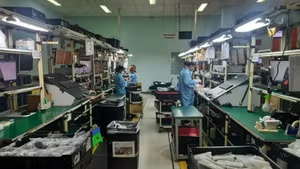
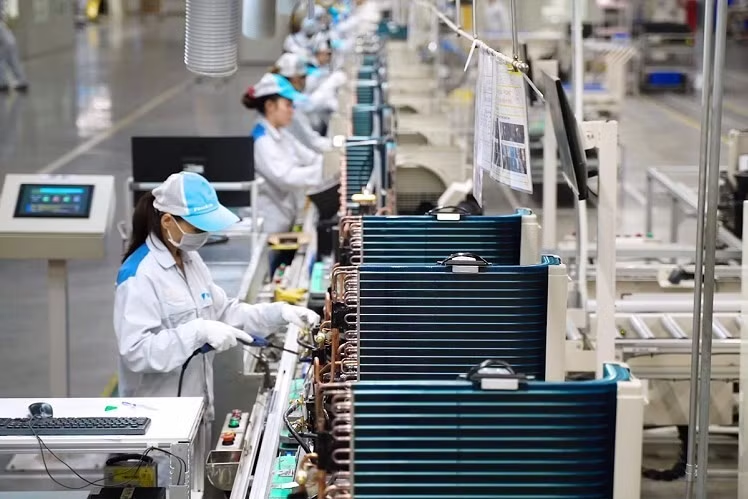
First is the electronics, semiconductor and digital devices cluster. This should not be confined to final assembly; it must evolve into an ecosystem covering design, testing, packaging, certification, component manufacturing, industrial automation, engineer training and supplier development. To attract high‑value projects, Viet Nam must ensure stable power supply, standards‑level technical infrastructure, specialised human resources and effective mechanisms to connect FDI firms with domestic enterprises.
The second cluster is artificial intelligence, big data, cloud computing, the Internet of Things and digital platforms. These sectors require little land compared with traditional industry but demand robust data infrastructure, computing capacity, cybersecurity, tech talent and legal frameworks. If well organised, this cluster can attract not only data centres and software firms but also R&D centres, operations hubs, shared services and activities with high added value.
Viet Nam can form six strategic industry clusters to attract the next generation of FDI. This is not a rigid geographic partition but a spatial strategy based on location advantages, infrastructure, human resources, regional linkages and a region’s development capacity.
The third cluster is advanced biotechnology and biomedicine. Viet Nam has strong demand for medicines, medical devices, diagnostics, functional foods, high‑tech agriculture and healthcare. To attract quality capital here, an ecosystem for research, clinical trials, testing, production, storage, distribution and specialised training must be developed. When these elements are synchronised, Viet Nam can shift from a consumer market to a regional centre for research, production and supply.
The fourth cluster is energy technology, advanced materials and green industry. With tightening standards on emissions, clean energy and traceability, this field is not only a new investment frontier but also essential for the competitiveness of many other industries. This cluster should link to renewables, energy storage, novel materials, energy‑saving equipment, recycling, circular economy solutions and emissions‑reduction technologies in manufacturing.
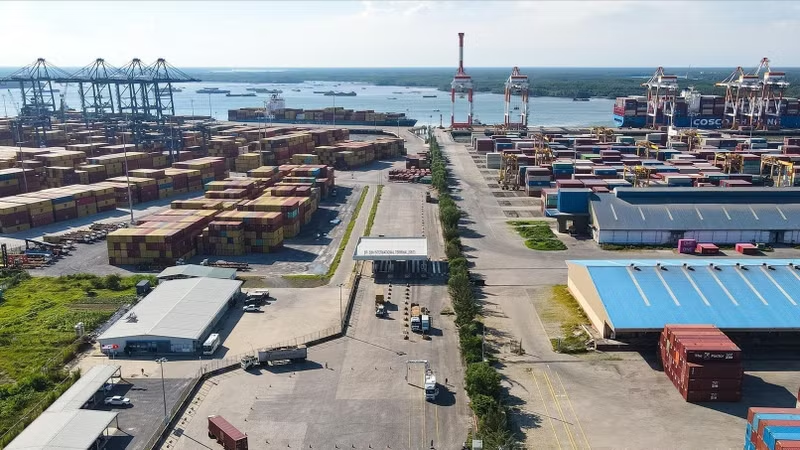
The fifth cluster is modern logistics and supply‑chain services. A strong industrial base cannot rely on disjointed transport routes, ports lacking connectivity or high customs costs. The logistics cluster should be organised around major transport nodes, connected to seaports, airports, expressways, railways, warehouses, distribution centres, digital customs and supply‑chain operation services. This cluster elevates the competitiveness of the entire economy, not only logistics firms.
The sixth cluster is finance, trade, innovation and high‑value business services. When a global corporation establishes a base in Viet Nam, it needs more than a factory but also an operations centre, a shopping centre, treasury, legal, advisory, financial, insurance, audit, design and other shared services. If Viet Nam organises a modern services ecosystem, it can attract not only FDI in production but also regional operational units and international financial flows.
These six clusters do not mean each region must specialise in only one field. Localities can participate in several clusters depending on real advantages. Some places will produce core components, others act as suppliers, training hubs, logistics providers or centres for research, data or finance.
Crucially, localities must not compete by lowering standards or creating a low‑wage incentive floor, but by linking together to complete an attractive, shared ecosystem.
Accordingly, the approach to attracting FDI must change. It should not begin by asking how much industrial land a locality has or how far taxes can be cut.
The right questions are: which missing links does the cluster need, at what stages can domestic firms participate, what skills must be developed, which infrastructure must be prioritised and which coordination mechanisms are required so projects do not stall during implementation.
Resolution No.10‑NQ/TW targets higher‑quality FDI through linkages, technology transfer, supplier development and deeper integration into global value chains.
These are also the conditions for retaining investors. A multinational may come for incentives, but will only expand when it sees a predictable business environment, capable local partners, an adequate labour pool and infrastructure ready to match project growth.
Resolution No.10‑NQ/TW targets higher‑quality FDI through linkages, technology transfer, supplier development and deeper integration into global value chains.
Vietnamese firms therefore cannot remain mere observers of production chains operating on their soil. Investment policy must be paired with measures to upgrade domestic firms in governance, technology, standards, finance, environment and order‑fulfilment capacity.
Viet Nam needs high‑quality capital. To prompt such capital to choose and commit long term, Viet Nam must demonstrate matching development quality. That is the profound meaning of shifting from attracting FDI by administrative boundaries to developing industry clusters, value chains and innovation ecosystems. Viet Nam is not merely inviting capital; it must create the conditions for good capital to root, spread and become part of the nation’s endogenous capability.
MSc. Nguyen Tuan Anh - Saigon Industry Corporation
MSc. Vu Thi Quy - Faculty of Economics, Society and Environment, Academy of Politics Region II