This is considered a key factor enabling Vietnamese businesses not only to meet customers’ immediate requirements but also to create opportunities for deeper participation in global value chains that are being restructured towards greater sustainability, flexibility, and lower emissions, in line with the long-term pursuit of sustainable development and the implementation of the strategic resolutions of the Party and Government of Viet Nam.
Garment 10 Corporation is actively implementing a smart management reporting system integrating key indicators such as revenue, production progress, and labour productivity. Data is continuously updated in real time, enabling the company's leadership to gain an overview of the operations of its units and make timely and appropriate management decisions. The smart reporting system helps reduce manual data consolidation at individual units, minimise errors during data collection, and shorten information-processing times, thereby improving workforce efficiency.
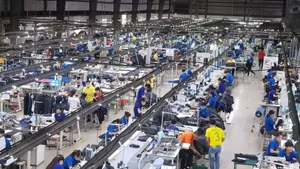
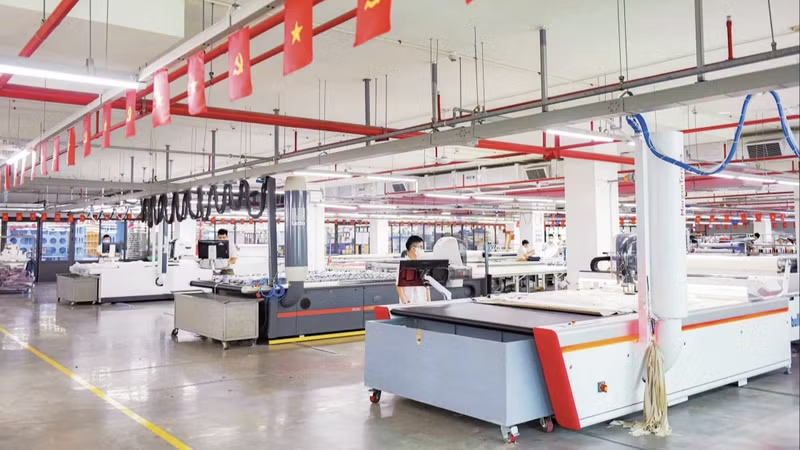
Alongside the digitisation of management data, the corporation is also deploying an integrated production and quality management system (GMES) at its production units. The system uses QR-code technology to monitor and control the entire production cycle, from input material management and warehousing to product quality monitoring. GMES is also integrated with the management reporting system, allowing real-time data updates and enhancing transparency in production management.
Garment 10 has also developed an asset management system (AMS) to centrally manage asset data across different categories and levels of management. The system helps standardise and clean asset data, reduce duplicate or unnecessary information, and optimise the use of existing assets. In addition, a range of modern solutions have been and are being deployed, including an upgrade to the Bravo financial and accounting software and the development of a digital working environment.
Garment 10 General Director Than Duc Viet affirmed that digital transformation remains a key priority for the company in enhancing management capacity and optimising production and business operations. In 2025, the company invested more than 5.41 billion VND and is expected to invest a further around 4.07 billion VND in 2026, demonstrating its commitment to building a comprehensive and long-term digital management platform. In addition, the company is promoting its green transformation programme by providing consultancy and implementing LEED “Green Building” certification at several member enterprises, including Hung Ha Garment, Hung Ha Veston, Thai Ha Garment, Ha Quang Garment, and Bim Son Garment.
At March 8 Textile One-Member Co., Ltd., completing a set of import and export documentation previously took four to five days. Following the digitisation of data, document coding and the integration of information into QR codes, processing time has been reduced to one to two days, improving labour productivity while reducing administrative workloads. The use of QR codes in product quality management allows customers to access comprehensive information on input materials, green certifications, and product quality. All data is stored over the long term, enabling the company to monitor quality consistency over many years while significantly reducing printing costs.
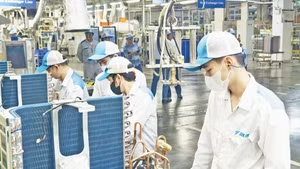
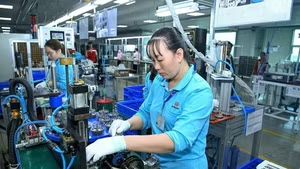
In production, March 8 Textile has invested in monitoring systems for ring-spinning machines, winding machines, and air-conditioning systems. The data is connected to central production management software, enabling 24-hour monitoring of production lines. As a result, tasks that previously required four to five workers to record and consolidate data can now be handled by just one or two people. Data is updated in real time, allowing the company to quickly detect and address emerging anomalies. “The economic benefits are clearly reflected in the company’s average reduction of 1 per cent in raw material consumption each month, equivalent to savings of around VND360 million in monthly production costs,” the leadership of March 8 Textile One-Member Co., Ltd. said.
Viet Nam’s textile and garment industry is facing mounting pressure in areas such as costs, productivity and delivery times, and especially new regulations and standards. Next-generation free trade agreements are opening markets while also requiring businesses to strictly comply with regulations on the environment, emissions, labour, and traceability. Global brands are shifting from “trusting reports” to “demanding data”. Textile and garment supply chains therefore need to become more transparent and capable of providing end-to-end information, from input materials to finished products. Businesses that fail to digitise their operations and turn them into data-driven processes will therefore find it difficult to maintain their position in supply chains.
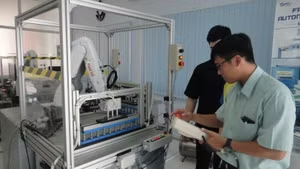
Viet Nam Textile and Apparel Association (VITAS) Chairman Vu Duc Giang said textile and garment businesses had rapidly adopted automation, robotics, and AI solutions, particularly amid shorter delivery times, stricter quality requirements, and intensifying price competition. As a result, Industry 4.0 equipment and technologies are becoming key factors helping businesses adapt to new purchasing practices adopted by global brands.
According to Le Tien Truong, Chairman of the Board of Directors of the Vietnam National Textile and Garment Group (Vinatex), the group has developed a comprehensive digital transformation model, including standardising Bravo financial and accounting software for its controlled entities and deploying industry management software for the spinning sector at seven production units within the system, as well as applying Power BI to production and business statistics and management.
In the next time, Vinatex will develop a four-layer digital architecture framework, comprising Layer 1 for digital infrastructure and cybersecurity; Layer 2 for data and core platforms; Layer 3 for applications and business operations; and Layer 4 for interaction channels, performance measurement and a digital management service model based on a two-dimensional service matrix: by industry (including spinning, weaving and dyeing, and garment manufacturing) and by function (including finance and accounting, human resources, production, and customer and market management).
The group will also develop internal policies governing the design, development, and management of digital products to ensure coordinated implementation from the parent company to key units using the group’s digital management services.