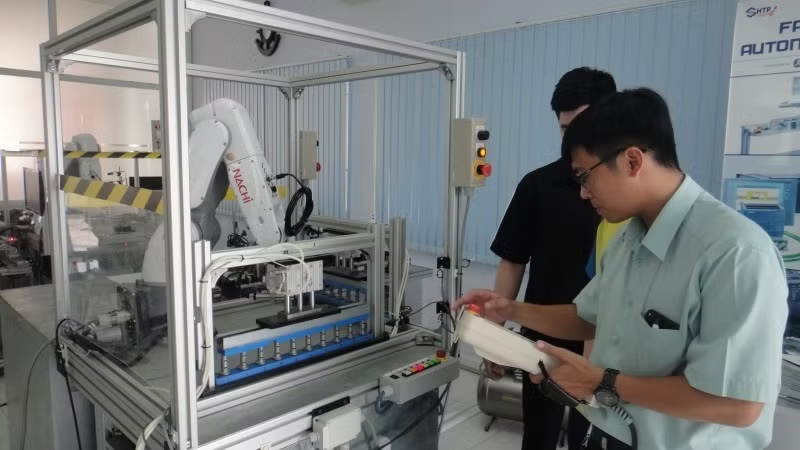
The merger of Ho Chi Minh City with two neighbouring provinces has opened up a larger development space, spanning a bigger economy, industrial base, urban area and maritime sector. The post-merger city’s economy is equivalent to about one-third of the national economy.
What matters is not merely the increase in scale but also how the strengths the three localities developed before the merger complement one another.
Ho Chi Minh City is strong in services, finance, trade, science and technology; Binh Duong has a solid industrial base and large-scale manufacturing; and Ba Ria-Vung Tau has advantages in the maritime economy, deep-water ports, energy and industry.
These strengths make it possible to reorganise the development space around closer links between production, services, logistics, research and markets.
Before the merger, however, separate administrative boundaries and coordination mechanisms meant that resources and complementary advantages had not been fully tapped within a unified development space.
Experts said Ho Chi Minh City previously faced pressure on land for production amid rapid urbanisation. Binh Duong, meanwhile, had a solid industrial base but needed to increase the share of higher-value industries. Ba Ria-Vung Tau, despite its considerable seaport advantages, needed to strengthen links between port operations and production, logistics and service chains.
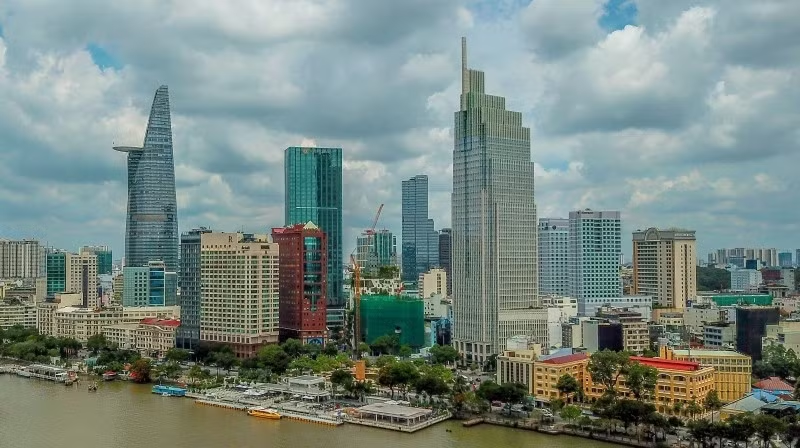
Bui Duy Hoang, a researcher at the Southern Institute of Social Sciences (SISS) in Ho Chi Minh City, said the merger had transformed the economic structure of the new city. Ho Chi Minh City’s former single-engine, service-led model had been replaced by one in which industry and services developed in tandem.
Hoang said this structural shift makes it possible to build a complete, integrated value chain, from energy, chemicals and basic materials (in the former Ba Ria-Vung Tau Province) to large-scale manufacturing (in the former Binh Duong Province) and on to research and development (R&D), finance, logistics and supply chain coordination (in the former Ho Chi Minh City). No other locality in Viet Nam had previously possessed all these elements.
However, potential does not automatically become reality. The question is which growth model the new Ho Chi Minh City should adopt to turn its greater scale and structural synergies into growth drivers capable of lifting it out of annual growth of 5-7% and achieving sustainable double-digit growth of 10-12%.
According to Hoang, to make the most of its new development space, Ho Chi Minh City needs to refine its governance model to match the scale of a major metropolis and coordinate more closely on planning, public investment, infrastructure and investment promotion.
Planning should link economic areas rather than organise development along former administrative boundaries. Transport, logistics, urban and industrial infrastructure, and innovation centres should be planned as one integrated system to improve connectivity and the allocation of resources.
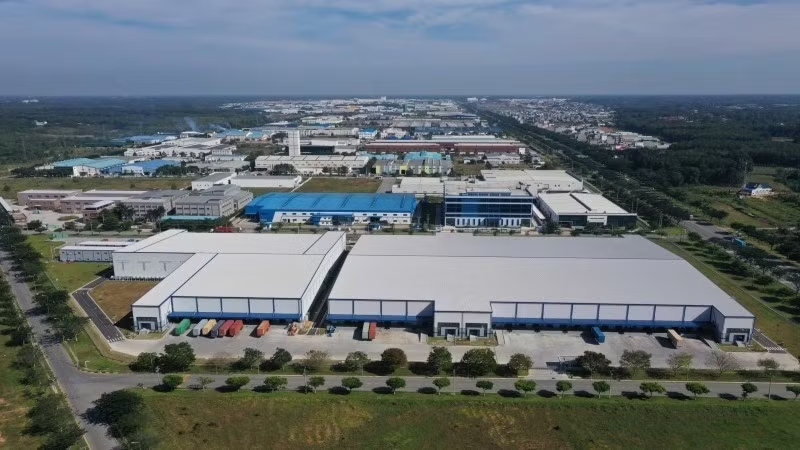
One proposed approach is to organise the development space around complementary value chains. The former Ho Chi Minh City area could build on its strengths in the knowledge economy, services, finance, and science and technology; the former Binh Duong area could develop manufacturing and high-tech industry; and the former Ba Ria-Vung Tau area could capitalise on its advantages in the maritime economy, seaports, logistics and energy.
Alongside this spatial reorganisation, connectivity infrastructure should be a key priority so that the entire value chain runs smoothly. By shortening distances between areas through integrated transport, logistics and digital infrastructure, the city can turn its advantages of scale into higher productivity and competitiveness.
As the growth model is restructured, science, technology and innovation need to be more closely tied to production and business.
Dr Hoang Thi Thu Huyen, a researcher at the SISS, said Ho Chi Minh City needed to strengthen links between R&D, production and technology commercialisation.
The priority should be not simply to increase research investment but, more importantly, to establish mechanisms that enable businesses to commission research, take part in it and bring its findings into production.
To this end, the city could promote joint R&D programmes involving universities, research institutes, high-tech parks and businesses, and develop shared laboratories, testing centres and intellectual property support organisations, creating a continuous pathway from research through testing and production to commercialisation.
Another requirement is to strengthen supporting industries and build closer links between foreign-invested enterprises and domestic businesses.
Investment promotion policies should place greater emphasis on projects that can help develop local supply chains, transfer technology, train workers and foster R&D cooperation. This would help domestic businesses move into higher-value segments of global value chains.
Following the merger, Ho Chi Minh City has gained a larger development space, greater scale and more diverse resources. Even so, these advantages will not automatically produce a new growth driver.
The challenge is to reorganise the development space, strengthen governance, improve infrastructure connectivity, promote innovation and develop a workforce suited to the new economic structure.
These are the foundations that will enable the city to steadily turn its advantages of scale into greater competitiveness and higher-quality growth.