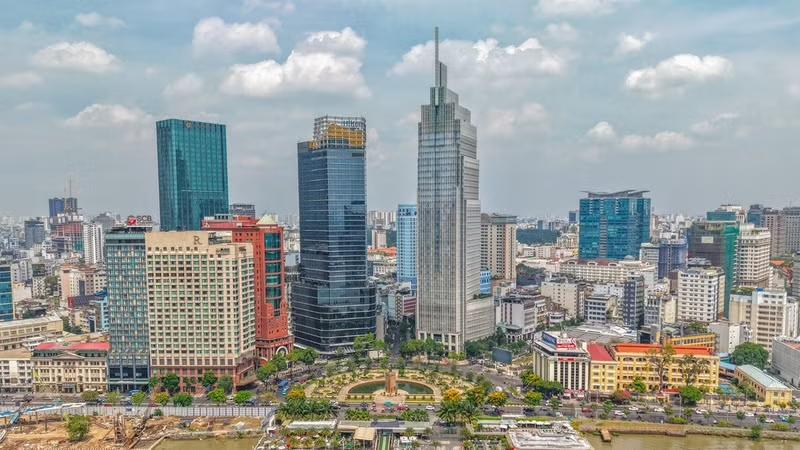
This was the second-largest rise globally in this edition, behind only Copenhagen (Denmark). Across two consecutive rankings in 2026, Ho Chi Minh City has climbed a total of 28 places, gradually affirming its position in the international financial network.
Outstanding growth, improved financial infrastructure
The GFCI 40 assessment showed that Ho Chi Minh City's overall score increased by around 4.1%, significantly higher than the global average increase of 0.8% and the Asia–Pacific average of 1.48%.
Within ASEAN, Ho Chi Minh City currently ranks fourth, behind Singapore, Kuala Lumpur, and Labuan. In FinTech, the city also climbed 12 places to 71st globally, with 645 points.
Notably, Ho Chi Minh City has retained its place among the 15 financial centres that experts and representatives participating in the international survey expect to increase in importance over the next two to three years.
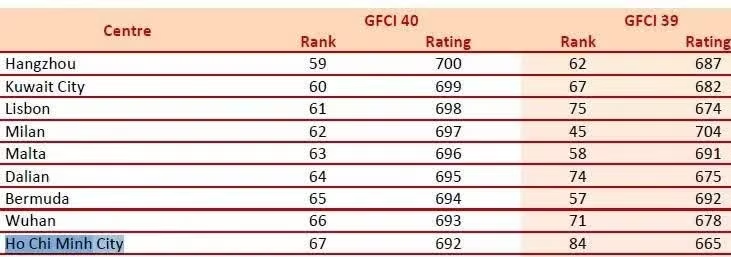
First appearing in the global ranking in 2022 at 102nd, the city has continuously improved its position through successive editions. The simultaneous increases in its ranking and score provide a stronger foundation for promoting the city's development prospects to international investors and financial institutions.
Commenting on the result, Richard McClellan, Chief Executive Officer of the operating agency of the Viet Nam International Financial Centre–Ho Chi Minh City (VIFC-HCMC), said: "VIFC–HCMC's rise to 67th, together with Viet Nam having two internationally ranked financial centres, is encouraging. But more important are the foundations that have been built, the quality of the financial ecosystem, and the ability to connect capital flows over the years ahead."
He stressed that the management agency understands that rankings may fluctuate from one edition to another, but VIFC–HCMC is being developed as a financial driver for Viet Nam's next stage of development, gradually bringing capital markets, banking activities, and asset management closer to international standards.
Expectations of turning confidence into substantive capital flows
The GFCI 40 is based on 144 quantitative factors provided by international organisations, combined with 39,531 assessments from 6,147 survey participants worldwide. Business environment, human capital, infrastructure, financial sector development, and general prestige are the core groups of criteria included in the analysis.
Ho Chi Minh City's rise in the rankings reflects the international community’s recognition of its efforts to improve the investment environment and enhance its overall competitiveness.
Alongside Ho Chi Minh City's breakthrough, this edition also saw Da Nang make its first appearance in the GFCI at 71st globally, giving Viet Nam two representatives in the international financial ranking for the first time. The simultaneous presence of the two cities provides an additional foundation for supporting regional financial integration.
Commenting on the future development direction, Marc Knapper, a member of the VIFC–HCMC Strategic Advisory Group and former US Ambassador to Viet Nam, said the 17-place rise was a positive signal, but a high ranking was not the ultimate goal. The real measure lies in the ability to turn increased investor confidence into substantive capital flows into the economy.
Marc Knapper stressed that achieving this goal requires close coordination between management agencies and market participants to develop a more predictable legal environment, strengthen investor protection mechanisms, develop deeper and broader capital markets, and improve the quality of the financial workforce in the time ahead.