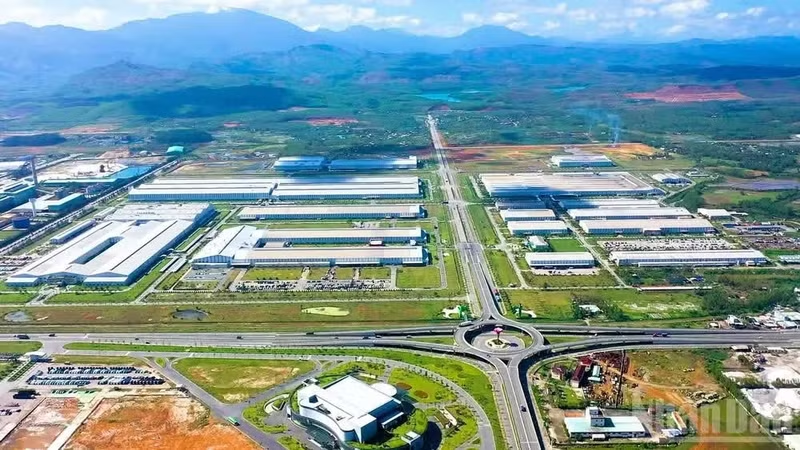
This reflects a trend in which foreign investors are moving away from fragmented, small-scale investments towards larger, high-tech manufacturing projects with greater strategic importance and longer-term prospects.
According to the National Statistics Office under the Ministry of Finance, total registered FDI in Viet Nam reached 34.65 billion USD in the first half of 2026, up 61% year on year. The manufacturing sector continued to be the main driver, attracting 18.47 billion USD, accounting for more than half of total registered FDI.
Notably, while the number of newly registered manufacturing FDI projects fell from 759 in the first half of 2025 to 468 in the same period this year, newly registered investment capital still reached 10.71 billion USD.
John Campbell, Director and Head of Industrial Services at Savills Viet Nam, said the most notable feature of the market in the first half of 2026 was not the decline in the number of projects, but the significant increase in investment scale. Viet Nam is currently attracting fewer new manufacturing projects, but these projects have higher values, greater technological content and a more important role in regional supply chains.
This trend is most evident in high-tech industries. The computers, electronics and optical products sector alone attracted more than 7.03 billion USD in newly registered manufacturing FDI in the first half of the year, accounting for nearly 66% of total new manufacturing FDI nationwide.
Although only 65 new projects were recorded, significantly fewer than the 99 projects recorded in the same period of 2025, total investment in the electronics sector surged 614%, from around 984.5 million USD to more than 7 billion USD. This shows that international corporations are increasing investment in high-value-added fields such as semiconductors, electronic components, precision engineering and advanced manufacturing.
Another prominent feature of the market is the increasing number of very large-scale projects. The three largest new manufacturing projects recorded in the first half of 2026 had a combined investment of up to 6.36 billion USD, accounting for nearly 60% of total newly registered manufacturing FDI. Notable among them were projects by Samsung Semiconductor Asia Holdings, Samsung Electro-Mechanics Viet Nam and LG Innotek Viet Nam.
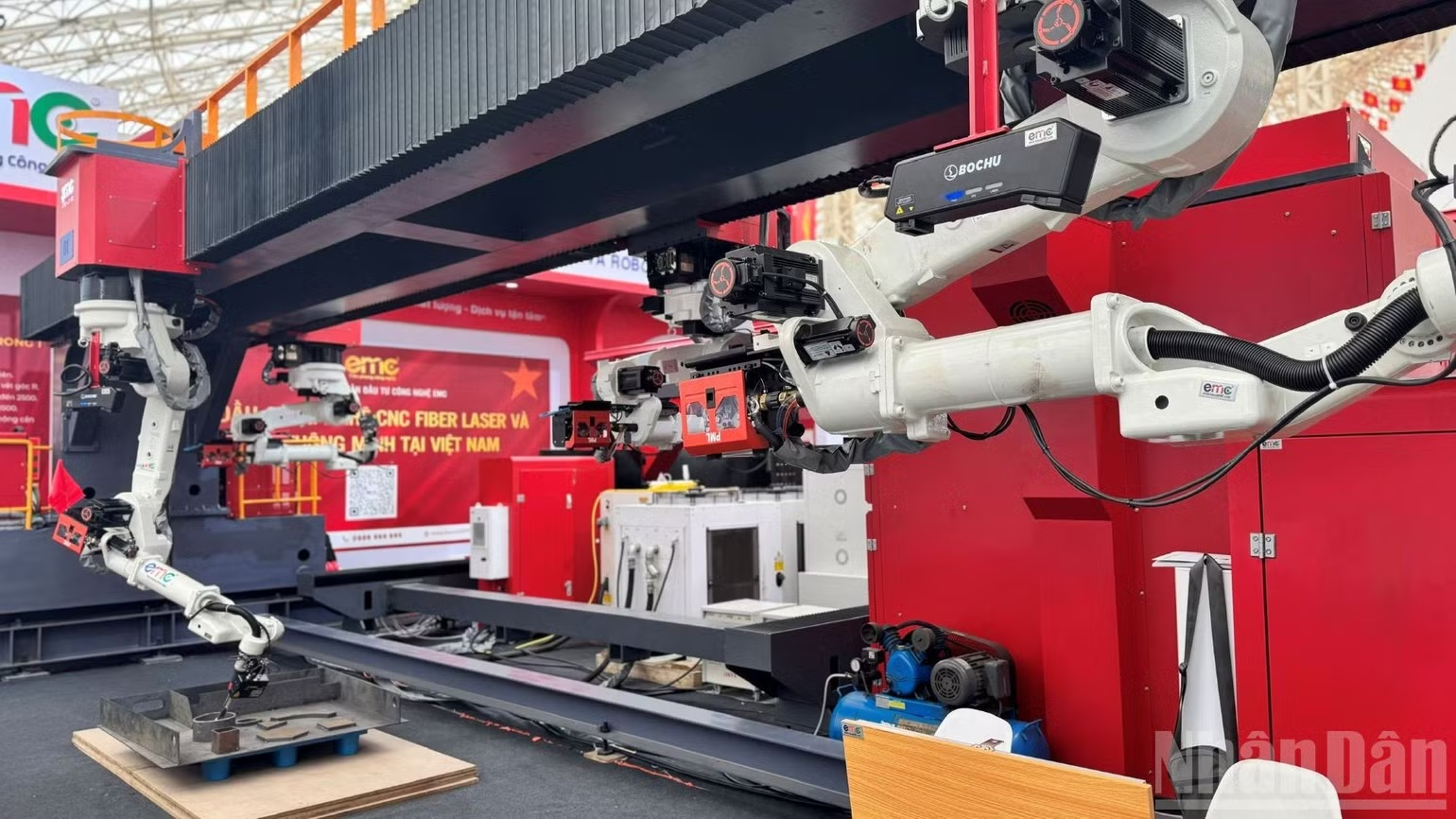
According to Campbell, this is a sign that Viet Nam is entering a new phase of FDI development.
“We are seeing a shift from a wave of broad-based manufacturing expansion towards more specialised investments focused on technology, scale and production capabilities. Investors are not simply looking for locations to set up factories, they are building critical links in their long-term supply chain strategies in Viet Nam,” Campbell said.
The shift is also reflected in the geographical distribution of investment. In the first six months of the year, northern Viet Nam attracted around 8.63 billion USD in newly registered manufacturing FDI, equivalent to 80.5% of the country’s total.
Thai Nguyen stood out as the leading destination, attracting around 5.77 billion USD in new investment, accounting for more than half of Viet Nam’s total newly registered manufacturing FDI. Hai Phong, Hung Yen and Bac Ninh continued to maintain important positions in the manufacturing ecosystem, particularly in electronics and high-tech industries.
However, although electronics and semiconductors are the main growth drivers, the investment structure remains relatively diverse. Industries such as mechanical engineering and manufacturing, electrical equipment, metal products, rubber, plastics, food and automotive manufacturing also recorded active investment.
This shows that Viet Nam is developing as a diversified manufacturing hub rather than relying on a single sector. Overall, the first-half 2026 data show that Viet Nam is not only continuing to attract strong FDI flows but is also upgrading the quality of those flows.
The success of the market is no longer measured by the number of newly registered projects alone, but is increasingly assessed through investment scale, technological content and the role of projects in global supply chains.
John Campbell said, “Viet Nam is entering a more mature phase of manufacturing FDI growth. Investment quality, the complexity of manufacturing activities and Viet Nam’s position in global manufacturing networks will be more important indicators than the sheer number of projects in the years ahead.”