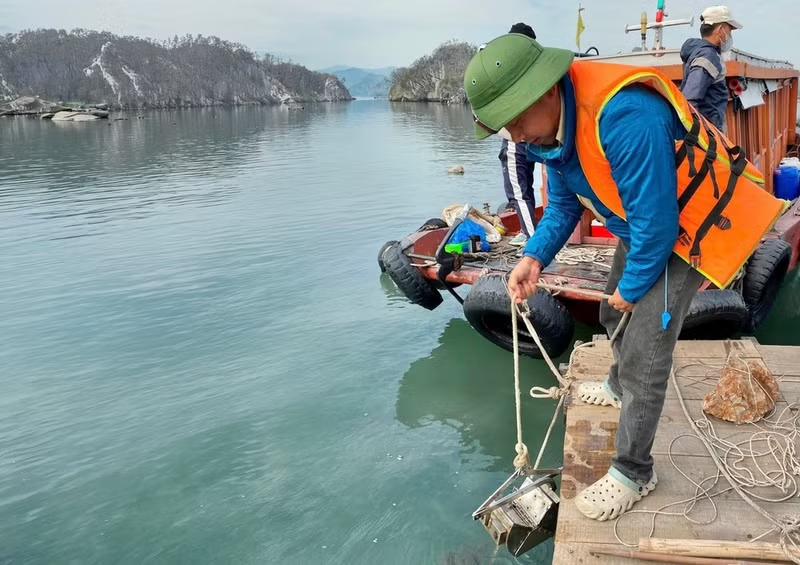
In areas such as Cam Pha Ward, Dam Ha Commune, and the Van Don Special Zone in Quang Ninh City, aquaculture is developing strongly and has become the main source of income for many families. The main farmed species include grouper, seabass, cobia, and bivalve molluscs such as oysters and mussels. However, the increasing density of farming cages restricts water circulation, causing uneaten feed, faeces, and excretory matter to accumulate in the water and bottom sediments, increasing the risk of pollution and disease. Large amounts of organic waste also reduce dissolved oxygen and increase nitrogen and phosphorus compounds, thereby affecting the ecosystems and biodiversity of farming areas.
In this context, domestic studies have mainly focused on assessing pollution conditions and traditional marine aquaculture models, while in-depth research into Integrated Multi-Trophic Aquaculture (IMTA) remains limited. This provided the basis for Dr. Le Van Nam from the Hai Phong Sub-Institute of Oceanography (Institute of Oceanography, Viet Nam Academy of Science and Technology), together with his colleagues, to carry out a project titled “Research on proposed solutions to minimise organic and nutrient pollution generated by concentrated cage aquaculture in the waters of Quang Ninh.”
The study focuses on assessing the current situation and the risk of water and sediment pollution in several concentrated cage aquaculture areas, while also testing an Integrated Multi-Trophic Aquaculture (IMTA) model to reduce organic matter and nutrients by using farmed species occupying different trophic levels. The research team will conduct surveys and monitor environmental parameters, as well as carry out experiments to assess the applicability of the model under actual conditions.
For the experiment, the team selected the Van Don Special Zone as the study site, using farming cages of approximately 27 cubic metres per cage and combining fish, oysters, seaweed, and other species from different trophic levels. Separate experiments were also conducted on each species to assess their roles in absorbing and transforming organic matter, suspended solids, and dissolved nutrients.
According to Dr. Le Van Nam, integrated multi-trophic aquaculture (IMTA) has been studied and widely applied in many countries with marine aquaculture industries. The model makes use of natural nutritional relationships among groups of organisms such as fish, molluscs (oysters and mussels), and seaweed to absorb and transform excess organic matter and nutrients in farming areas. Fish are the main farmed species as well as the source of organic matter and nutrients; rabbitfish are placed near the bottom to utilise material in the bottom layer; oysters and mussels filter suspended particles; and seaweed absorbs some of the dissolved nutrients such as nitrogen and phosphorus.
Under this model, waste from aquatic species farmed at higher trophic levels can become a source of nutrients for species at lower trophic levels. Through this mechanism of nutrient reuse and recycling, IMTA systems help reduce waste, improve the aquaculture environment, and enhance economic efficiency for aquaculture households.
Initial results show that the multi-trophic aquaculture model can improve several water-quality indicators in the experimental area. According to the study, total phosphorus decreased by 16.9%, ammonia by about 16%, and suspended solids by 11.6%, while water transparency increased by an average of 0.10m. The model not only helps reduce pressure on the marine environment but also improves economic efficiency, as farming households can harvest additional molluscs and seaweed alongside their main fish products, using the same area and farming period.
Dr. Dao Thi Anh Tuyet from Graduate University of Science and Technology under Viet Nam Academy of Science and Technology, said the initial results of the IMTA model led by Dr. Le Van Nam are significant both scientifically and practically. Further expansion of the scale and scope of the research will help provide additional data for the marine aquaculture sector and enable a clearer assessment of the model's effectiveness under different environmental conditions.
Prof. Dr. Trinh Van Tuyen, Chairman of the acceptance council at the Viet Nam Academy of Science and Technology, said the project had assessed the current situation and risks of water and sediment pollution in concentrated cage and raft aquaculture areas, thereby clarifying the mechanisms through which organic pollutants and nutrients accumulate and spread. The initial results also provide a reference basis for local authorities to develop marine aquaculture in a more environmentally friendly direction.