From small-scale production to enhancing the value of agricultural products
In Dong Tho Commune, Tuyen Quang Province, the Sang Nhung Safe Food Production and Processing Cooperative has established a closed-loop production chain under the 3F (Feed-Farm-Food) model, linking all stages from breeding stock, animal feed, and commercial livestock farming to slaughtering, processing, and delivering products to consumers.
Within this production chain, the cooperative applies science and technology, uses animal feed mixed with medicinal herbs, implements biosecurity measures, adheres to VietGAP standards, and ensures product traceability to guarantee quality from farm to table.
At the same time, a network of stores under the Sang Nhung Green Agricultural Products brand has been established, helping expand linkages, bring products closer to consumers, enable the cooperative to secure outlets for its products, and boost the value of agricultural produce.
Nguyen Ngoc Sang, Director of the Sang Nhung Safe Food Production and Processing Cooperative, said that after eight years of operation, the cooperative has gradually enhanced its production, processing, sales, and environmental management activities, while developing linkages with thousands of members, households, and cooperatives both within and outside the province.
At present, the cooperative provides regular employment for approximately 150 workers, with an average monthly income of 10 million VND per person. It has developed a plan and an action programme for the next five years, targeting annual growth of 10–15% through value-chain linkages.
The cooperative’s target fully aligns with the province’s Collective Economy Development Programme for 2026–2030.
Specifically, by 2030, the province aims to have more than 1,850 cooperatives comprising 38,000 members, with at least 50% of agricultural cooperatives participating in value-chain linkages, and more than 100 cooperatives receiving support to adopt high technology.
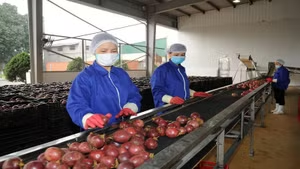
In recent years, value-chain linkages have gradually reshaped fruit production and marketing in Gia Lai. The province currently has more than 50 businesses and nearly 60 cooperatives engaged in fruit value-chain networks.
In the durian sector alone, linkages have been established between 16 cooperatives and 11 businesses, covering nearly 2,900 hectares.
Within this network, the Ia Phin Organic Durian Cooperative in Chu Prong Commune stands out, with more than 60 members cultivating over 220 hectares, 70 of which are covered by two export growing-area codes.
Besides adopting organic farming practices and increasing the use of organic fertilisers to enhance soil and fruit quality, cooperative members focus on maintaining electronic farming records, digitising growing areas, and ensuring product traceability, gradually standardising production processes to meet export market requirements.
Compliance with production procedures under value-chain linkages is delivering tangible economic benefits to durian growers in Gia Lai.
Duong Mah Tiep, Vice Chairman of the Gia Lai Provincial People’s Committee, said the province encourages cooperatives to join value-chain linkages and organise production under uniform procedures to create a substantial supply, ensure quality, and meet market requirements.
“The province consistently provides advice and information to help durian-growing households and cooperatives understand market demand and standards. Businesses work alongside producers and connect them with export markets, contributing to the production of quality produce,” Duong Mah Tiep said.
Strengthening competitiveness and expanding markets through linkages
In practice, value-chain linkages help establish concentrated raw material production areas with consistent crop varieties, cultivation procedures, and quality that meet market requirements, cut intermediary costs, and enable cooperatives to access preferential credit, trace product origins, apply sustainable farming techniques, and eventually participate in the carbon credit market.
With future development targets in mind, these linkages also pose major challenges concerning the planning of raw material production areas, processing, and infrastructure to support cultivation.
Dang Kim Son, Vice Chairman of the Association of Enterprises Applying High Technology in Agriculture, said specialised production areas should be established to connect farmers, farms, and cooperatives with deep-processing centres and an integrated logistics system.
In particular, focus must shift from providing support to investing in the capacity of cooperatives, laying the foundation for reorganising production and participating in value chains. The provision of information and development of digital infrastructure also play an important role in helping cooperatives leverage these linkages.
Nguyen Van Viet, Head of the Ethnic Affairs Committee of the Tuyen Quang Provincial People’s Council, said the province is focusing on developing sectoral databases and upgrading the website of the Department of Agriculture and Environment, which attracts an average of 15,000 visits per day, helping residents, businesses, and cooperatives access timely information for production and commercial operations.
Alongside the efforts of localities, digital transformation, particularly e-commerce, is unlocking further opportunities to promote and sell agricultural produce and connect with export partners.
Kieu Tien Anh, Chief Operating Officer of the Hi1 e-commerce platform, said joining an online marketplace is only the first step. To retain customers and secure long-term sales outlets, cooperatives need to ensure product quality, a stable supply, and compliance with consumer standards.
To achieve this, value-chain linkages must be reinforced from production organisation to distribution, with the participation and shared responsibility of all stakeholders.
Ngo Tuong Vy, Director of Chanh Thu Fruit Import-Export Group Joint Stock Company, said farmers must comply with production procedures, cooperatives must organise production and control quality, businesses must honour their purchasing commitments, while regulatory authorities must promptly resolve emerging bottlenecks.
When all stages operate in unison, risks will be shared, trust will be strengthened, and sales outlets for agricultural products will stabilise.
Nguyen Tien Dinh, Head of the Cooperative Economy Division under the Department of Cooperative Economy and Rural Development, said businesses’ commitments to purchase products are a key strength of the value-chain linkage model.
This model is best suited to production areas where businesses invest in processing and exports, and cooperatives operate stably with sufficient management capacity to coordinate production and commercial operations across raw material areas of 100 hectares or more.
However, to expand linkages and sustain long-term co-operation, cooperatives require robust financial resources to invest in production, enhance management capacity, and meet increasingly demanding market standards.
Cao Xuan Thu Van, President of the Viet Nam Cooperative Alliance, proposed exploring value-chain-based financing models that engage the State, businesses, and credit institutions to provide cooperatives with stable sources of capital.
Only when policies align with practical needs, cooperatives have sufficient capacity to organise production, and businesses have a basis for long-term investment can value-chain linkages move beyond short-term agreements to become the corenerstone for the sustainable development of agricultural products.