Barriers to development
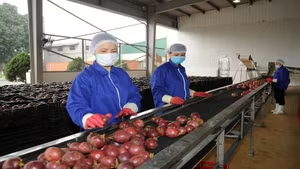
Vegetables are an essential food group with a direct impact on public health. On their journey from the field to the table of each household, vegetables pass through numerous stages: planting, harvesting, preliminary processing, storage and distribution before reaching consumers. If any stage fails to comply with food safety and hygiene requirements, the quality of the food supply is put at risk.
According to the Ministry of Agriculture and Environment, Viet Nam has around 1.15 million hectares of vegetable cultivation, but a little over 8,000 hectares are produced in accordance with Vietnamese good agricultural practices (VietGAP), accounting for just around 0.7% of the total cultivated area.
These telling figures show the urgent need to change production methods and apply standards for safe vegetable production to meet consumers’ demand for quality and food safety.
Nguyen Quy Duong, Deputy Director of the Department of Crop Production and Plant Protection under the Ministry of Agriculture and Environment, said: “Most farmers still carry out production on their household farms, in cooperatives and at small-scale production establishments, which sometimes operate on only a few hundred to a few thousand square metres of farmland. Meanwhile, the cost of producing to VietGAP standards remains relatively high.”
For years, vegetables grown on a small scale without adequate safety controls have been widely sold in wholesale markets, and have even been mixed with safe produce, making their way into supermarkets and schools.
This shows that discipline in the stages of production and distribution remains a major barrier to developing a modern and safe agricultural sector.
Many experts also point to fragmented production and landholdings, as well as inadequate technical guidance for farmers, as factors making it difficult to control the quality of vegetables.
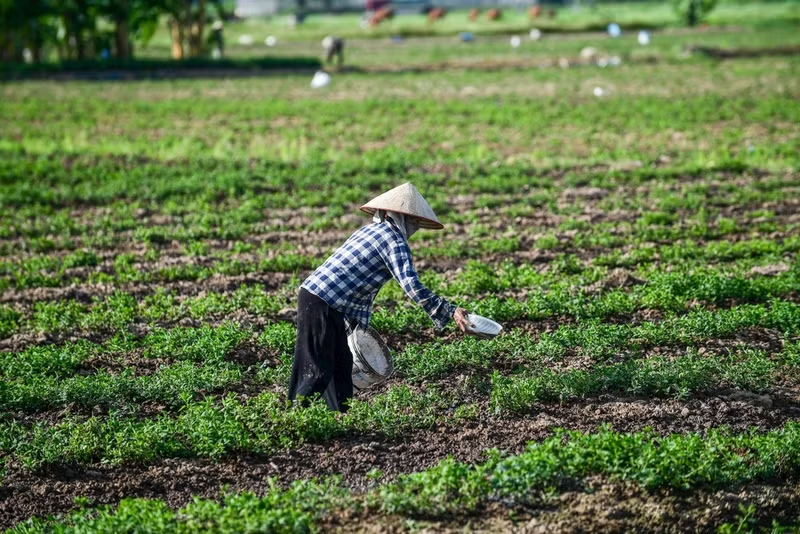
In Kim Quy Village, Dai Xuyen Commune, on the outskirts of Ha Noi, a long-established vegetable-growing area involving thousands of farming households, only a handful of households have consolidated their landholdings and invested in technology, for example.
Recognising the shift in consumer demand from simply having enough to eat to eating clean and safe food, Nguyen Van Bao joined several other farming households in investing in clean vegetable production on their own land in Kim Quy Village.
He said: “We have made great efforts, but we still face difficulties in terms of capital and market access, and, in particular, we find it very difficult to compete with farmers engaged in unregulated production who continue to sell their produce in wholesale markets.”
Addressing the issue through key pillars
The Ministry of Agriculture and Environment is drafting a national standard entitled “Process for Producing and Pre-processing Vegetables to Ensure Food Safety” and is seeking comments from relevant specialised agencies.
The draft builds on and updates Viet Nam’s existing regulations, while selectively drawing on various domestic and international standards, as well as regulations on traceability and food safety.
The aim is to help management agencies improve the effectiveness of controls, support businesses and cooperatives in reducing costs, and provide producers with specific practical guidelines for safer and more transparent production.
Alongside developing the national standard, many experts stress that competent authorities should also develop detailed standards suitable for small-scale farming households; strengthen controls over soil, water, fertilisers and pesticides; and further improve product transparency and traceability, thereby gradually professionalising and modernising the crop production sector.
Traceability has become an indispensable requirement as domestic and international markets place increasing importance on quality, supply-chain responsibility and food safety.
Ha Noi has planned and developed safe vegetable-growing areas in the city’s outskirts. Last year, to further professionalise vegetable production, the Ha Noi government issued a plan on developing concentrated safe vegetable production areas, ensuring traceability and linking production with processing and consumer markets.
Localities such as Bac Ninh, Hung Yen and Ninh Binh have also developed programmes to establish specialised, concentrated safe vegetable-growing areas, promote the formation of sustainable value-chain linkages, apply technology to monitor production processes and encourage the use of organic fertilisers.
To ensure effectiveness, localities should draw on the experience of Lam Dong, the country’s largest agricultural locality, with more than 880,000 hectares of cultivated land, including around 101,000 hectares of vegetables, much of which is farmed using high technology and safe practices.
In recent years, Lam Dong has introduced preferential policies to attract resources, promote land consolidation and encourage investment in science and technology. The province has also promoted linkages, helping farmers move away from fragmented production while opening up a path towards sustainable development and creating closer links between production and consumption.
Having spent many years producing safe vegetables, Tran Xuan Dang, Director of the Tri Yen Commune High-Tech Agriculture Cooperative in Bac Ninh Province, said: “One solution that the authorities need to focus on is supporting farmers and businesses in consolidating farmland for production. Many young people have the ambition, but they cannot do so without supportive policies.”
Most agricultural land is in the hands of farmers, but they lack the capacity to plan production zones and do not have sufficient resources to invest in large-scale cultivation. Therefore, the government, ministries and sectors need to introduce mechanisms to adjust land policies, enabling localities to consolidate farmland and laying the groundwork for businesses to apply science and technology in production.
“Localities need to adopt the right approach: making science and technology the foundation, businesses the driving force and farmers the centre. This will accelerate the transition from traditional to modern production,” said Nguyen Xuan Diep of the Fruit and Vegetable Research Institute.