Fuel prices test resilience of agricultural sector
Rising fuel prices are emerging as a key test of the resilience and durability of Viet Nam’s agricultural sector, as well as the organisational capacity of its production system.
#Agriculture
Có 39 kết quả
Rising fuel prices are emerging as a key test of the resilience and durability of Viet Nam’s agricultural sector, as well as the organisational capacity of its production system.
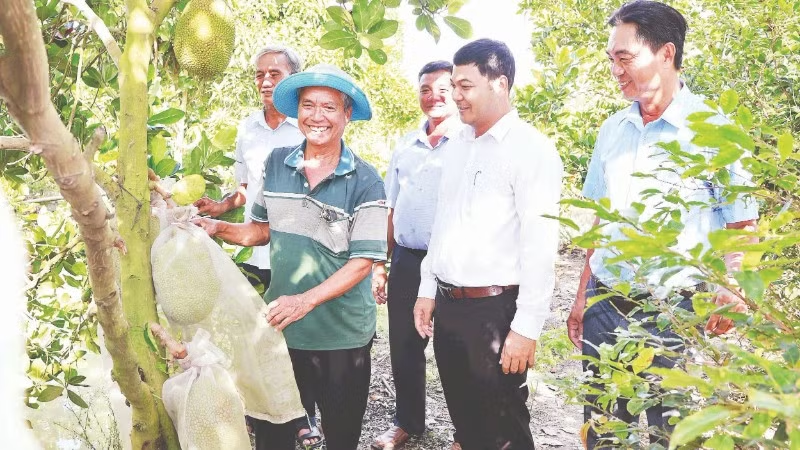
Agriculture can only transform and develop sustainably when farmers are placed at the centre of the innovation process. In Dong Thap Province, the development of professional farmers has created a vital driving force, helping to enhance the value of agricultural products while responding to new development requirements.
The year 2026 ushers in a new phase of national development, marked by high expectations and a strong aspiration for advancement. In this context, the goal of achieving double-digit economic growth is not merely a quantitative target but also a strategic imperative.
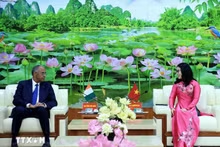
Vice Chairman of the People's Committee of Can Tho Nguyen Van Khoi has affirmed the city's commitment to creating a transparent and favourable investment environment and providing support for Indian enterprises exploring and implementing projects in the locality.
Deputy Prime Minister Tran Hong Ha on March 27 held a working session with Mariam J. Sherman, the World Bank's Division Director for Viet Nam, Cambodia and Laos, discussing measures to step up cooperation initiatives in water resources, agriculture and environmental management.
Vice Chairman of the Can Tho People’s Committee Tran Chi Hung on March 10 hosted a delegation from Zambia’s Ministry of Agriculture and Ministry of Finance and National Planning, who came to study the Mekong Delta city’s experience in agricultural transformation and sustainable rice production.
Looking back on 40 years of Doi Moi (Renewal), agriculture is often cited as one of the most resilient pillars of Viet Nam’s economy. In an interview with Nhan Dan, Le Minh Hoan, National Assembly Vice Chairman and former Minister of Agriculture and Rural Development, said that agriculture needs to be properly recognised and safeguarded in long-term development strategies.
Dong Thap Province covers nearly 6,000 square kilometres with a population of more than 4.2 million. It stretches from the Cambodian border at the headwaters of the Tien River to the East Sea/South China Sea.
The province enjoys a vast economic space, strong competitiveness and favourable conditions to harness its strengths in industry, exports and commodity agriculture, while strengthening transport infrastructure linkages and developing the marine economy.
Viet Nam’s economy maintained strong growth in 2025 despite facing severe natural disasters and a volatile global environment, with gross domestic product (GDP) estimated to have increased 8.02% year on year, meeting targets set by the National Assembly and the Government, according to Nguyen Thi Huong, Director General of the National Statistics Office (NSO) under the Ministry of Finance.
As agriculture faces the imperative of establishing a new growth model, the Politburo has issued Conclusion No. 219-KL/TW on continuing the implementation of Resolution No. 19-NQ/TW dated June 16, 2022 of the 13th Party Central Committee on agriculture, farmers and rural areas through to 2030, with a vision to 2045.
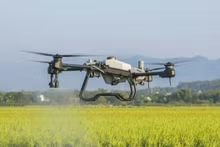
The agricultural extension sector is actively promoting socialisation to maximise its potential through public-private partnerships (PPP), thereby promoting the transfer of advanced technical and digital technologies, improving production organisation capacity, and building raw material areas.
According to the National Statistics Office under the Ministry of Finance, in the first ten months of 2025, Viet Nam recorded a total import-export turnover of 762.44 billion USD, up 17.4% year on year, and posted a trade surplus of 19.56 billion USD.
Building on the achievements during the 2020–2025 tenure, Dak Lak’s agricultural sector is implementing the Provincial Party Congress Resolution for the 2025–2030 period, with a central focus on developing ecological, circular, transparent and high-tech agriculture in tandem with digital transformation.
President and Chief Executive Officer of Japan’s Mitsui & Co Ltd. Hori Kenichi on November 27 reaffirmed Mitsui’s commitment to long-term cooperation and investment in Viet Nam when he met with Prime Minister Pham Minh Chinh in Ha Noi.
In the closing session, representatives from the Office of the US Trade Representative (USTR) and the Vietnamese negotiating team stated that the talks yielded positive results, laying a favourable foundation for the early conclusion of the Viet Nam – US Reciprocal Trade Agreement.
Minister of Industry and Trade Nguyen Hong Dien held talks with US Congressman Adrian Smith in Washington D.C. on November 13, seeking to advance Viet Nam-US trade negotiations and expand imports of American agricultural products.
The forum “Digital transformation in agriculture: Seizing opportunities, adapting to the future” was organised on October 29 in Ha Noi, under the chairmanship of the Viet Nam Cooperative Alliance, and co-organised with Business Magazine to promote agricultural sector digitalisation and share practical experiences among management agencies, experts, enterprises, and agricultural cooperatives.
It is time for Viet Nam to step onto the global stage not only with its agricultural products, but also with strong management capacity, transparent data, shared digital platforms and a circular economy mindset.
Although accounting for less than 6.5% of the country’s total land area, the Red River Delta currently contributes around 18% of the nation’s total rice output, along with numerous other crops, thereby playing an important role in ensuring domestic food security and supporting exports.
Vietnamese Acting Minister of Agriculture and Environment Tran Duc Thang had a meeting with Agnes Pannier-Runacher, French Minister for Ecological Transition, Biodiversity, Forests, the Sea and Fisheries, in Paris on September 30.