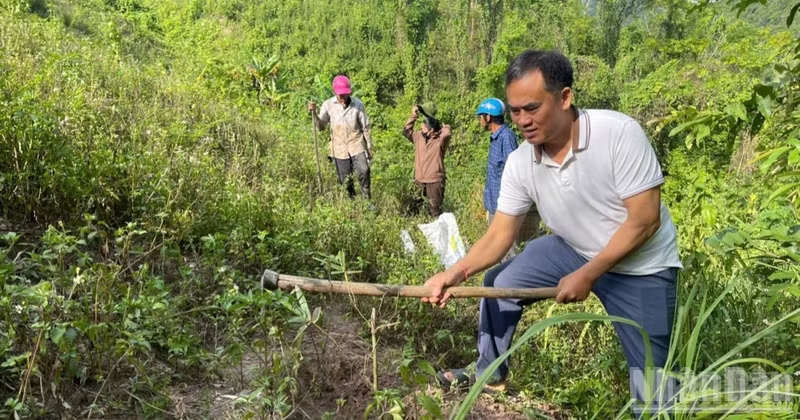
Agricultural production focused on sowing and tending the summer-autumn and main-season rice crops, as well as other seasonal crops. Pig and poultry farming advanced consistently, with production increasingly shifting towards commercial farms and biosecure farming practices.
Forestry production sustained positive growth, with timber output surging in response to stronger demand from wood processing and export enterprises. Aquaculture also recorded robust growth as stable prices for pangasius and shrimp, together with higher procurement demand from seafood processors and exporters, stimulated production. Capture fisheries likewise expanded driven by favourable weather conditions and declining fuel prices.
As of July 20, 2026, farmers nationwide had planted 1.1385 million hectares of main-season rice, down 45,600 hectares compared with the same period in 2025. The decline stemmed primarily from the conversion of low-productivity rice land to higher-value annual crops, perennial crops, aquaculture, or land designated for public infrastructure and industrial development.
By the same date, 1.8628 million hectares of summer-autumn rice had been planted, marking a decline of 24,000 hectares year-on-year. Planting was slower than last year asthe winter-spring harvest concluded later than usual, while prolonged hot weather and limited irrigation water in several localities compelled farmers to reduce planting areas or postpone sowing.
In southern provinces, farmers had planted 170,000 hectares of autumn-winter rice by July 20, equivalent to 59% of the area planted during the same period last year, driven primarily by delays in harvesting the summer-autumn crop.
Alongside rice cultivation, farmers across the country proceeded with planting seasonal crops. However, the cultivation area of several major annual crops contractedcompared with the previous year as growers transitioned toward crops and production models offering higher economic returns.
Buffalo and cattle farming sustained its downward trajectory driven by relatively low profitability, shrinking natural grazing land, reduced availability of green fodder,and persistently high feed costs.
Pig farming remained stable throughout July. Although live hog prices softened slightly in parts of northern and central Viet Nam during the second half of the month after remaining elevated for an extended period, prices generally consistently generated sufficient returns for farmers to maintain production and restock their herds.
However, African swine fever persisted in several localities, primarily among small-scale farms where biosecurity measures remain inadequate and the control of breeding stock, sanitation, and disinfection practices has not been consistently maintained, increasing the risk of further outbreaks.
The Statistics Office therefore urged local authorities to strengthen disease surveillance, promote biosecure farming practices, and closely monitor herd restocking to minimise disease risks and ensure a stable pork supply.
Poultry production sustained robust growth across most localities, supported by short production cycles, rapid capital turnover, and steady consumer demand for poultry meat and eggs.
As of July 26, 2026, Viet Nam had successfully eradicatedoutbreaks of Porcine Reproductive and Respiratory Syndrome (PRRS) and foot-and-mouth disease. Lumpy skin disease lingered in Cao Bang, Ho Chi Minh City, and Dong Thap, while avian influenza persisted in 11 localities and African swine fever remained active in 15 localities where outbreaks had not yet passed the 21-day control period.
In forestry, the area of newly planted concentrated forests achieved an estimated 14,600 hectares in July, up 5% year-on-year. Around 6.5 million scattered forest trees were planted, an increase of 3.2%, while timber production reached 2.387 million cubic metres, up 13.5%, reflecting stronger demand from wood processing and export industries.
During the first seven months of the year, newly planted concentrated forests totalled an estimated 159,800 hectares, declining 3.1% from a year earlier. Scattered tree planting reached 57.9 million trees, up 2.4%, while timber production expanded by 6.1% to 14.182 million cubic metres.
Forest damage totalled 449.6 hectares in July, a 6.2-fold surge from the same month of 2025. Of this, 45 hectares were lost to illegal logging and forest clearance, dropping23.4%, while 404.6 hectares were ravaged by forest fires —29.3 times higher than a year earlier — as prolonged heatwaves and exceptionally high temperatures escalated wildfire risks.
For the first seven months of 2026, total forest damage stood at 845.4 hectares, down 9% year-on-year. Illegal logging and forest clearance plunged 46.6% to 337.1 hectares, while forest fires surged 71.2% to 508.3 hectares.
Statistics also revealed that fishery output in July totalled an estimated 918,900 tonnes, up 4.3% compared with July 2025. Aquaculture production reached 586,800 tonnes, an increase of 6.1%, bringing total aquaculture output for the first seven months to 3.58 million tonnes, up 5.8% year-on-year.
Capture fisheries produced an estimated 332,100 tonnes in July, up 1.2%, as favourable weather and lower fuel costs enabled fishermen to spend more days at sea and optimisefishing efficiency. During the first seven months of 2026, capture fisheries output reached 2.293 million tonnes, up 0.7%, while total fishery production culminated in 5.873 million tonnes, an increase of 3.7% compared with the same period last year.
Shrimp production also sustained its growth. Favourable conditions for brackish-water shrimp farming, stable farm-gate prices, and stronger purchasing demand from seafood processors incentivised farmers to maintain production and harvesting. Output of whiteleg shrimp was estimated at 142,800 tonnes in July, up 7.8% year-on-year, while black tiger shrimp production reached 32,800 tonnes, up 3.5%.
During the first seven months of 2026, whiteleg shrimp production totalled 637,100 tonnes, expanding by 9.1%, while black tiger shrimp output reached an estimated 200,400 tonnes, up 4.2% compared with the same period of 2025.




![[Infographic] Viet Nam's 16 Comprehensive Strategic Partners](https://en-cdn.nhandan.vn/images/nyM650OGFWrOVWc-xajqN-rTZ68Rlmc1fiGJOhBRYHHdkBILL2hAdMw_FHcqH-128bTaQBSOAMd0_NcTypwz7H-j_NBZzuSdgF8ETMmVl1xLtdcCjym8rCUyKZqQgOZtC4ouMEzxlJoQ-MllehtjehDxIkn58uqaoaCRy4fSY54/1792513260540-1528117236743671738-1528117236743671738-9e797c256fe32c7c7b9c1cc03b0ca64e.jpg.avif)