In this context, the Vietnamese peasantry continues to affirm its role as the principal force, the central and largest component in the strategy for agricultural development, rural economy advancement and new-style rural development.
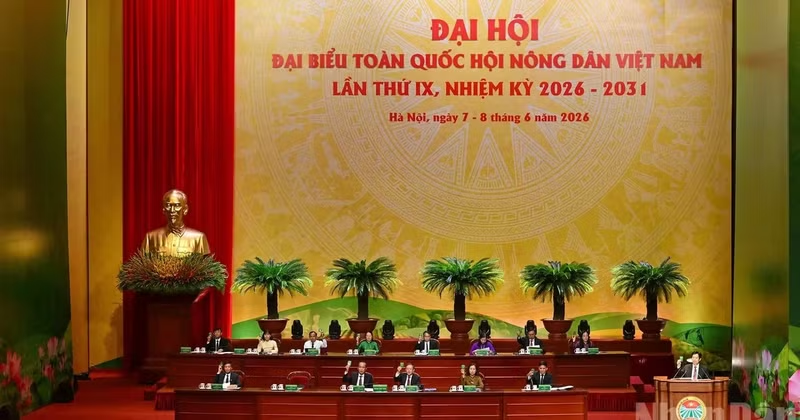
Under the spirit of “Solidarity – Democracy – Breakthrough – Cooperation – Development”, the congress provides an opportunity to draw lessons from vivid practical experience and chart a new course associated with building a modern farming community united by the aspiration for a prosperous, strong, civilised and happy nation.
Looking back on the journey since the 8th Congress, there is every reason to take pride in the achievements of Vietnamese agriculture, created through the diligent efforts of farmers under the wise leadership of the Communist Party of Viet Nam.
Overcoming countless difficulties and challenges, from unpredictable global fluctuations to natural disasters and complex domestic epidemics, the role of agriculture as a “pillar” of the national economy has become even more evident and worthy of appreciation.
In this transformation, the revolutionary spirit of farmers nationwide has been clearly demonstrated through the donation of more than 530 hectares of land, contributions of 4.6 million working days, and collective efforts to build and repair over 3,500 kilometres of rural roads and irrigation canals, establish more than 11,000 environmental protection models, along with many other meaningful achievements.
Through movements launched by the Union, the quality and depth of farmers’ agricultural economic thinking have advanced remarkably. The movement entitled “Farmers compete in excellent production and business, unite to become prosperous and sustainably reduce poverty” has been renewed, attracting 6.5 million participating households each year. Of these, more than 3.4 million households have earned recognition for outstanding production and business achievements at various levels, while more than 56,000 poor households have received support to improve their living conditions.
Through the movement “Officials and farmer members actively participate in developing collective agricultural economies”, thousands of ecological, green and circular agriculture models applying high technology and value-chain linkages have been established or effectively reorganised. The Union has played an outstanding supporting role by mobilising, guiding and assisting in the establishment of more than 1,000 agricultural cooperatives, together with thousands of cooperative groups, 2,419 professional farmer branches and 11,708 professional farmer groups operating effectively.
Farmers’ Union officials across the country have actively supported more than 5,400 products of farmer members in obtaining OCOP certification. Numerous trade promotion activities have also been organised, connecting more than 600,000 farming households with e-commerce platforms.
Notably, the promotion of the model “Saying no to banned chemicals and dirty food” has gradually become a new cultural norm widely embraced by farmers, making an important contribution to protecting public health. In many areas, the image of farmers “toiling under the sun and dew” has increasingly been replaced by that of a new generation of farmers — owners of modern farms and production cooperatives supplying products that meet export standards for even the most demanding markets.
Nevertheless, facing reality directly, on the path towards ecological agriculture, civilised rural areas and modern farmers, the country still faces numerous challenges, ranging from rising input costs to the severe impacts of climate change, natural disasters and epidemics.
The development of value-chain linkages in some areas remains limited and unsustainable. Progress in renewing thinking, organising large-scale agricultural production and implementing digital transformation is still constrained. Labour productivity among farmers generally remains low.
Farmers’ movements and Union activities are also uneven across some localities. The capacity of certain Union officials has yet to meet current requirements, while some levels of the Union remain initially confused in implementing the two-tier local government model, especially at the commune level.
These shortcomings require the political system as a whole, and the Viet Nam Farmers’ Union in particular, to adopt fundamental and comprehensive solutions during the 2026–2031 term. With both honourable responsibilities and considerable challenges ahead, all levels of the Union must devote their full efforts to building a strong farming class in the new era, worthy of its role as the principal and central force in agricultural economic development, rural economic growth and new-style rural development.
To achieve this, the Union system nationwide must share a common determination to strongly transform its operational content and methods in line with the new organisational model; build a capable contingent of Union officials able to meet current tasks; and strengthen the application of science, technology and digital transformation in Union activities and farmers’ movements.
The Farmers’ Unions at all levels must remain proactive and uphold their core role in advising on and proposing mechanisms and policies; promoting their role as a bridge between the Party, authorities and farmers; representing, protecting and safeguarding the legitimate rights and interests of farmers; and serving as a pillar of support to help members and farmers strengthen linkages, expand cooperation and successfully implement digital transformation.
A country advancing towards industrialisation and modernisation from an underdeveloped agricultural base — where many areas remain fragmented and outdated — cannot be separated from the Party’s renewal policies regarding production methods in dialectical relation to means of production; the application of science, technology and innovation in agriculture; new thinking and vision in production, markets and value chains; and the organic relationship between agriculture, farmers and rural areas. During this process, the creative traditions and internal strength of the farming class have always served as a driving force for overcoming difficulties and embracing new developments.
With the deep attention and care from the Party and State, together with the close guidance, organisation, training and companionship of the Farmers’ Union, farmers across the country will continue to strongly promote patriotism, national pride, solidarity and creativity to overcome every challenge, joining hands to build a peaceful, independent, democratic, prosperous, civilised and happy Viet Nam in the new era.