The story of rice, fruit, and aquaculture
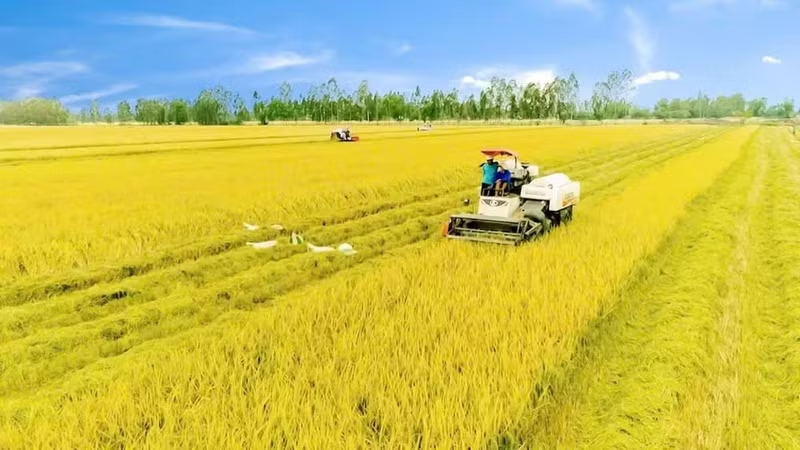
Rice has always been the cornerstone commodity of the Mekong Delta. Whereas the primary objective historically aimed to ensure food security and boost export volumes, the focus is now shifting towards improving quality and generating greater added value. The project to develop 1 million hectares of high-quality, low-emission rice in line with green growth goals is a clear demonstration of this direction.
In the future, breeding programmes should concentrate on fragrant rice, nutritious varieties, rice suited to deep processing, and varieties capable of withstanding drought, saline intrusion, and flooding. Simultaneously, advanced cultivation practices such as alternate wetting and drying (AWD), smart water management, mechanisation, and digital transformation should be scaled up to reduce production costs and greenhouse gas emissions.
A particularly important direction is developing rice varieties suited to specific ecological zones, rather than seeking a single variety capable of thriving across the entire delta. This approach will enable the establishment of specialised production areas tied to local brands and the distinct demands of different markets.
Alongside modern varieties, indigenous genetic resources, including traditional seasonal rice, floating rice, and other speciality varieties, should be preserved and effectively utilised. These resources are not only valuable breeding materials but also provide a foundation for developing distinctive rice products with significant cultural, ecological, and commercial value.
The Mekong Delta is also Viet Nam’s largest fruit-producing region. However, a major constraint remains inconsistent planting material quality. Many valuable indigenous fruit varieties are gradually being displaced by short-term commercial varieties and imports.
Meanwhile, research, evaluation, and seedling supply systems have yet to fully meet producers’ needs. Trend-driven variety selection has caused many localities to fall into a recurring cycle of planting and uprooting, resulting in substantial economic losses.
To achieve sustainable development, the fruit sector must shift from a production-focused mindset towards building comprehensive value chains. This process should begin with research, conservation, and breeding programmes, alongside the establishment of high-quality seedling supply systems tailored to local ecological conditions.
This foundation enables the development of concentrated production areas linked to geographical advantages, planting area codes, traceability systems, and quality standards that meet both domestic and international market requirements.
At the same time, stronger linkages among producers, cooperatives, processing enterprises, and distributors are needed to increase added value, build brands, and enhance the global competitiveness of the Mekong Delta’s fruit sector.
Aquaculture is another key export sector of the Mekong Delta, with shrimp and pangasius as its two strategic products. However, the industry faces numerous challenges, including disease outbreaks, rising feed and input costs, market fluctuations, and increasingly stringent requirements for traceability, food safety, environmental protection, and carbon emission reduction. Furthermore, the sustainable development of aquaculture is heavily dependent on water quality.
In this context, smart aquaculture is emerging as an inevitable trend. The application of technologies such as the Internet of Things (IoT), artificial intelligence (AI), environmental sensor systems, and real-time monitoring can improve management efficiency, strengthen disease control, optimise feed utilisation, and reduce production costs.
Alongside high-tech intensive farming models, ecological approaches such as shrimp-forest farming, shrimp-rice farming, integrated multi-species farming, and recirculating aquaculture systems are demonstrating significant advantages in environmental protection, climate resilience, and economic performance.
These models also provide an important foundation for obtaining international certifications, accessing premium markets, and strengthening competitiveness.
In the future, the Mekong Delta’s competitive edge in aquaculture will lie not only in production volumes but also in environmental quality, technological capability, innovation capacity, and compliance with global green standards.
Science, technology, and innovation: the key to the future
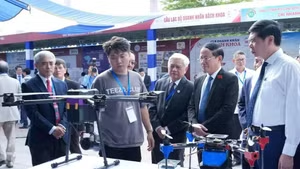
In this new era of development, science, technology, and innovation will serve as the core drivers of agricultural transformation in the Mekong Delta. Areas such as biotechnology, advanced breeding, post-harvest technology, deep-processing, and digital transformation are creating new opportunities to improve productivity, quality, climate resilience, and the added value of agricultural products.
At the same time, strategic technologies, including artificial intelligence (AI), big data, geographic information systems (GIS), remote sensing, the Internet of Things (IoT), and blockchain, will support more effective production management, better risk forecasting, more efficient resource utilisation, and greater transparency throughout agricultural value chains.
However, innovation is not solely a matter of technology; it also requires the active participation of stakeholders across the agricultural ecosystem.
Universities and research institutes must play a central role in research, genetic resource conservation, technology development, knowledge transfer, and the training of skilled human resources.
Farmers, meanwhile, should be recognised as key actors in the innovation process, directly participating in the testing, refinement, and application of new solutions.
Strong collaboration among government agencies, scientists, businesses, and local communities will lay the foundation for a modern, sustainable, and highly competitive agricultural sector.
The Mekong Delta stands at a historic juncture, with the opportunity to restructure its agriculture along modern and sustainable lines.
To realise this goal, efforts should focus on five key priorities: developing climate-resilient, high-quality crop and livestock varieties; promoting digital transformation and high-tech adoption; conserving and harnessing indigenous genetic resources to build internationally competitive advantages; advancing deep processing and the circular economy; and building an innovation ecosystem involving government, businesses, scientists, and local communities.
The effective implementation of these directions will help consolidate the Mekong Delta’s role as Viet Nam’s leading agricultural production region, while laying the foundation for green agriculture, high-quality food production, and innovation-led growth.
The Mekong Delta is Viet Nam’s most important agricultural region, contributing approximately 50% of the country’s rice output, more than 90% of its rice exports, 70% of its exported fruit, and around 60–70% of national aquaculture output. For decades, the region has played a pivotal role in ensuring national food security, driving agricultural exports, and improving the livelihoods of millions of rural residents.