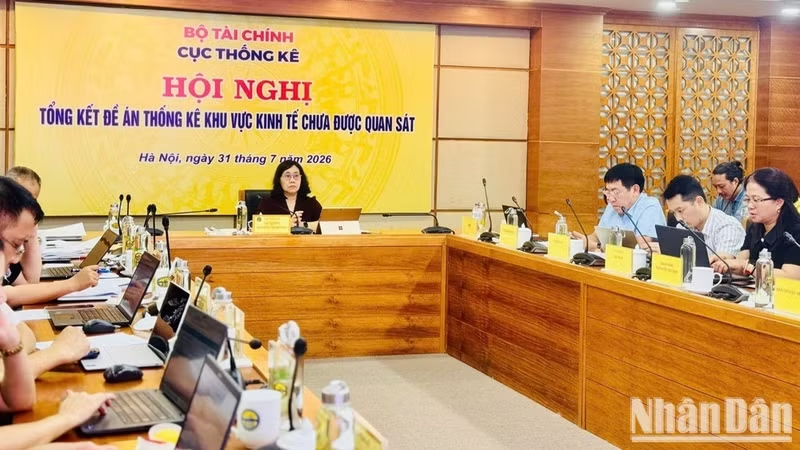
NSO Director Nguyen Thi Huong emphasised that this was the first time Viet Nam had implemented a comprehensive project on measuring the non-observed economy — a new and highly complex area with a broad scope involving multiple sectors, levels of government, and sources of information.
She said information on the non-observed economy remains fragmented and lacks consistency, noting that some activities are deliberately concealed, complex in nature, or difficult to access directly, while the boundaries between different components of the sector are not always clearly defined in practice.
As a result, measuring the non-observed economy must be carried out in phases, combining methodological approaches, data sources, national accounts expertise, technology, and inter-agency coordination mechanisms.
She proposed that, in the coming period, the focus should shift from developing the project to maintaining, refining, and gradually integrating statistical methods for measuring the non-observed economy into routine statistical operations.
Huong stressed that priority should be given to areas where data and methodologies are already relatively well established, while more complex components should continue to be studied and tested with caution.
Presenting a summary of the project’s implementation, Le Trung Hieu, Deputy Director of the NSO, said: “One of the project’s most significant achievements has been to promote the modernisation of methodologies and professional practices for compiling GDP, GRDP, and the national accounts in line with international standards.”
Notably, the project has laid an important foundation for modernising statistical methodologies and the System of National Accounts in Viet Nam, contributing to a more comprehensive reflection of the economy’s size and structure while improving the quality of key macroeconomic indicators.
These achievements provide an important basis for the statistics sector to further enhance the quality of official statistics, better meeting the needs of policymaking and public administration, as well as the growing demand for information to support socio-economic development in the new stage.
Participants at the conference shared the common view that measuring the non-observed economy cannot be the responsibility of the statistics sector alone. Each government agency holds valuable datasets relating to production, business activities, transactions, and financial flows across the economy.
For example, Pham Thi Minh Hien, Deputy Head of the International Tax Policy Division under the Tax Department, highlighted the role of tax administration data, electronic invoices, and information on household businesses, individual business operators, and e-commerce in reviewing business entities, assessing revenues, and identifying activities that have not yet been fully captured.
Meanwhile, Nguyen Tat Thai, Deputy Head of the Forecasting and Statistics Department at the State Bank of Viet Nam, shared information on cashless payments, electronic identification, and authentication, as well as anti-money laundering efforts, all of which contribute to improving the transparency of financial flows and provide additional data sources for management, verification, and analysis.
At the conference, representatives of the Ministry of Industry and Trade stressed the need to integrate market surveillance, e-commerce management, anti-smuggling measures, efforts to combat trade fraud and counterfeit goods, and the development of databases on business entities and commercial activities in the digital environment.
Recognising the project’s initial achievements, the representative of the International Monetary Fund (IMF) in Viet Nam shared international experience and offered recommendations on measurement methodologies, data utilisation, and the development of a roadmap aligned with international standards while taking account of Viet Nam’s specific conditions.