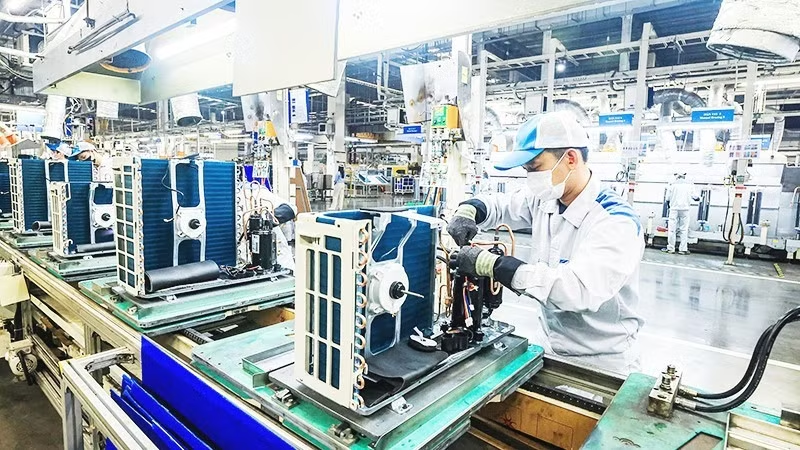
In his closing remarks at the third plenum of the 14th Party Central Committee, Party General Secretary and State President To Lam reaffirmed the determination to achieve economic growth of at least 10% while maintaining macroeconomic stability, controlling inflation, safeguarding major economic balances, and ensuring employment, income, and social welfare.
Notably, the Party Central Committee decided to issue a Resolution on reshaping Viet Nam's development model, characterising it as a "major, entirely new, and unprecedented" undertaking that will shape the country's development model through 2045 and beyond.
Reshaping the development model begins with institutional reform
According to Dr Nguyen Quoc Viet of the University of Economics and Business under the Viet Nam National University, Ha Noi, the Party Central Committee's decision to issue a thematic resolution on reshaping the development model signals a profound transformation in the nation’s development mindset.
Whereas previous efforts focused mainly on reforming the growth model, the current task is to build a comprehensive development model. Economic growth must proceed in tandem with improving development quality, competitiveness, and people's quality of life.
He noted that after nearly 40 years of Doi Moi (Renewal), Viet Nam's economy has accumulated crucial foundations for further development. The economy has continued to expand in scale, international integration has deepened, the investment environment has steadily improved, and the World Bank has recognised Viet Nam as an upper-middle-income country.
These achievements have generated new stature and momentum for the country to advance into a higher stage of development.
However, they have also underscored the imperative to reshape the development model.
According to Dr Nguyen Quoc Viet, Viet Nam's growth has so far relied heavily on traditional advantages such as low-cost labour, natural resource exploitation, and expanded investment. Labour productivity, technological content, and innovation have yet to constitute the true foundations of economic growth.
Although Viet Nam has become deeply integrated into global supply chains and has successfully attracted foreign direct investment (FDI), its technological capabilities remain modest. Linkages between the FDI sector and domestic enterprises have failed to generate the anticipated spillover effects.
As a result, economic growth still remains insufficiently driven by total factor productivity, domestic value added remains low, and the risk of falling into the middle-income trap will persist unless new growth drivers are forged without delay.
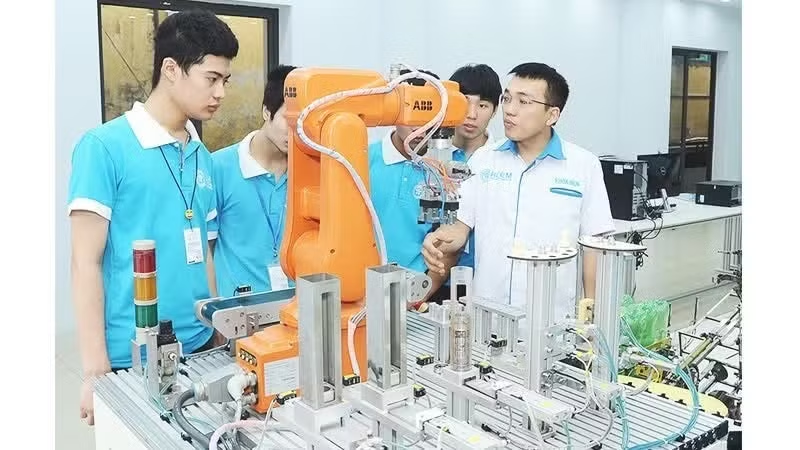
Experts view institutional reform as the paramount breakthrough for unlocking development resources.
According to Dr Nguyen Quoc Viet, over the past years, the Party and the State have consistently identified institutions as the "bottleneck of all bottlenecks".
He explained that businesses continue to shoulder substantial costs arising from overlapping legal regulations, cumbersome administrative procedures, and unnecessary transaction costs.
"The goal of reducing legal compliance costs by approximately 30% will provide businesses with substantial additional resources to invest in technological innovation, expand production, and improve productivity," he emphasised.
Beyond creating a more favourable business environment, institutional reform will also facilitate a shift in governance from pre-inspection to post-inspection, and from a regulatory mindset to an enabling development mindset.
This will afford both regulators and businesses greater latitude for innovation as new business models continue to emerge.
He added that sectors such as the digital economy, green economy, circular economy, artificial intelligence, and other emerging technology industries all demand a more agile institutional framework to create new "growth space". If institutions fail to keep pace with change, they will themselves become impediments to development.
"Institutional reform is the key to unlocking resources, reducing costs for businesses, and creating new growth drivers for the economy," he affirmed.
In addition to the Resolution on reshaping Viet Nam's development model, the third plenum of the 14th Party Central Committee also decided to promulgate four additional pivotal resolutions:
- A Resolution on the national security strategy.
- A Resolution on building a disciplined, safe, civilised, harmonious, and developed society.
- A Resolution on the guiding principles for amending the Land Law and related legislation.
- A Resolution on building and developing Viet Nam into a strong maritime nation.
Raising productivity to achieve double-digit growth
While institutional reform serves as a prerequisite for unlocking resources, forging new growth drivers will prove decisive in realising the rapid yet sustainable growth target set by Party General Secretary and State President To Lam.
Economist Dr Can Van Luc asserted that both international experience and Viet Nam's own development trajectory demonstrate that no country can sustain high growth over the long term while relying primarily on expanded investment and labour inputs.
To advance into a new stage of development, the economy must shift decisively towards a growth model driven by productivity, science and technology, and innovation.
He noted that Viet Nam's growth has so far depended heavily on traditional production factors such as capital and labour. In the next stage of development, however, the contribution of total factor productivity to GDP growth must be elevated to approximately 53–55%.
This is also a consistent objective reflected in the Party's resolutions aimed at elevating growth quality and national competitiveness.
According to Dr Can Van Luc, realising this objective demands the simultaneous implementation of five major groups of solutions.
First, science and technology, innovation, and digital transformation must be vigorously accelerated, particularly through the application of artificial intelligence (AI) and the use of data as a new factor of production.
Second, the nation must cultivate a highly skilled workforce, placing people at the centre of the development process and recognising human capital as the decisive factor in national competitiveness.
Third, investment must continue in modern infrastructure, including transport, energy, and digital infrastructure, to meet the demands of the digital economy.
Fourth, economic institutions must be continuously reformed to create a more enabling environment for innovation while enhancing enterprises' capacity to absorb new technologies.
The fifth issue, which Dr Can Van Luc highlighted as paramount, is enhancing the efficiency of resource mobilisation and allocation.
He emphasised that, given finite development resources, the priority is not only to mobilise more capital but also to allocate it to sectors capable of generating the highest productivity and value added. This is vital for sustaining rapid economic growth while ensuring investment efficiency and macroeconomic stability.
Experts assess that the greatest significance of General Secretary and State President To Lam's address lies not merely in the pursuit of higher growth, but in the call for a fundamental elevation of development quality.
That message also runs throughout his remarks as the Party Central Committee decided to formulate the Resolution on reshaping Viet Nam's development model. It represents not simply an adjustment in growth mindset, but a strategic shift towards building a new development model in which economic growth is closely linked to innovation, sustainable development, and, above all, the continuous elevation of people's quality of life and happiness.