In transforming deep-sea and offshore waters into a new development space, the long-term growth momentum of marine aquaculture will not be determined solely by natural advantages, but largely by institutional capacity, governance quality, scientific and technological mastery, and business participation.
Awakening the sea with high technology
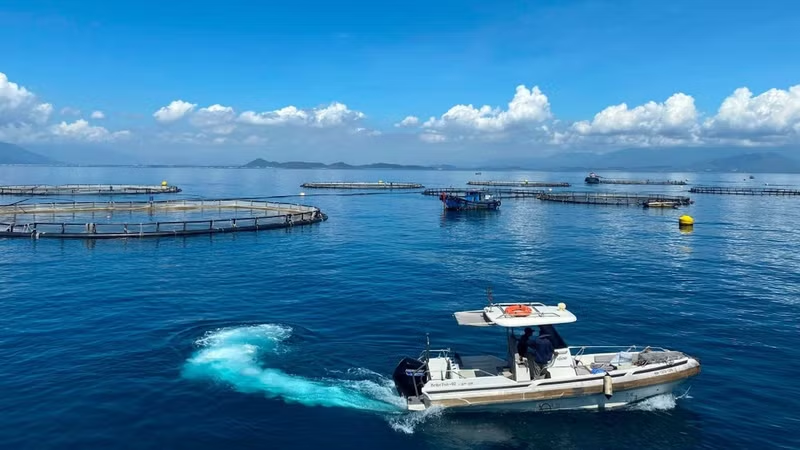
The giant HDPE cage clusters stood out against the vast blue waters of Van Phong Bay in Khanh Hoa Province as they came into view after a half-hour canoe ride from the mainland. This is the high-tech barramundi farming system of Australis Viet Nam Seafood Co., Ltd., one of the world’s leading barramundi farming and export companies, with an output of more than 12,000 tonnes per year.
Unlike traditional nearshore farming models, the cages here are placed in deep-water areas with strong currents and a stable marine environment. All cages are designed to modern technological standards, with the ability to withstand storms of up to level 12 and net depths of 14–15m, helping optimise fish growth and reduce environmental impact.
While monitoring fish health via AI cameras, Philip Bodington, Production Director of Australis Viet Nam Seafood Co., Ltd., noted that through this system, all important parameters such as water temperature and environmental quality are displayed on computer screens. Through 360-degree cameras submerged in the cages, technicians can monitor every movement, along with the health and weight of the fish, and then control the automatic feeding system with the most suitable quantity, speed, and timing. AI and modern technology enable a single technician to operate the entire cage system at the farm.
“In the future, inland aquaculture models will gradually reach saturation, and marine aquaculture is an inevitable trend. With favourable marine conditions, long-standing experience in the fisheries sector, and a highly skilled workforce, Viet Nam has great potential to become a global leader in sustainable marine aquaculture. The company can contribute advanced farming technology to support the long-term development of Viet Nam’s marine aquaculture sector,” Philip Bodington said.
After the reorganisation of administrative units, Khanh Hoa Province now has vast marine space, with nearly 500km of coastline and beautiful bays such as Nha Trang, Cam Ranh, and Van Phong. The province possesses special advantages in tourism, fisheries, seaports, and marine science and technology. To create momentum for modern marine aquaculture towards the development of a strong marine economy, the Khanh Hoa People’s Council recently passed a resolution providing nearly 60 billion VND in support to help local people replace outdated marine cages with high-tech ones.
As a pioneer in applying AI-based automation technology in aquaculture, including automatic feeding systems and net-cleaning robots, STP Group has worked with Phat Co Cooperative to successfully develop an aquaculture farm combined with experiential tourism in Quang Ninh City. Nguyen Thi Hai Binh, General Director of STP Group, said the company is researching and applying scientific and technological solutions to develop sustainable marine aquaculture and protect the environment.
Marine aquaculture development needs to be placed within a “multi-layered” marine space linked with science and technology. This approach opens up the possibility of exploiting multiple layers of value within the same marine space, from aquaculture, eco-tourism, and scientific research to environmental education and sustainable livelihoods for local residents. When planned and organised scientifically, a marine area can generate many layers of value within the same unit of space.
The success of the modern barramundi cage system in the blue waters of Van Phong, as well as the aquaculture farm combined with tourism on Phat Co Island, will serve as models for the future development of marine aquaculture in Viet Nam.
Unlocking institutional resources
A review of the 2015 Law on Marine and Island Resources and Environment shows that many regulations have proven effective in the integrated management of resources and the protection of the marine and island environment. However, as the country enters a new stage of development with heightened growth demands on the marine economy, several institutional bottlenecks have emerged that must be addressed.
On August 7, 2026, the Government issued Resolution No. 218/NQ-CP outlining the action programme for implementing Resolution No. 20-NQ/TW on developing Viet Nam into a maritime powerhouse. The programme identifies nine breakthrough task groups for the 2026–2030 period, with a vision to 2045, serving as a basis for ministries, sectors, and localities to develop implementation plans.
Assoc. Prof. Dr Nguyen Huu Dung, Chairman of the Viet Nam Marine Aquaculture Association, said that as space for inland aquaculture continues to narrow, the ocean represents the “last field” for generating a new growth driver. However, Viet Nam’s marine aquaculture potential remains vastly underexploited. The bottleneck lies not only in cage farming technology, but also in how production is organised.
Policies on allocating marine areas must be clearer and more stable. Local people, cooperatives, and businesses must have a robust and long-term legal foundation to invest in modern cages, monitoring systems, breeds, feed, and logistics services. As offshore aquaculture requires substantial capital investment and faces many risks from natural disasters, long-term credit and marine aquaculture insurance are critical for local people and businesses.
On August 7, 2026, the Government issued Resolution No. 218/NQ-CP outlining the action programme for implementing Resolution No. 20-NQ/TW on developing Viet Nam into a maritime powerhouse. The programme identifies nine breakthrough task groups for the 2026–2030 period, with a vision to 2045, serving as a basis for ministries, sectors, and localities to develop implementation plans. In particular, institutional improvement and innovation in national marine spatial planning are identified as fundamental to driving breakthroughs in the nation’s maritime development.
The Viet Nam Agency of Seas and Islands is now spearheading the drafting of the revised Law on Marine and Island Resources and Environment, with a clear focus on institutionalising the core orientations of Resolution No. 20-NQ/TW. Director General Nguyen Quoc Toan said the ocean is not merely a site for resource extraction but a strategic national development space that must be managed in a unified, modern, and sustainable manner.
The new policies will have a positive impact on most marine economic sectors, especially those that require stable, long-term marine spatial rights and large-scale investment, such as industrial marine aquaculture.
Once marine usage rights are clearly established and incentive mechanisms enhanced, businesses will be more confident in committing long-term capital, adopting high technology, and mobilising social resources. More importantly, the law will facilitate the transition from sector-by-sector marine exploitation to integrated marine spatial governance, promoting linkages among marine aquaculture, tourism, seaports, and energy, thereby forming new value chains with international competitiveness.