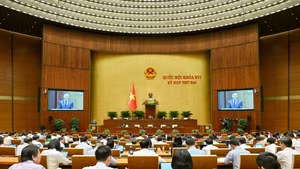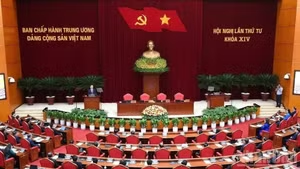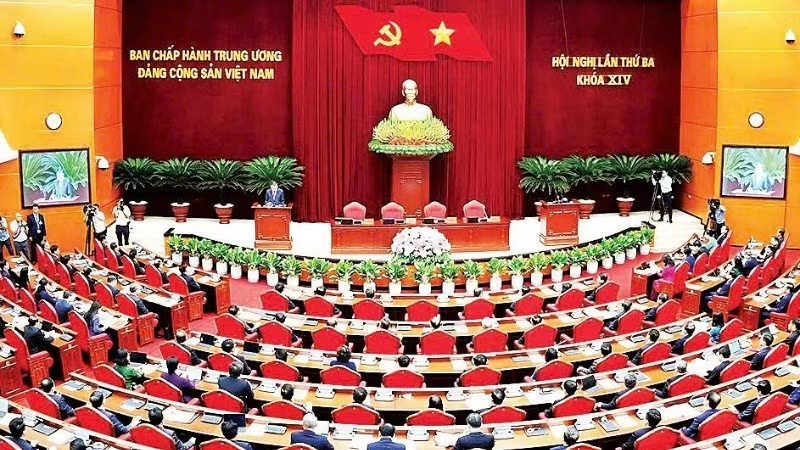
Resolution No. 20-NQ/TW states that the international and domestic context, together with the particularly important position and role of the seas and oceans, requires Viet Nam to build and develop into a strong maritime nation. It affirms that Viet Nam's seas and islands are inseparably linked to the country's sovereignty and its space for survival and development. Building and developing Viet Nam into a strong maritime nation is identified as a long-term national development strategy closely associated with the cause of national construction and defence. It is described as a strategic task for the entire Party, people, armed forces, and political system.
According to the resolution, Viet Nam aims to establish a modern, unified, and integrated national maritime governance system by 2030, while at the same time developing a modern and highly competitive marine economy.
The combined gross regional domestic product (GRDP) of coastal provinces and centrally governed cities is expected to account for more than 70 % of national GDP. Average per capita income in coastal localities is targeted to reach 1.2 to 1.3 times the national average, with average annual GRDP growth exceeding 11 %. Three special economic zones are to be established, while the Human Development Index (HDI) in coastal provinces and cities is expected to surpass the national average.
Looking ahead to 2045, the vision is for Viet Nam to become a strong maritime nation, gaining prosperity through the sea and achieving sustainable development based on its marine resources, with the support of modern maritime governance and advanced marine science and technology.
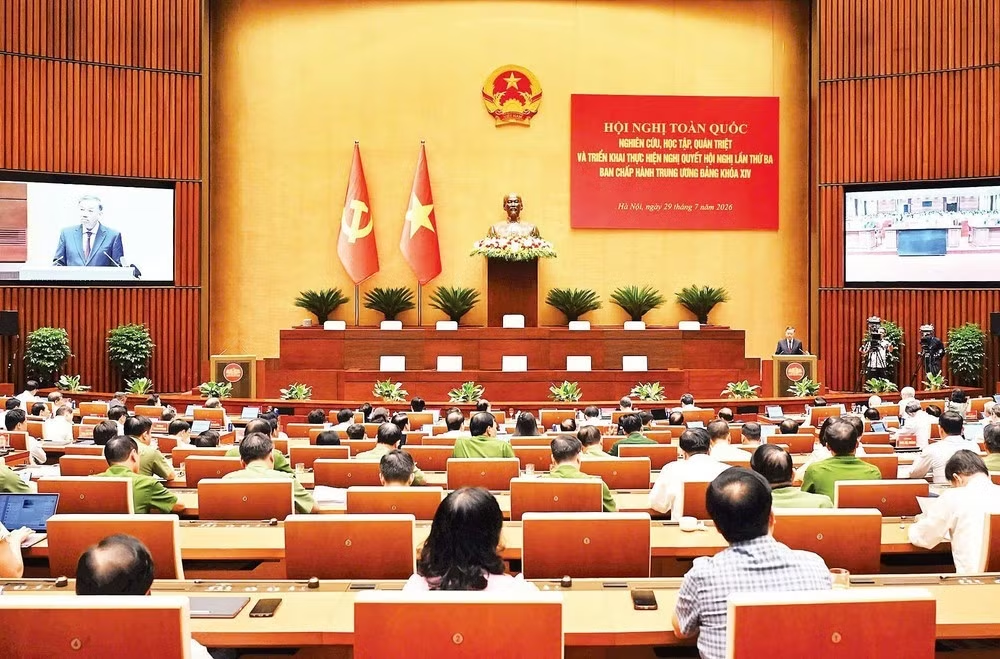
To achieve these objectives, the resolution sets out nine groups of tasks and solutions. It stresses the need to strengthen the Party's leadership while fundamentally renewing awareness, thinking, and strategic vision regarding the development of a strong maritime nation. It also calls for improving public communication and external information work on seas and islands.
The resolution advocates a fundamental shift from a mindset focused primarily on resource exploitation and marine economic development towards a comprehensive approach to developing the national maritime space. It also calls for moving from sector-based management to a modern, integrated, and unified maritime governance model built on digital data and marine spatial planning. The legal framework governing seas, islands, and related sectors is to be reviewed and refined without delay.
It further calls for improving mechanisms for mobilising, allocating, and efficiently using resources to support maritime development. Large-scale state-owned enterprises and private corporations with international competitiveness are to be developed in key maritime sectors. Greater investment is also to be directed towards marine scientific research, technological development and innovation, while promoting breakthroughs in modern, green, and smart marine industries as well as emerging maritime sectors, alongside the development of a modern marine economic ecosystem.
The resolution also calls for the coordinated development of maritime infrastructure, expanding the country's development space, and establishing major marine economic centres of national and regional significance. It envisages the creation of growth poles, economic corridors, and dynamic regions with strong competitiveness, closely linked to the national urban network. Protecting marine, island, and coastal biodiversity and ecosystems is identified as a priority, alongside improving sustainable livelihoods for local communities and advancing the blue economy. The resolution also stresses proactive responses to climate change and sea-level rise, while strengthening resilience, disaster prevention, and risk reduction.
In addition, it calls for fostering a maritime culture, improving the quality of life for coastal communities, and harnessing the strength of maritime communities in national development and defence. It emphasises preserving, restoring, and promoting the cultural, historical and heritage values of Viet Nam's seas and islands while strengthening the country's maritime cultural identity. The resolution also highlights the need to enhance social welfare policies and sustainable poverty reduction, with particular attention given to remote island areas and disadvantaged regions.
Finally, it calls for more proactive and effective international integration, diplomacy, and external communication on maritime affairs, while consistently promoting the peaceful settlement of maritime issues in accordance with international law.