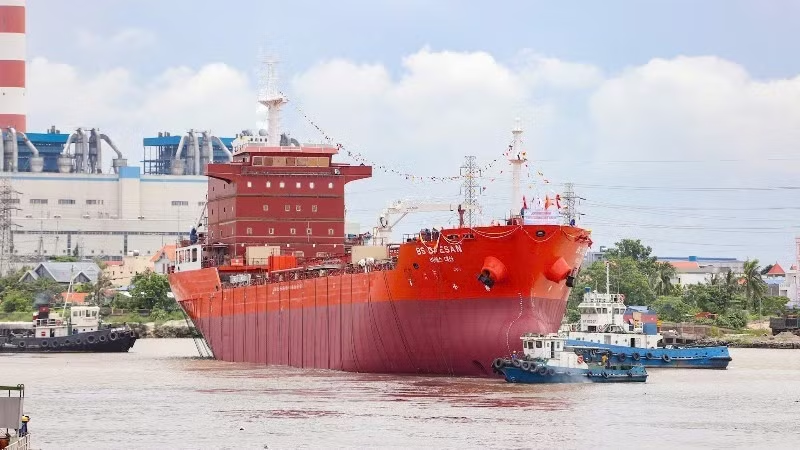
At a working session with relevant agencies on the development of the national maritime industry, General Secretary and President To Lam called on the Government Party Committee to direct the relevant authorities to research and propose a solution for SBIC that focuses on recovery and development, guided by the principle of preventing any loss of state assets or the erosion of industrial capacity that would be difficult to rebuild.
Nhan Dan spoke with Assoc Prof, Dr Nguyen Ngoc Son, a full-time member of the National Assembly’s Committee for Science, Technology and Environment, about the issue.
Q: In 2025, exports of seagoing vessels accounted for only a very small proportion of Viet Nam’s total export value. Why, then, is shipbuilding still regarded as a strategic task?
A: If GDP contribution were the sole criterion, not only Viet Nam but even major powers such as China, Japan, and the US would have little reason to prioritise shipbuilding. For many years, however, the world’s leading shipbuilding nations have consistently concentrated resources on this industry because the real consideration is not how much it contributes to GDP, but how vulnerable the country would become if it lost its shipbuilding capability.

Viet Nam has nearly 3,300 kilometres of coastline and lies along major international shipping routes. Maritime transport carries around 80% of the country’s import and export cargo. For a maritime nation, failing to master the construction, repair, and conversion of watercraft means that, regardless of how modern its ports and logistics network may be, it cannot achieve genuine autonomy in its marine economy.
A notice issued following General Secretary and President To Lam’s working session, also clearly states the objective of avoiding vulnerability when supply chains are disrupted, markets fluctuate, or emergencies arise. Against the backdrop of today’s strategic competition among major powers, shipbuilding capacity also serves as an industrial backbone for national defence and maritime security.
This spirit is also reflected in a resolution issued by the 14th Party Central Committee on July 28, 2026, on building and developing Viet Nam into a strong maritime nation.
Q: Resolving SBIC’s situation is identified as a bottleneck that must first be removed. Why is it considered such a bottleneck, and would the proposed approach of recovery and development face any legal obstacles?
A: This is not simply the story of a single enterprise; it concerns the bulk of the country’s shipbuilding capacity. SBIC and its joint ventures account for around 65% of Viet Nam’s total shipbuilding capacity, with SBIC alone representing approximately 35% of the country’s overall design capacity of around 3.5 million DWT per year.
Years of prolonged restructuring have prevented the company from reinvesting in its development, significantly weakening the nation’s overall shipbuilding capacity while also undermining customer confidence. I therefore believe it is entirely appropriate to identify this as a bottleneck that must be addressed.
Although SBIC’s shipyards remain in bankruptcy proceedings, they already have full orders through to the end of 2028. Within this year alone, they are expected to launch more than 60 vessels worth 1-1.3 billion USD. This demonstrates that the assets being dealt with are not dead assets; they are operational, have a market, and are burdened only by the legacy debts inherited from the Vinashin era.
The prolonged restructuring process has also led to a loss of skilled personnel and interruptions to production orders. Every additional year means another cohort of highly skilled workers leaving the industry. Once that expertise is lost, it is extremely difficult to recover, particularly at this stage.
From a legal perspective, the Law on Business Recovery and Bankruptcy, which was adopted by the National Assembly last year and took effect in March this year, replaced the 2014 Bankruptcy Law. The new law establishes a fundamentally different principle: prioritising the recovery of business operations and creating conditions for viable enterprises to return to the market rather than defaulting to liquidation.
It also introduces support measures relating to taxation, fees, credit, interest rates, land, and other areas. Accordingly, what is needed now is a review of SBIC’s member companies to determine which remain viable and have market prospects, so that recovery procedures can be applied and the tax, credit, and land-related support measures provided under the law can be utilised immediately.
At the same time, I suggest particular attention should be given to policies aimed at retaining skilled workers. While the law gives employees priority in the order of debt repayment, giving them priority for payment is not the same as retaining experienced, highly skilled workers.
Assets can be auctioned and replaced, but once a skilled workforce has dispersed, it is effectively lost, and rebuilding it would require considerable time and effort.
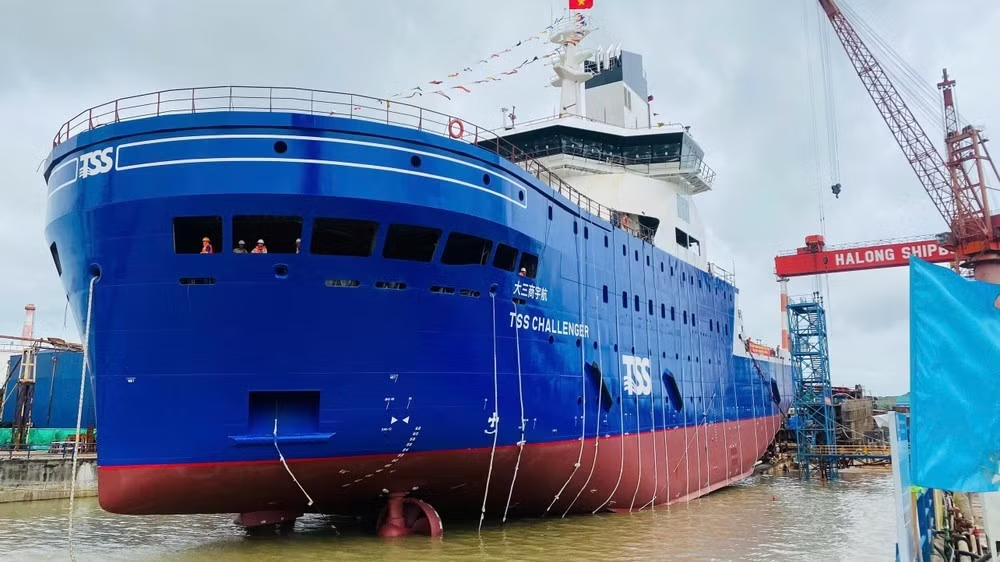
Q: In your view, where should efforts begin to increase the localisation rate of Viet Nam’s shipbuilding industry?
A: I believe the starting point should be shipbuilding steel and basic materials, rather than high-tech equipment. Many development plans begin with main engines or advanced marine equipment, which sounds attractive but takes much longer to reduce production costs.
At present, the localisation rate in Viet Nam’s shipbuilding industry stands at only 20-30%, while domestically manufactured materials and equipment account for just 10-15%, leaving the industry 70-80% dependent on imports.
Steel represents around 20-30% of a vessel’s value. If Viet Nam can gradually achieve self-sufficiency in shipbuilding steel plates and basic materials, the industry’s localisation rate will increase substantially.
Q: Some have proposed giving domestic shipbuilders priority in meeting the demand of Viet Nam’s own shipping fleet. What do you think about this proposal?
A: It is a sound economic idea, but any supporting policy and legal framework must be designed with great care; otherwise, it could conflict with international commitments. I therefore suggest three approaches.
First, place orders for national defence, security, and public service purposes. Second, apply preferences to procurement packages below the relevant thresholds and to entities that fall outside the scope of international commitments. Third, use demand-side instruments such as preferential credit for shipowners who choose to build vessels domestically rather than introducing discriminatory measures in the tendering process.
I believe this is the most appropriate approach. Viet Nam’s plan to rejuvenate its merchant fleet by 2030 will require around 4-5 million DWT of new capacity. That is a genuine, quantifiable market. The only question is whether those orders will go to domestic shipyards or overseas ones.
Thank you very much.