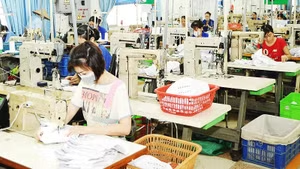
As the global economy faces new challenges and opportunities, shifts in tax policies in major markets like the United States and stringent technical requirements for exports to the European Union (EU) are imposing new demands on exporting enterprises.
“The trend toward green transformation is no longer merely an option; it has become a mandatory requirement and a ‘green passport’ for businesses to enhance their competitive edge and expand into international markets,” emphasised Ho Thi Quyen, Deputy Director of the Ho Chi Minh City Investment and Trade Promotion Centre (ITPC).
The trend toward green transformation is no longer merely an option; it has become a mandatory requirement and a ‘green passport’ for businesses to enhance their competitive edge and expand into international markets.
Ho Thi Quyen, Deputy Director of the Ho Chi Minh City Investment and Trade Promotion Centre (ITPC)
Quyen also noted that the Fourth Industrial Revolution is unfolding rapidly; in particular, the continuous advancement of artificial intelligence (AI), big data, and cloud computing is profoundly transforming production, business operations, and corporate management.
According to statistics from the Ministry of Industry and Trade, the adoption of digital technologies and smart energy management systems can help enterprises reduce operating costs by 10–15%, boost productivity by 20%, and cut CO2 emissions by 5–8% annually. Consequently, digital transformation and green transformation are no longer separate processes but are converging into a “twin transition” strategy. In this context, digital technology has become a tool to drive green growth and enhance the competitiveness of enterprises.
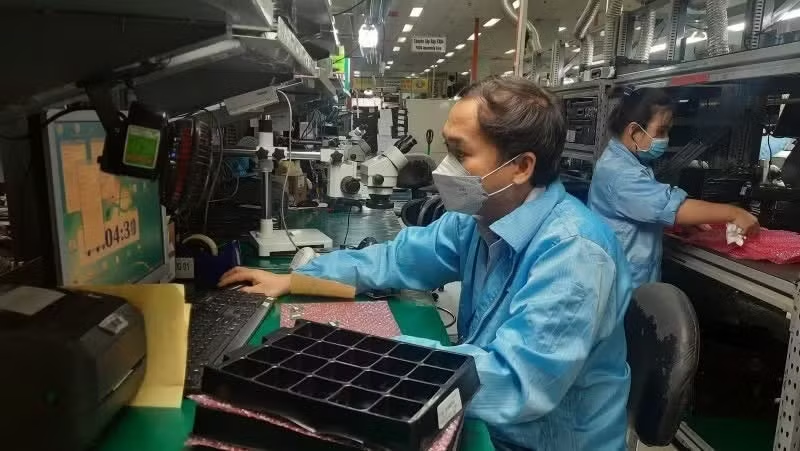
In light of this, experts believe that investing in enhanced management capabilities and updating the knowledge of leadership teams is a crucial solution for establishing a solid foundation for long-term, sustainable growth.
To help businesses boost their international competitiveness, the Ho Chi Minh City Investment and Trade Promotion Centre (ITPC), in collaboration with relevant agencies, recently organised a training programme on the twin transition for the manufacturing sector.
The training program features a practical, in-depth curriculum designed to provide businesses with a comprehensive understanding of global ESG (Environmental, Social, and Governance) trends and the green transition. It also focuses on applying technological solutions—such as ERP (Enterprise Resource Planning), MES (Manufacturing Execution Systems), IoT (Internet of Things), and AI (Artificial Intelligence)—to optimize production, management, and smart factory operations.
Quyen noted that a key feature of this year’s programme is its specific focus on industry sectors most likely to be impacted by the twin transition. The program allocates significant time for interaction and discussion between businesses and the training experts.
Upon completing the course, participants will have an additional session where experts evaluate their practical assignments, providing guidance and advice on step-by-step solutions to implement a twin transition roadmap tailored to their specific business conditions.
According to experts, a key concern for businesses is the evolving European regulatory landscape regarding imports. Key areas of focus include the implementation timelines for the Carbon Border Adjustment Mechanism (CBAM) and the Corporate Sustainability Reporting Directive (CSRD), alongside increasingly stringent data requirements for production and reporting.
This situation presents a complex challenge: while businesses must possess sufficient data to substantiate their production processes, a lack of focus in data collection can deplete resources without necessarily improving management efficiency. Consequently, companies need to identify truly critical metrics rather than engaging in broad, indiscriminate data collection.
Crucially, data management must begin right at the production floor. Information regarding raw materials, energy, output, quality, and emissions must be recorded consistently to ensure auditability and traceability. This serves as the foundation for meeting ESG requirements and evaluating production performance. Reliable and comprehensive data also enables businesses to more easily identify sources of waste and make informed adjustments.

While investment in manufacturing technology is surging, simply installing new equipment or software in a factory does not guarantee improved efficiency. Nguyen Manh Cuong, Deputy Secretary General of the Viet Nam Automation Association, warns of the risk that businesses might merely “digitise chaos” if they adopt technology without first standardising their production processes.
According to Cuong, before investing in a digital system, enterprises should review their current operations and identify areas that drive up costs or negatively impact business performance. Cash flow, inventory management, and product quality are key issues that require priority attention.
This approach helps businesses avoid “bandwagon” technology investments that leave underlying organisational inefficiencies unresolved. Technology delivers results only when it addresses a specific operational problem. Alongside process standardisation, businesses must build a unified and clean data foundation—a prerequisite for implementing advanced applications, including artificial intelligence (AI).