Viet Nam becoming increasingly attractive destination to Chinese tourists
As neighbours, Viet Nam and China share a long-standing, friendly relationship that has been continuously nurtured by generations of leaders and citizens in both countries. Throughout the cultivation of this relationship, tourism has served as a bridge of friendship, extending the journeys connecting Viet Nam, China, and ASEAN. Each journey not only takes visitors to new destinations but also brings people closer together and promotes greater understanding and appreciation of each other's cultural values.
Nguyen Trung Khanh, Head of the Viet Nam National Authority of Tourism, said that Viet Nam's tourism industry had recovered rapidly following the Covid-19 pandemic and recorded strong growth. China remains one of Viet Nam's most important international tourism markets, accounting for around 25-30% of total international arrivals.
The launch of the Viet Nam-China Tourism Cooperation Year 2026-2027 has opened a new direction for bilateral tourism cooperation in the coming time. Viet Nam hopes to work with Chinese partners to strengthen air, road, and rail connections, expand tourism routes and tours, and develop new products, thereby promoting cultural exchanges and two-way tourist flows.
Previously, Tian Qiru, Counsellor at the Chinese Embassy in Viet Nam, proposed making greater use of tourism potential and resources to diversify and improve the quality of tourism products and services. He also called for stronger tourism links between localities of the two countries and the development of cross-border tourism products, particularly at the Ban Gioc-Detian Waterfalls Scenic Area.
The two sides were also encouraged to organise study tours for travel businesses, upgrade tourism infrastructure and services, and improve transport links to facilitate cross-border travel. Both sides also need to expand cross-border payment options — such as QR code payments — to enhance convenience for tourists and boost trade.
In reality, Viet Nam is becoming an increasingly attractive destination for Chinese tourists. In 2025, Viet Nam welcomed 5.28 million Chinese visitors, making China its largest international source market. During the first eight months of 2026, the flow of Chinese tourists to Viet Nam has continued to maintain positive growth momentum.
According to the Viet Nam National Authority of Tourism, these figures demonstrate the appeal of Viet Nam — a beautiful, safe, and friendly country with rich cultural identity, diverse natural landscapes, and varied cuisine, where Chinese tourists are always welcomed with genuine warmth and hospitality.
Conversely, an increasing number of Vietnamese people are choosing China as a travel destination. Statistics show that in the first half of 2026, Viet Nam was the fourth-largest source market for tourism to China, surpassing traditional markets such as the US, Japan, and Australia. This two-way exchange of tourists has contributed to creating a vast and dynamic tourism market between Viet Nam and China.
Enhancing the recognition of Vietnamese tourism brand
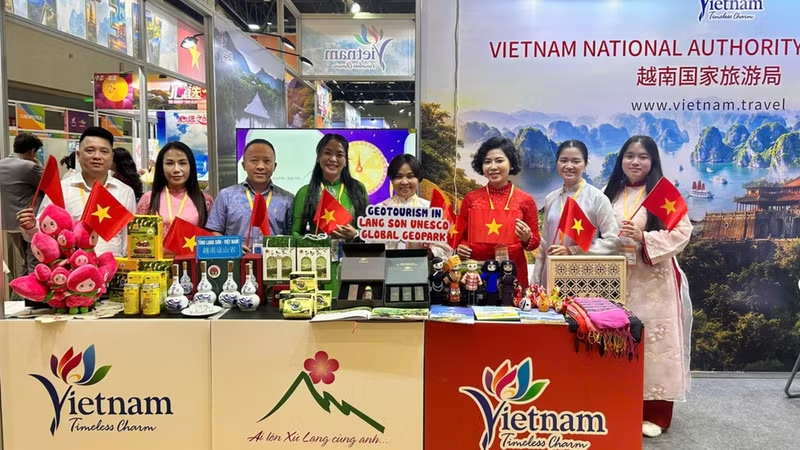
At the 23rd China-ASEAN Tourism Expo, recently held in Guilin, Guangxi, China, Viet Nam was invited to participate as a featured destination for promotion.
The event focused on showcasing cultural and tourism resources, distinctive products, and technology, equipment, and travel services. Within the framework of the event, various exchange activities and specialised discussions took place to facilitate business connections and partnership negotiations among tourism agencies, organisations, and enterprises from China, ASEAN, and the international community.
The Viet Nam National Authority of Tourism stated that the China-ASEAN Tourism Expo served as an opportunity for Viet Nam to promote its destination image and signature tourism products. It also enables the strengthening of connections with management agencies, localities, and tourism businesses from China, ASEAN, and the international community.
"The China-ASEAN Tourism Expo is an annual event that acts as a vital link between China and ASEAN. Within this landscape of connectivity, Viet Nam holds a unique position when it is both an attractive destination and a gateway linking China and ASEAN, serving as a bridge for tourism, culture, trade, and people-to-people exchanges," said Ha Van Sieu, Deputy Head of the Viet Nam National Authority of Tourism.
Accordingly, built upon a foundation of friendly relations and close ties regarding geography, culture, and people, tourism cooperation among Viet Nam, China, and ASEAN is poised for continued robust, substantive, effective, and sustainable development.
This year's expo was held under the theme "CAFTA 3.0 Opportunities, Better Life." Key topics of discussion include cultural and tourism experiences and consumption, international tourism, tourism technology and equipment, creative cultural products, and cultural economics and trade. In addition, the organisers arranged areas to showcase artificial intelligence equipment and smart services for international visitors, alongside business promotion and connection activities.
The 108-square-meter Vietnamese pavilion was designed to promote the country's overall tourism image, showcasing destinations, signature tourism products, and offerings tailored to the Chinese and ASEAN markets.
These promotional and connection activities helped boost Viet Nam’s recognition as a destination while creating opportunities for localities and tourism businesses from both sides to discuss market demands, link products, expand cooperation, and foster visitor exchanges.
"Coming to Guilin — a region of stunning landscapes in Guangxi — for a regionally significant event like the China-ASEAN Tourism Expo represents more than just a tourism promotion activity for Viet Nam; it is also an opportunity to gain a deeper appreciation of the shared values connecting the peoples and localities of China and Viet Nam, as well as the wider Southeast Asian region," added Ha Van Sieu, Deputy Head of the Viet Nam National Authority of Tourism.
Viet Nam aims to strengthen air, road, and rail connectivity with its Chinese partners, while also expanding tourism routes and tours and developing new products. These efforts are intended to boost cultural exchange and increase two-way visitor flows.





![[Video] Viet Nam among Top three Asian destinations for return visitors](https://en-cdn.nhandan.vn/images/nyM650OGFWrOVWc-xajqN-rTZ68Rlmc1fiGJOhBRYHErj-E25MBpvJqrpphXazfrpe9t-fYCGuQU4CN0yXo3Rg/du-lich-vietnam.jpg.avif)