SMEs make up a large proportion of the business community, but the effectiveness of existing support policies remains a concern. The Government has therefore proposed a new Law on SME Development to replace the 2017 Law on Support for SMEs.
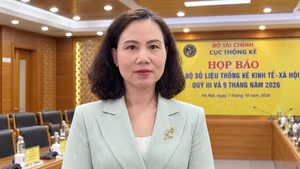
Speaking at the Ministry of Finance’s third-quarter press briefing on October 6, Trinh Thi Huong, Deputy Director of the Department of Private Enterprise and Collective Economy Development, said the policy system had been gradually improved, but some measures had yet to deliver clear impacts, while businesses’ access to support remained limited.
The draft law, comprising five chapters and 35 articles, shifts the focus from broad-based support to targeted measures based on businesses’ needs and stages of development. Support would be time-bound and linked to outcomes, following a pathway from household businesses to micro, small and medium-sized enterprises, and eventually larger businesses.
The draft also proposes moving from procedure-based management towards data- and results-based administration, with greater use of digital platforms and interconnected business data. The State would shift from directly providing support to building an ecosystem connecting businesses with experts, incubators, universities, research institutes, financial institutions, investment funds and larger enterprises.
Support measures would include improved access to capital, premises, technology and markets. The draft also seeks to simplify tax procedures and reduce compliance costs, alongside tax incentives for SMEs.
For household businesses converting into enterprises, the draft proposes reducing business registration processing time to one working day and waiving certain initial fees. New enterprises would also be eligible for simplified tax, accounting and reporting requirements for 36 months, as well as digital and accounting support.
A simplified governance model is proposed for single-member limited liability companies converted from household businesses and meeting the criteria for micro-enterprises.
Overall, the draft aims to ensure that support reaches the right businesses at the right time, while enabling enterprises to choose assistance that best matches their development needs.