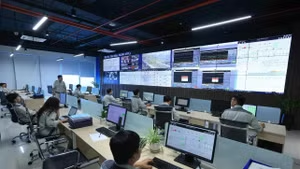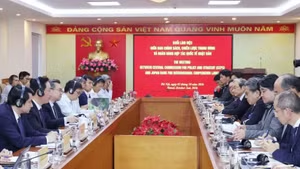
In its role of exercising state management over industry and trade, the Party Committee of the Ministry of Industry and Trade has actively advised the Government Party Committee and the Government on measures to promote rapid and sustainable socio-economic development.
With a focus on renewing governance thinking, improving the quality of policy advice and strengthening implementation capacity, the Party Committee of the Ministry of Industry and Trade has directed Party committees and specialised units under the ministry to translate Government-assigned targets into monthly and quarterly indicators and management scenarios. They have also been tasked with forecasting risks, closely monitoring developments, identifying and promptly addressing bottlenecks and emerging issues, and preventing difficulties from accumulating into major obstacles to implementation.
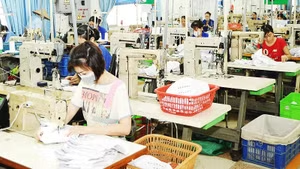
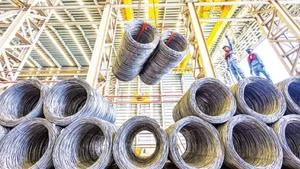
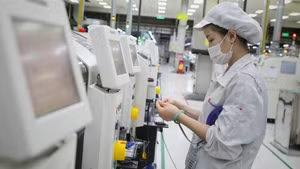
Industrial production, particularly processing and manufacturing and sectors capable of generating high added value and significant spillover effects, continues to play an important role in development. The ministry’s Party Committee has directed its leadership and relevant units to strengthen direct engagement with localities, associations and businesses to address difficulties relating to orders, raw materials, investment procedures and project progress, while focusing on sectors and industries experiencing a slower recovery.
As a result, industrial production continued to maintain positive growth momentum in 2026. The processing and manufacturing sector grew by 12.5%, contributing 9.6 percentage points to overall industrial growth.
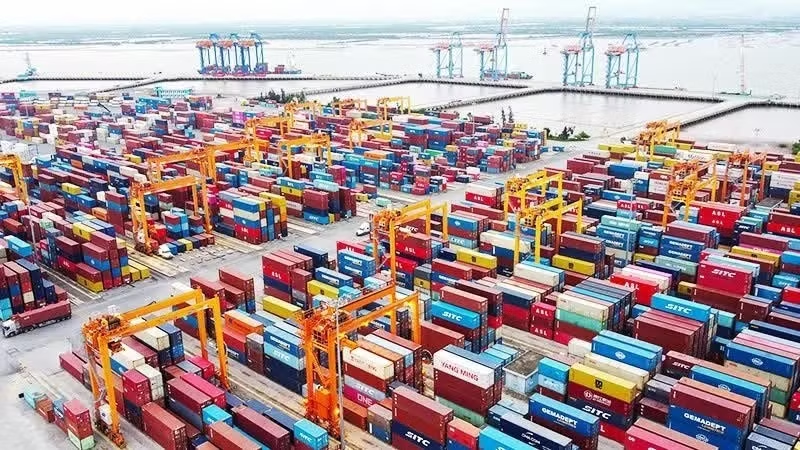
To boost exports, the ministry’s Party Committee has directed efforts towards making more effective use of free trade agreements (FTAs), diversifying markets and supply chains, and identifying solutions to improve the quality and sustainability of growth. It has also strengthened early-warning mechanisms, proactively responded to trade remedy cases, tightened origin controls, and supported businesses in meeting increasingly stringent green and technical standards in major markets.
As of September, export turnover reached 374.84 billion USD, up 22.4% year on year, exceeding the full-year 2026 export growth target of 15–16% and providing a favourable foundation for achieving the annual target.
Notably, in response to a sharp increase in the trade deficit, the Ministry of Industry and Trade proactively implemented measures to promote exports and curb the deficit. As a result, the monthly trade deficit gradually narrowed from 5.21 billion USD in May to 2.12 billion USD in August.
Regarding the domestic market, the Party Committee of the Ministry of Industry and Trade has actively directed coordination to promote substantive demand-stimulus programmes, strengthen supply-demand linkages, and develop modern distribution systems and e-commerce. It has identified the domestic market as an increasingly important pillar of growth, particularly amid fluctuations in global markets.
By August, total retail sales of goods and consumer service revenues had increased by 13.3% year on year, reflecting continued expansion in consumer demand and service activities and contributing to growth in the services sector.
Thanks to efforts by Party committees and units under the Ministry of Industry and Trade, two targets under the Government’s 2026 socio-economic development plan and State budget estimates have been met: total electricity production and imports; and growth in total retail sales of goods and consumer service revenues. Three targets have exceeded the plan: export growth; the power generation capacity reserve ratio; and the proportion of enterprises using e-commerce. These results have contributed to efforts to achieve the double-digit growth target set by the Party Central Committee.
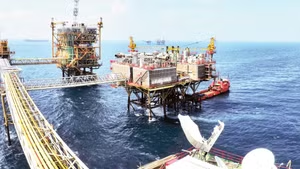
However, many sectors and industries continue to face difficulties. Progress in adding new power generation capacity remains slower than targeted, posing potential risks to growth in the coming years, while the trade deficit in raw and auxiliary materials with several markets remains high. Three Government targets have yet to be met and require continued attention: industrial production growth; growth of the B2C e-commerce market; and total power generation capacity.
According to Phan Van Ban, full-time Deputy Secretary of the Party Committee of the Ministry of Industry and Trade, the Party Committee will continue to direct specialised units to maintain industrial production growth; ensure sufficient supplies of electricity and petroleum products under all circumstances; expand export markets while controlling the trade deficit and safeguarding supply chains; stimulate domestic demand; and promote e-commerce.
The Party Committee has also called for decisive changes in its leadership methods, with a focus on removing institutional bottlenecks and completing the drafting of legal documents. Issues within the ministry’s authority should be addressed proactively, while matters beyond its authority should be promptly submitted to the Government for consideration.
Responsibility of Party committees and their leaders will be linked to the performance of political tasks, with the quality of policy advice, progress, outcomes and effectiveness in handling assigned work serving as key measures of leadership capacity.
![[Infographic] GRDP growth scenarios for 34 provinces and cities in fourth quarter of 2026](https://en-cdn.nhandan.vn/images/nyM650OGFWrOVWc-xajqN-rTZ68Rlmc1fiGJOhBRYHFSa4DhrHNDxEFdnz313Vk5dNJuxdkHglPA3rLeaPeiaUheNuCI723k2lNssd-YLJuKR58epWq7s21lV5WjM-HR2-Qpbi4MwAzqt9wRjL4WjGkfEz7RO9qhcwg8o8LQFK8/grdp-growth-scenarios-for-34-provinces-and-cities-in-q42026-anh-dai-dien.jpg.avif)