Workers – major factor for productivity improvement
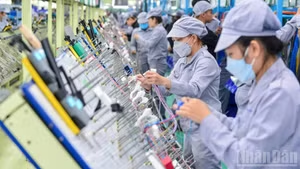
Amid the rhythmic hum of offset printing machines at MYS Group Viet Nam Packaging Technology Co., Ltd., Bui Tien Trung still maintains the habit of recording every issue that arises during production. For this experienced technician, every stage of the manufacturing process presents an opportunity for improvement.
After numerous trials, Trung proposed adjustments to several technical parameters, optimised machine operating procedures and standardised production norms. Although the changes were relatively modest, they significantly reduced material waste, shortened order-processing time and improved product quality.
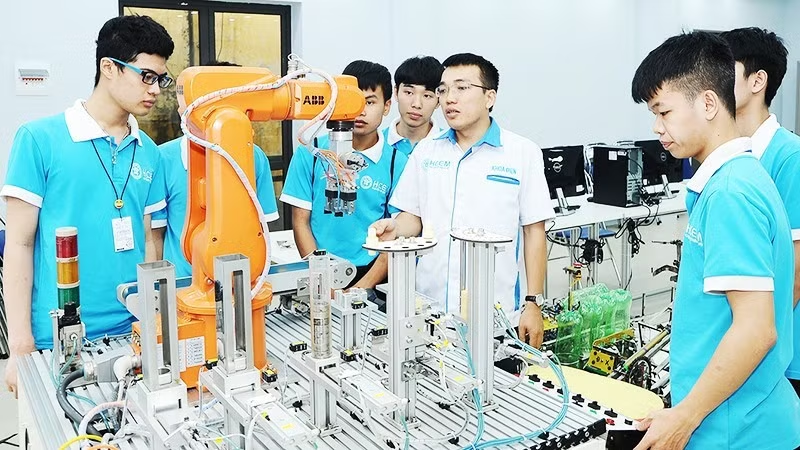
“Previously, I simply followed established procedures. After receiving further training in engineering and technology, I gained a much deeper understanding of how the machines operate, allowing me to proactively suggest process improvements,” Trung said.
His story reflects a a reality currently unfolding in many manufacturing businesses. Labour productivity is driven not only by modern production lines but also by the small initiatives generated by workers themselves.
At R-pac Viet Nam Co., Ltd., a packaging design and manufacturing company, productivity improvement is directly linked to human resource development. The company regularly conducts professional skills assessments, which serve as the basis for determining skill allowances, productivity bonuses and other employee benefits.
Nguyen Thi Nhan, one of the company's workers, said: “Every six months or once a year, the company evaluates our professional skills. The results are reflected in our bonuses and allowances, so everyone is motivated to keep learning and improving.”
According to representatives of R-pac Viet Nam, in today's increasingly competitive business environment, companies can no longer rely solely on machinery or capital investment. Instead, they must place employees at the centre of productivity enhancement. Even seemingly small improvements on the production line can generate added value not only for individual businesses but also for the broader economy.
The key to achieving double-digit growth
For many years, Viet Nam's economic growth has relied primarily on traditional inputs such as investment capital, an abundant labour force and natural resources. However, these growth drivers are gradually losing momentum as labour costs rise and land and natural resources become increasingly constrained.
Against this backdrop, improving labour productivity has become the inevitable path to sustaining high economic growth and strengthening national competitiveness.
According to official statistics, Viet Nam's labour productivity has improved steadily in recent years. In 2023, labour productivity reached approximately 201 million VND per worker. This increased to 222 million VND in 2024 and is estimated to reach 245 million VND per worker in 2025. Nevertheless, Viet Nam's labour productivity currently stands at only around 60% of Thailand's, 40% of Malaysia's, and remains far below that of Singapore.
Experts believe this gap represents not only a challenge but also significant room for future growth.
Ngo Duy Hieu, Vice President of the Viet Nam General Confederation of Labour, emphasised that people remain the most important factor in improving productivity. He added to enhance labour productivity, firstly, it is essential to improve workers' professional knowledge, vocational skills and workplace discipline. These are also the decisive factors determining enterprises' competitiveness in the era of digital transformation and deeper international integration.
The Resolution of the 14th National Party Congress sets an ambitious target of achieving average annual economic growth of around 10% during the 2026–2030 period. Many economists argue that such a goal can only be realised through a major breakthrough in labour productivity.
Ultimately, labour productivity measures how efficiently an economy utilises its resources. With the same amount of labour and investment capital, higher productivity can generate greater output, higher value-added and stronger competitiveness. This is why many developed economies consistently regard productivity as the foundation of long-term growth.
Speaking at a recent dialogue with delegates attending the 14th Congress of the Viet Nam Trade Union, Prime Minister Le Minh Hung stressed that improving labour productivity is both an urgent requirement and a key driver for achieving rapid, sustainable growth and eventually reaching double-digit growth rates during the country's new development phase.
According to the Prime Minister, the Resolution of the 14th National Party Congress clearly identifies the need to transform the growth model by placing greater emphasis on labour productivity, science and technology, innovation and the quality of human resources. Labour productivity is a comprehensive indicator reflecting both the efficiency of resource utilisation and the quality of economic growth. It is not merely an economic issue but also a matter of people and sustainable development.
The Government is currently finalising a National Labour Productivity Enhancement Programme, which will be submitted to the Secretariat for approval in the near future. The programme will outline comprehensive solutions to make labour productivity a principal driver of rapid and sustainable economic growth, with improving the quality of human resources identified as the strategic breakthrough.
“If we want to increase national labour productivity, we must begin by improving the quality of our workforce. Workers need to be equipped with digital skills and the ability to adapt to new production models so they can master science and technology and actively participate in digital transformation and innovation,” Prime Minister Le Minh Hung affirmed.
In addition to workforce development, the Government is also accelerating policies to help businesses adopt science and technology, innovation and digital transformation. At the same time, greater attention is being paid to housing, healthcare, education and social welfare policies for workers to create better living and working conditions.
The 14th National Party Congress has set the goal of ensuring that 35–40% of the workforce possesses formal qualifications or professional certificates by 2030. This is not merely an education target but a fundamental prerequisite for raising national labour productivity and strengthening Viet Nam's long-term growth prospects.