Private economy at the centre of growth strategy
Q: Dr Nguyen Minh Thao, how do you assess the phrase “the private economy is at the centre of the growth strategy” in the current context?
A: In the current context, with the goal of double-digit growth, the role of enterprises is always important. Without enterprises, we cannot create momentum or unlock resources for growth.
The central role of the private economy in the growth strategy reflects an important shift in Viet Nam’s development thinking. This is a strategic orientation aimed at creating new growth drivers. The Party’s guidelines and policies have clearly affirmed that the private economy is one of the most important drivers of the national economy.
As Viet Nam moves towards high and sustainable growth, the central driver is the robust development of the business sector, in which the private economic sector plays a key role.
Q: Given the current internal strength and “health” of Vietnamese private enterprises, what breakthroughs or turning points in strategic thinking are needed for them to truly shoulder the double-digit growth target?
A: In reality, private enterprises are still facing many interwoven institutional bottlenecks, including legal documents and implementation; a heavy burden of administrative procedures; market conditions and rising cost pressures; and limited internal competitiveness.

Therefore, given their responsibility and central role in driving the country’s growth strategy, breakthrough and substantive solutions are needed to create a “push” for this economic sector.
Private enterprises are still facing many interwoven institutional bottlenecks, including legal documents and implementation; a heavy burden of administrative procedures; market conditions and rising cost pressures; and limited internal competitiveness.
Dr Nguyen Minh Thao
First of all, we need to change our mindset, shifting from management to enabling a policy environment for enterprise development. It is necessary to establish an open institutional foundation that encourages investment and business activity. This should be accompanied by a mechanism to monitor and supervise the implementation of this principle in practice.
Enterprises need not only preferential policies, but also a stable, transparent and open business environment, with lighter procedural burdens and lower compliance costs. In my view, it is necessary to urgently materialise plans to reduce business conditions and administrative procedures, in association with substantive digital transformation and the companionship of the authorities. The gap between policy and implementation must be narrowed.
Special and breakthrough mechanisms should be established to develop large-scale private enterprises with a leading and spillover role, and to attract enterprises in the state economic sector to participate in nationally key projects and important projects.
At the same time, it is necessary to focus on improving the legal framework to encourage enterprises to conduct research and develop science and technology, and to create momentum for innovation, thereby laying the foundation for enterprises to contribute to breakthrough growth.
Finally, it is necessary to support and accompany enterprises so that they can comply with new standards and requirements, such as green standards and traceability. These are urgent requirements that many countries around the world have been applying, and Vietnamese enterprises must not be left behind in global development trends.
Enterprises need not only preferential policies, but also a stable, transparent and open business environment, with lighter procedural burdens and lower compliance costs.
Dr Nguyen Minh Thao
Multiplying strength through public-private cooperation
Q: For the private economy to truly become the “centre”, how should public-private partnership, or the interaction between the state economic sector and the private economy, change over the next five years? How can state resources serve as seed capital, leading and activating the huge amount of idle capital in society from the private sector to flow into development investment?
A: Party documents and resolutions have clearly affirmed that the state economy plays the leading role, while the private economy is one of the most important drivers. The state economy plays a guiding and spillover role, attracting participation and encouraging the creativity of the private sector.
The PPP model is considered a key solution in mobilising, allocating and effectively using resources in society, in which state resources serve as seed capital and private resources are an important factor. The Government has proposed total public investment capital of 8.22 quadrillion VND for the 2026-2030 period, 2.7 times higher than the figure implemented in the previous five-year period. Of this, around 80% of public investment capital is expected to be mobilised from other resources, such as domestic enterprise resources, social investment resources and foreign investment capital.
The policy framework for PPP has gradually been improved. However, regulations and administrative procedures for attracting investment, risk-sharing mechanisms, co-investment mechanisms and the mechanism for government companionship also need to be further completed to ensure policy coherence. In addition, it is necessary to closely monitor and assess the effectiveness of PPP policy implementation in order to identify bottlenecks and obstacles and, on that basis, promptly propose solutions to unlock them. Reality shows that the process of implementing PPP projects remains complex and time-consuming; revenue risk-sharing mechanisms are not attractive enough; and information transparency remains unclear.
Criteria and procedures for selecting investors need to be implemented on the principles of openness, transparency and competition, with a mechanism to supervise implementation.
Reforming business conditions, removing burdens on enterprises
Q: We are placing high expectations on unlocking resources so that private enterprises can grow stronger. However, the boundary between a policy that “paves the way” and a regulation that “binds” is sometimes very thin. In your view, for reforms to business conditions to truly “untie” enterprises rather than remain only on paper, what are the core principles in designing policies to reform administrative procedures and cut business conditions in order to truly create a safe and supportive environment for enterprises?
A: The common goal that countries around the world pursue when reforming the investment and business environment consists of three core principles: first, reducing time; second, reducing costs; and third, minimising risks, towards building a safe business environment. I believe these are the consistent principles we need to continue pursuing.
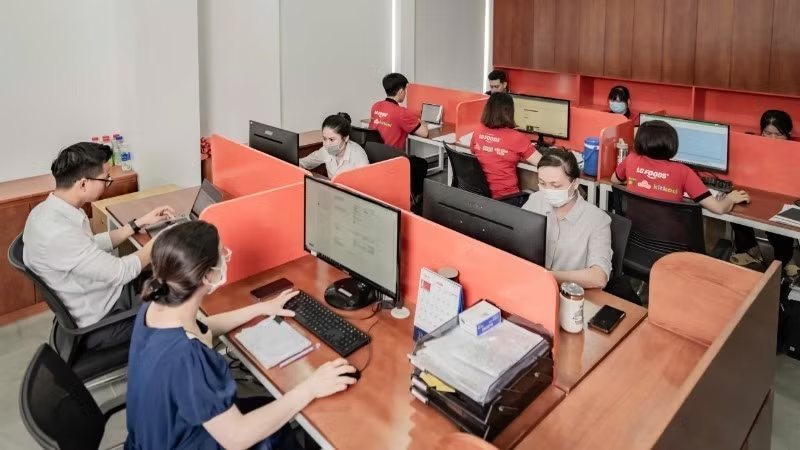
In addition, another important factor is the companionship of the Government and local authorities. In the past, there were periods when the business community was extremely encouraged. That was when many dialogues and meetings between authorities and enterprises were held regularly. At those forums, all recommendations and feedback from enterprises were truly listened to.
I consider these to be valuable practical experiences that we need to continue maintaining and promoting in order to create more spaces for connection, where enterprises are willing to share. Reality has shown that through direct dialogues at conferences, leaders of ministries and sectors made clear commitments that any legal document issued incorrectly or with shortcomings would be immediately revised and adjusted to ensure that obstacles facing enterprises were thoroughly resolved.
Q: For the review of hidden business conditions to become substantive, how should the model and operating mechanism of an independent monitoring unit be established to promote enterprise development?
A: In the period before the Covid-19 pandemic, the ratio between the number of enterprises entering the market and those withdrawing from the market differed by around three to four times. However, during the Covid-19 pandemic and the early stage of economic recovery, the picture changed completely. There were times when we saw this ratio fall sharply, even to below one. At present, the figure stands at 1.18 times.
This figure shows that the development momentum of our country’s business sector has slowed to a certain extent compared with the previous period. Although many policies have been issued over the past time, I personally recognise that the system has undergone many reforms and positive changes.

In particular, since Resolution No. 68/NQ-CP was issued, the ratio of enterprises entering the market to those withdrawing has grown strongly, doubling. Specifically, right after Resolution 68 entered life, in 2025, this ratio doubled.
With the result of 1.18 times over the past six months, we have every reason to expect that in the last six months of the year, under the impact of recently issued policies, especially the Government’s resolutions on cutting business conditions, a strong push will be created to bring this ratio back to the two-fold growth mark. This is a perspective based on actual data that I would like to share.
Regarding how we can effectively monitor hidden business conditions, we conducted a large-scale review in 2016, covering 6,000 business conditions and carried out by an independent unit. After this review was completed, based on the recommendations and data collected, ministries and sectors cut up to 30% of the existing business conditions.
From that practical lesson, for the current monitoring mechanism, I would like to emphasise the core role of an independent monitoring unit. When an independent organisation carries out and supervises this entire process, it creates an effective cross-monitoring mechanism. At that point, the business community will have the opportunity to raise its feedback, while state management agencies will also become more proactive and resolute in conducting reviews.
Only when such a mechanism is established can the review and reduction of business conditions become substantive and meet the great expectations and aspirations of the business community.
Thank you very much.