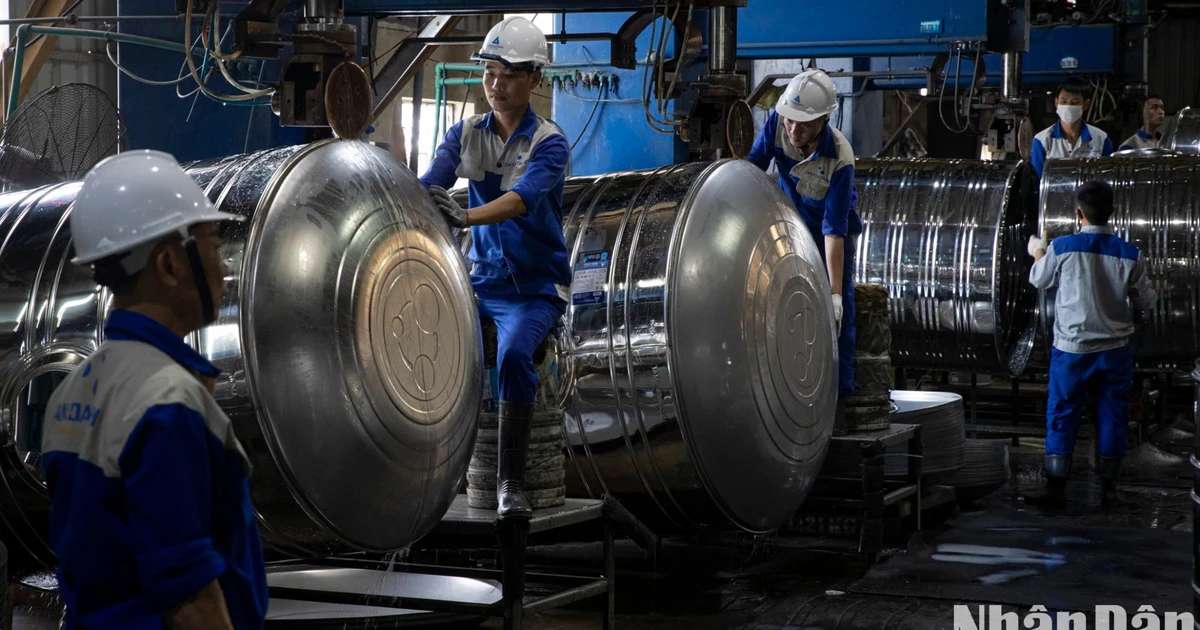
The Resolution underscores the need to eliminate prejudice and the “ask–give” mechanism toward the private sector; reduce interventions in production and business activities that run counter to market principles; and remove administrative barriers to create a transparent, stable, low-cost, and internationally standardised business environment. These measures are intended to provide a strong boost, transforming the private sector into a key driver of sustainable economic growth.
After nearly eight months of implementation, the market has recorded clear and positive changes. On average, more than 18,000 new enterprises have been established each month, while around 11,300 businesses have resumed operations, up approximately 38% and 46%, respectively, compared with the average of the first four months of 2025.
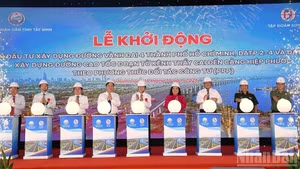
In 2025, more than 300,000 enterprises were newly established or resumed operations, with total registered capital exceeding 6 quadrillion VND (228.4 billion USD), up over 30% and 71%, respectively, compared with 2024. This brought the total number of active enterprises nationwide to nearly 1.1 million. Private investment has also been effectively unlocked. Following three waves of simultaneous groundbreakings and inaugurations of major national projects, 564 projects with a total investment of more than 5.14 quadrillion VND (195.7 billion USD)—equivalent to about 40% of GDP—have been implemented, with private capital accounting for over 74%, approximately 3.8 quadrillion VND (144.7 billion USD). These figures reflect a renewed vitality in the economy, where business confidence continues to strengthen, affirming the soundness of the policy of using public investment as “seed capital” to lead and stimulate private investment.
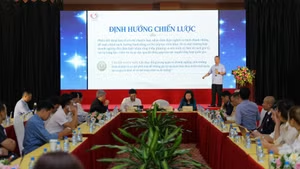
However, speaking at a recent meeting, Prime Minister Pham Minh Chinh noted that there remain shortcomings and constraints in the implementation of Resolution No.68-NQ/TW. In some places, dissemination and awareness-raising have not been sufficiently comprehensive, rigorous, or effective. Administrative procedure reform in certain localities and sectors has yet to meet set targets; information and communication efforts, particularly policy communication, have not received adequate attention. Decentralisation and delegation of authority in resolving issues and removing bottlenecks have not been thorough, with remnants of the “ask–give” mechanism still evident.
In addition, the Resolution’s impact in some sectors and localities remains limited, while certain direct support policies (on taxation, credit, production and business premises, etc.) have yet to be fully institutionalised. The business community, especially small and micro enterprises and household businesses in certain sectors, continues to face numerous difficulties and has not fully met development requirements in the new era. Efforts to encourage large enterprises to participate more deeply in global value chains have also been uneven and insufficiently robust.
Therefore, to ensure more effective implementation of Resolution No.68-NQ/TW in the time ahead, the entire political system must adopt synchronised solutions, strengthen dissemination and supervision from central to local levels, and establish clear accountability mechanisms. Ministries and sectors need to urgently issue detailed guidance on land and legal support policies and amend the Law on Support for Small and Medium-sized Enterprises. Financial support measures, green credit, tax reductions for enterprises and technology startups, and the promotion of venture capital funds should also be continued.
More importantly, a coherent legal framework must be built, with stronger application of science and technology to address overlaps among related laws and simplify administrative procedures for enterprises. Timely removal of difficulties and obstacles will help create momentum and inspiration for the private sector to develop strongly and sustainably in the coming period. Notably, greater encouragement should be given to enterprise participation in policymaking, ensuring that policies are grounded in reality, closer to businesses, and that Resolution No.68-NQ/TW truly comes to life.