The consistent orientation of the State Bank of Viet Nam in recent times indicates that credit flows will be managed more tightly, with priority given to production, business, retail, consumption, and sectors generating sustainable added value. This approach is expected to strengthen the medium- and long-term growth foundation of the economy.
Selective tightening
Recently, several commercial banks’ adjustments to increase lending rates for real estate have drawn market attention. According to experts, this is not an isolated move but clearly reflects the policy of steering capital flows — reducing the share of credit directed towards potentially risky sectors, particularly speculative real estate — and reallocating it to priority areas where demand for capital to support production, exports, and consumption remains present and capable of effective absorption.
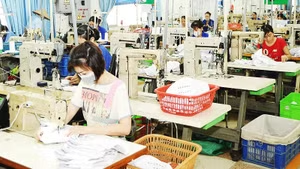
While capital flows into real estate are being more strictly controlled, the production sector has recorded rising capital demand alongside a recovery in orders. At the disposable chopstick manufacturing plant of Hoa Lu Handicrafts Company in Ha Noi, work has become busier than ever as the enterprise increases shifts to fulfil export orders signed months in advance. “On average, we export more than 10 containers per month. Orders currently extend through the end of the first quarter of 2026,” said factory director Do Duc Dung. To sustain this production pace, the enterprise requires stable capital flows to proactively procure raw materials and avoid being exposed to market volatility.
In response to actual business demand, many commercial banks have actively restructured their lending portfolios and rolled out credit packages structured along production chains and sectoral ecosystems. This approach not only ensures smooth capital flow from input to output but also enables banks to better manage risks by monitoring enterprises’ actual cash flows. According to Pham Nhu Anh, General Director of the Military Commercial Joint Stock Bank (MB), the bank is focusing resources on household businesses, production enterprises, consumer goods manufacturers, and exporters, especially during the year-end peak season and the Tet holiday.
From another perspective, Le Hoang Tung, Deputy General Director of the Joint Stock Commercial Bank for Foreign Trade of Viet Nam (Vietcombank), affirmed that the consistent orientation is to pursue credit growth alongside strict quality control, ensuring system safety, and directing capital towards sectors with strong spillover effects on economic growth rather than merely chasing loan scale.
This orientation is also clearly reflected in credit management for 2026. Accordingly, the State Bank of Viet Nam requires credit institutions to tightly control outstanding loan growth from the beginning of the year, particularly in the first quarter, with growth not exceeding 25% of the annual target. Compared with previous years, when banks were allowed to allocate credit according to their business plans, this marks an important change aimed at limiting localised credit overheating that could exert pressure on liquidity, interest rates, and exchange rates.
Channelling capital into high-spillover sectors
According to specialists, distributing credit more evenly throughout the year will help reduce the economy’s seasonality, avoiding concentration of capital flow toward the end of the year as seen in previous years. When capital is not concentrated at specific times, the economy can operate more steadily, macroeconomic volatility risks are reduced, and monetary policy gains more room for proactive and flexible management. However, a key challenge remains: the economy’s capacity to absorb capital still depends heavily on business health and actual market demand. Therefore, credit management cannot be separated from fiscal policy, public investment, and improvements to the business environment.
Economist Dr Can Van Luc, a member of the Prime Minister’s Policy Advisory Council, pointed out that bank credit currently accounts for around 50% of the total capital of the economy, while other sources such as the bond and stock markets, investment funds, public investment, FDI and even private enterprises’ own capital have not developed commensurately. Overreliance on bank credit not only creates pressure on the financial system but also distorts resource allocation.
Therefore, to use each unit of capital effectively, experts believe that in the long term it is necessary to reduce dependence on bank credit and further develop other capital channels. When the capital structure becomes more balanced, bank credit can focus more deeply on sectors with high spillover coefficients such as processing and manufacturing, exports, high-tech agriculture, small and medium-sized enterprises, digital transformation projects, and green production initiatives.
Practice shows that when capital is directed to the right place, the results are clear. In many agricultural cooperatives, credit capital has been used to restructure farming methods towards greener and more sustainable models. The organic rice–ragworm–mud crab model at An Thanh Agricultural Services Cooperative in Chi Minh Commune, Hai Phong City, provides a vivid example: when capital is invested appropriately — from irrigation and field improvement to market linkages — the added value per hectare of agricultural land can increase many times compared with traditional production.
Amid numerous domestic and external uncertainties that continue to pose potential risks, the cautious yet flexible policy stance of the State Bank of Viet Nam reflects consistency in its objectives: maintaining macroeconomic stability, keeping inflation under control, and supporting growth by directing credit flows to sectors capable of generating sustainable added value for the economy.
In 2026, the State Bank of Viet Nam targets lower credit growth than in 2025. Amid numerous domestic and external uncertainties that continue to pose potential risks, the cautious yet flexible policy stance of the State Bank of Viet Nam reflects consistency in its objectives: maintaining macroeconomic stability, keeping inflation under control, and supporting growth by directing credit flows to sectors capable of generating sustainable added value for the economy.
Many experts note that with projected credit growth of around 15%, the issue lies not in the absolute figure but in allocation efficiency. If capital flow is guided towards production, business, exports, consumption, the green economy, and digital transformation, each unit of credit will generate stronger spillover effects, laying a solid foundation for Viet Nam’s long-term growth objectives.









![[Infographic] GRDP growth scenarios for 34 provinces and cities in fourth quarter of 2026](https://en-cdn.nhandan.vn/images/nyM650OGFWrOVWc-xajqN-rTZ68Rlmc1fiGJOhBRYHFSa4DhrHNDxEFdnz313Vk5dNJuxdkHglPA3rLeaPeiaUheNuCI723k2lNssd-YLJuKR58epWq7s21lV5WjM-HR2-Qpbi4MwAzqt9wRjL4WjGkfEz7RO9qhcwg8o8LQFK8/grdp-growth-scenarios-for-34-provinces-and-cities-in-q42026-anh-dai-dien.jpg.avif)