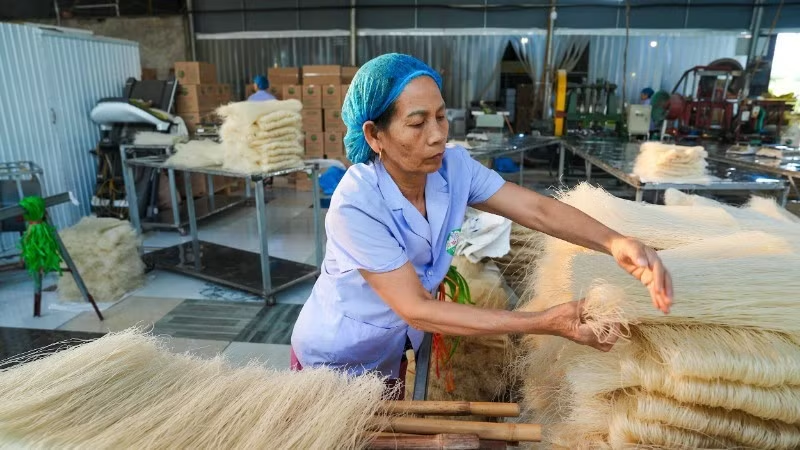
On the fields recently devastated by the storm, Nguyen Thi Lan, a goat farmer and crop grower in Khanh Hoa Province, is still reeling from the shock of her entire property being submerged, almost her entire herd of over 10 goats, and her corn crop ready for harvest being swept away. The biggest worry for individual producers like Lan is not rebuilding her goat herd, but rather the cash flow needed to repay bank loans and rebuild her life.
“Without capital, we’re doomed. If we don’t restore production in time, I don’t know how I’ll repay the bank and continue for the next seasons,” Lan shared.
Hope only came when the bank where she borrowed announced a three-month preferential interest rate reduction and offered additional loans with suitable limits. “This will help us maintain our production pace. Otherwise, it will all fall apart,” she said.
Lan’s story is just a small glimpse into the broader picture of the need for capital recovery after the floods, in the context of a surge in credit demand at the end of the year. This is also the time when the State Bank of Viet Nam is implementing a comprehensive set of solutions to ensure that capital flows to the right place at the right time.
Proactive management to maintain economic momentum
The latest figures from the State Bank of Viet Nam showed that, as of November 27, credit to the entire economy had exceeded 18.2 million billion VND, an increase of 16.56% compared to the end of 2024, a positive increase compared to the same period in previous years. Capital flows have been more strongly facilitated thanks to a series of solutions to overcome difficulties, especially preferential credit programmes following natural disasters.
“We have identified supporting people and businesses in recovery as a priority. The State Bank of Viet Nam has directed credit institutions, branches of foreign banks, and State Bank of Viet Nam branches in areas affected by storms and floods to urgently review and assess the production and business activities and debt repayment capacity of borrowers in order to promptly apply support measures,” said Deputy Governor of the State Bank of Viet Nam Pham Thanh Ha.
We have identified supporting people and businesses in their recovery as a priority. The State Bank of Viet Nam has issued directives to credit institutions, branches of foreign banks, and State Bank of Viet Nam branches in areas affected by storms and floods to urgently review and assess the production and business activities and debt repayment capacity of borrowers in order to promptly apply support measures.
Deputy Governor of the State Bank of Viet Nam, Pham Thanh Ha
According to statistics, the storms and floods following the storms from July 2025 affected approximately 250,000 customers with outstanding loans of nearly 60 trillion VND. Credit institutions have restructured repayment terms for thousands of customers. Interest rates have been reduced by 0.5 to 2% per year for three to six months for nearly 24,000 customers, with outstanding loans of approximately 14 trillion VND. Simultaneously, banks have also implemented a loan program to restore production and business after the storm with preferential interest rates, totaling approximately 70 trillion VND.
To date, credit institutions have disbursed nearly 1.5 trillion VND in loans to about 6,500 customers. Of this, for the agriculture, forestry, and fisheries sectors, credit institutions have disbursed approximately 600 billion VND to about 4,000 customers. This is a practical resource, helping businesses maintain cash flow and rotate their production and business cycles. Ngo Minh Duc, director of an export wood processing company in Dak Lak, said: “At the end of the year, orders piled up, but working capital was strained. The preferential loan package after the storm helped us access capital faster, and the reduced interest rates significantly reduced input costs.”
For poor and near-poor households and vulnerable groups, the Social Policy Bank's policies continue to play a crucial role as a “social security buffer”. The Prime Minister issued Decision No. 2654, reducing interest rates by 2% per year for the last three months of 2025 for approximately 3 million customers in 22 provinces and cities, with a total expected interest subsidy of over 1.1 trillion VND. Specifically, the four provinces of Gia Lai, Dak Lak, Lam Dong, and Khanh Hoa, which were most severely affected by Typhoon No. 13, are expected to receive an additional nearly 300 billion VND in interest subsidies for nearly 1 million customers.
Directing credit towards the most needed areas
Experts believe that without timely intervention, many small-scale producers could face livelihood disruptions after natural disasters. This interest rate reduction policy helps them maintain their production methods and avoid falling into a cycle of bad debt. In addition, the end of the year is usually a period when businesses accelerate production, stockpile goods, and fulfil export orders. Therefore, timely access to capital becomes even more important. In Thai Nguyen Province, the TNG Vo Nhai garment factory suffered heavy damage after the floods in early October 2025; the factory, machinery, and raw materials were affected, and the risk of ceasing operations is very high.
According to a representative of the factory, if operations cease, orders will not be completed on schedule, and most importantly, the lives of nearly 1,800 workers will be severely affected. Fortunately, thanks to immediate financial support from the Corporation and local credit institutions through preferential loan packages, along with policies to extend and reduce interest rates, the factory was able to quickly repair its facilities, replace damaged equipment, and replenish raw materials to restore production. At this point, the factory is basically stable and able to fulfil year-end orders on time.
Deputy Governor Pham Thanh Ha affirmed: “The State Bank of Viet Nam will continue to closely monitor developments in the macroeconomic situation and domestic and international financial and monetary markets, proactively and flexibly managing policy tools, coordinating closely with fiscal policy and other macroeconomic policies to continue supporting liquidity for credit institutions and commercial banks in a flexible manner through various channels, thereby stabilising the monetary and foreign exchange markets, especially during the peak period at the end of the year, contributing to maintaining macroeconomic stability, controlling inflation, and supporting economic growth.”
Sharing the same view, Le Xuan Nghia, a member of the National Financial and Monetary Policy Advisory Council, said that the coming period is predicted to be challenging as the policy trends of major central banks, especially the US, are difficult to predict, potentially impacting international markets as well as the currencies of emerging and developing countries, putting pressure on interest rates and exchange rates.
“The increase in interbank interest rates to 7% reflects the strained liquidity in the system as credit demand is growing faster than deposit mobilisation. The State Bank of Viet Nam may have to inject money through OMO or purchase government bonds if liquidity continues to be under pressure, but increasing the monetary base will also carry inflation risks,” Nghia noted.
Looking more broadly, expanding access to capital at the end of the year is not only a temporary support measure but also a crucial step in strengthening the medium- and long-term recovery capacity of the economy. As the market enters the year-end period, the peak production season, smooth credit flow will be the “key” to maintaining growth momentum, creating a foundation for the economy to enter the new year with a more stable outlook.