After years of rapid development, Viet Nam’s power system is entering a phase of operation with an increasingly diverse and complex generation structure.
System safety remains an immutable principle
According to the National System and Market Operation Company Limited (NSMO) under the Ministry of Industry and Trade, as of early 2026 the national power system comprises 479 power plants with a total installed capacity of more than 92,383MW. Under these conditions, the mobilisation and dispatch of power sources are not only influenced by load demand but also significantly by the technical characteristics of each generation type.
In the current generation mix, coal-fired thermal power continues to serve as a crucial baseload source, contributing to overall system stability. However, developments in 2025 showed that electricity demand did not grow as strongly as forecast, while the share of renewable energy continued to rise rapidly. As a result, the operating regimes of many thermal power plants have had to become more flexible than originally designed, particularly in the South Central region and the Central Highlands.
At the Vinh Tan 1 BOT Thermal Power Plant (capacity of 1,200MW), operations in 2025 recorded significant fluctuations in load. According to Phan Ngoc Cam Thanh, Deputy General Director of Vinh Tan 1 Power Company Limited, the plant was designed for baseload operation. However, with the rapid growth of renewable energy — especially during midday hours — its generating units have been required to ramp up and down frequently with large amplitudes, far removed from the original design conditions.
Coal-fired generating units have certain technical limitations, therefore continuous load changes within short periods may affect equipment durability and economic efficiency. While plants are ready to comply with dispatch requirements, they have recommended maintaining a reasonable duration of stable output to allow units to stabilise before further adjustments. In addition, several wind power enterprises have expressed regret that dispatched output at the end of 2025 did not meet expectations.
Facing these challenges in dispatching and operating the power system, Nguyen Quoc Trung, Deputy General Director of NSMO, affirmed that system safety cannot rely solely on dispatch operations but also depends closely on technical discipline and the operational responsibility of each participant in the system, including power plants and transmission units. NSMO’s consistent directive is to regard power system safety as a non-negotiable limit, never to be compromised for any reason — no pressure to relieve generation capacity, meet project schedules, or serve the interests of any organisation or individual can justify overlooking the safety of the national power system.
Transmission investment to enhance integration capacity
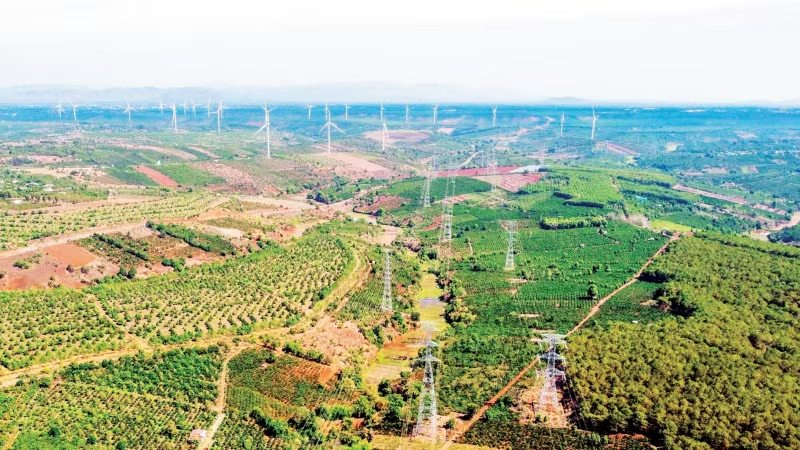
Alongside the requirement to safeguard system safety, synchronised development between generation sources and the grid has been identified as a fundamental solution to enhance renewable energy integration. In the South Central and Central Highlands regions, where numerous wind and solar projects are concentrated, coordination among power plants, transmission units and dispatch authorities plays a particularly important role in ensuring safe and stable system operation.
Under the adjusted Power Development Plan VIII, total investment in the transmission grid for the 2026–2030 period is projected to be approximately twice the current asset value of the grid. In this context, the National Power Transmission Corporation (EVNNPT) has identified improving the flexible, safe, and reliable operation of the transmission system as a key task — both to meet the need for evacuating generation capacity and to lay the foundation for effective integration of renewable energy sources.
Tran Dang Khoa, Member of the Board of Members of EVNNPT, said that in addition to new construction investment, the corporation is implementing a long-term strategy to enhance the reliability of existing transmission assets by accelerating digital transformation, applying modern technologies, deploying smart monitoring systems, and introducing automation solutions in grid management and operation.
From practical production and business experience, representatives of wind and solar power plants noted that maintaining regular dialogue and exchanges with dispatch authorities and transmission units has helped enterprises proactively prevent incident risks, shorten outage times for maintenance, improve operational efficiency, and optimise power output.
Sharing specific experience, Nguyen Le Anh Khoa, Deputy Director of Nhon Hoa 1 Wind Power Plant, said that 2025 marked a peak period when the plant had to ensure safe and stable operations while simultaneously implementing complex technical works related to upgrading its connection from the 220kV grid to the 500kV voltage level. This process required synchronised coordination and close technical support from dispatch authorities and transmission units to ensure progress and minimise impacts on overall system operations.

![[Video] Tax sector launches “Cleaning tax codes – Removing business bottlenecks” campaign](https://en-cdn.nhandan.vn/images/482b130c05ac864ba077f091edeb8ddd41e59c9a38dc5fbf9de2c281a71c51212f2f08d746a1d6481d827158125c7a212c04da37e6282bfd6dec7d255495d6ed/avatar-of-video-182433.png.avif)