Policy momentum driving rooftop solar expansion
In May 2023, the Government approved the eighth National Power Development Plan for the period 2021–2030, with a vision to 2050 (PDP VIII), and in April 2025 issued a decision approving adjustments to PDP VIII.
The key objective is to ensure sufficient electricity for national socio-economic development, aiming for an average GDP growth rate of around 10% per annum during 2026–2030, and approximately 7.5% per annum for 2031–2050.
Towards a just energy transition, the plan calls for a major push in renewable energy development (excluding hydropower), targeting a 28–36% share of electricity generation by 2030, rising to 74–75% by 2050.
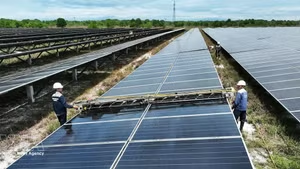
By 2030, the plan also aims for 50% of office buildings and 50% of households to use self-generated rooftop solar power for on-site consumption (not fed into the national grid).
By 2030, the PDP VIII aims for 50% of office buildings and 50% of households to use self-generated rooftop solar power for on-site consumption (not fed into the national grid).
Nguyen Ngoc Trung, Deputy Head of the Industry Economics Department under the Party Central Committee’s Commission for Policies and Strategies, affirmed that these figures demonstrate how green energy, particularly solar power, will play a vital role in ensuring national energy security and reducing greenhouse gas emissions.
Under the Prime Minister’s Decision 262/QD-TTg issued in 2024 and Decision 768/QD-TTg issued in 2025, 17 northern provinces and cities alone are allocated 19,057 MW of rooftop solar power in the 2025–2030 period, along with more than 11,000 MW of concentrated solar power.
In response, the Electricity of Viet Nam (EVN)’s Northern Power Corporation (EVNNPC), which manages, distributes, and sells electricity in 17 northern provinces and cities (excluding Ha Noi), has taken the lead in implementing support activities for installation.
By the end of Q3 2025, EVNNPC had received notifications from 111 customers registering for rooftop solar power development with a total capacity of 164.6 MW; of these, 64 customers had brought systems into operation with a combined capacity of 72.3 MW, while 7 customers were in the process of implementation, expected to add another 92.3 MW.
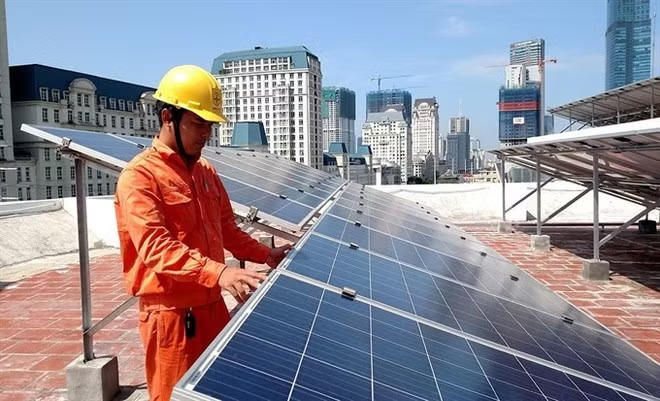
In addition, according to statistics from power companies in the area, 454 MWp of rooftop solar capacity has been generated by organisations and individuals through self-invested installations, accompanied by Battery Energy Storage Systems (BESS) totalling about 8,600 kWh. These figures highlight society’s growing interest in this clean energy source.
Head of Communications and Corporate Culture Department of EVNNPC, Trinh Thi Kim Ngan, noted that although solar irradiation in the northern region is lower than in other parts of the country, the area still has significant potential thanks to its vast roof space, particularly in urban areas, industrial zones, and midland-plain provinces.
She emphasised that deploying solar power does not require additional investment in power lines or transformer stations, helping to reduce infrastructure costs and ease peak-hour electricity supply pressure on the sector.
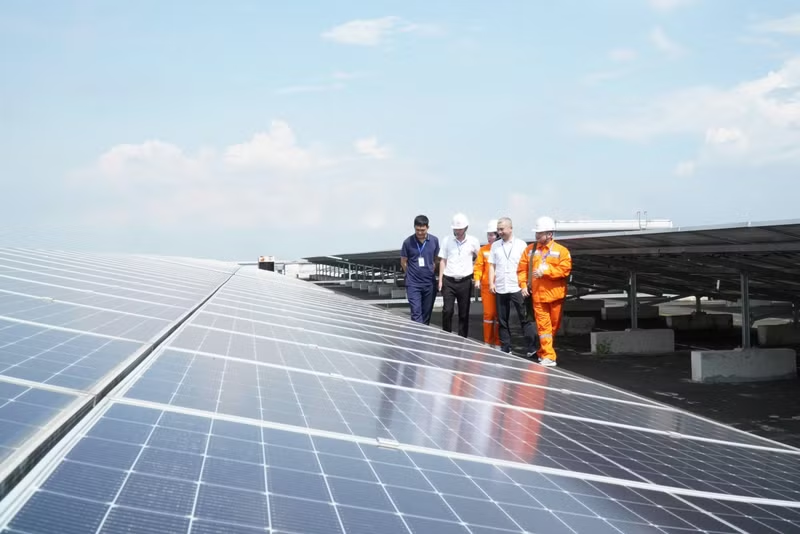
EVNNPC has assigned rooftop solar development plans to 17 power companies. The unit is also surveying installations at headquarters, management teams, warehouses, and stations to save operating costs and serve as pilot models.
Rooftop solar power is becoming a top priority for many seafood enterprises. Beyond reducing operating costs, it is also a major ‘plus point’ in negotiations with international customers, particularly in Europe and the US.
VASEP General Secretary Nguyen Hoai Nam
At the beginning of 2025, customer conferences were held in localities with more than 4,000 large enterprises attending, alongside turnkey solutions to help households and businesses deploy systems more easily.
Many practical models have already proven effective. At Van Trung Industrial Park in Bac Ninh Province, Crystal Martin Viet Nam Co., Ltd. installed a 3.06 MWp system, meeting 19.5% of the factory’s electricity demand and saving 3 million kWh per year.
The enterprise aims to increase solar output to 6 million kWh annually, reducing CO2 emissions by 35% by 2030.
In Lang Son Province, the Viet Nam–Japan DK Electric Vehicle One Member Co., Ltd. installed a 92 kWp system in 2020, producing an average of 6,420 kWh per month and saving 15–20 million dong in electricity bills each month.
Nguyen Hoai Nam, General Secretary of the Viet Nam Association of Seafood Exporters and Producers (VASEP), stressed that rooftop solar power is becoming a top priority for many seafood enterprises. Beyond reducing operating costs, it is also a major ‘plus point’ in negotiations with international customers, particularly in Europe and the US.
Sharing the same view, Deputy General Director of Ngai Cau Mechanical Company, Nguyen Quang Tao, said that in addition to energy cost efficiency, installing rooftop solar power also significantly reduces factory heat and improves working conditions.
Overcoming barriers to unlock local energy potential
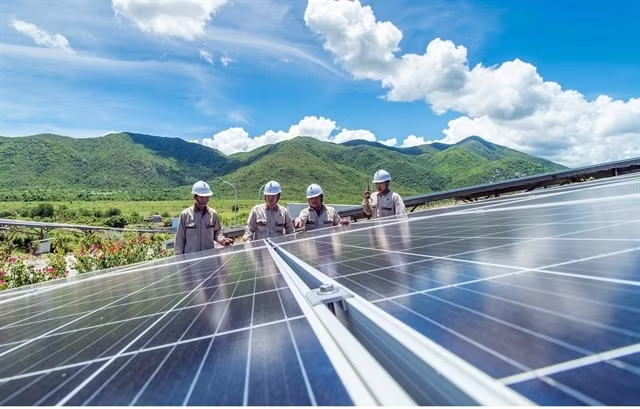
Despite its great promise, the development of self-produced and self-consumed rooftop solar power still faces many challenges.
Deputy Head of the Industry Economics Department, Nguyen Ngoc Trung, pointed out that the legal framework remains incomplete and inconsistent, causing confusion for businesses in registration, grid connection, and operation.
High initial investment costs also pose a barrier for small and medium-sized enterprises; technical infrastructure in many industrial zones does not yet meet the requirements for integrating distributed energy sources; and awareness of technology and the long-term benefits of green energy remains limited.
Self-produced and self-consumed rooftop solar power will become a vital driving force in the energy transition process, contributing to building a green economy and achieving sustainable development in the new era.
This reality calls for strong support from local authorities in issuing specific action plans, providing guidance, and streamlining procedures related to construction, environmental standards, and fire prevention; while encouraging the adoption of advanced technology and energy storage systems.
Experts also propose accelerating the completion of preferential credit policies to support households and businesses in investing.
The target of having 50% of households install rooftop solar power by 2030 can only be achieved through coordinated efforts from central to local levels.
With the determination of the power sector, and the joint efforts of authorities, businesses, and citizens, self-produced and self-consumed rooftop solar power will become a vital driving force in the energy transition process, contributing to building a green economy and achieving sustainable development in the new era.